Bhagavad Gita · Chapter 2: Sankhya Yoga · Speaker: Krishna
Bhagavad Gita 2.12: Na tvevaham jatu nasam na tvam
Krishna says there was never a time when he did not exist, nor Arjuna, nor these kings.
Bhagavad Gita 2.12
न त्वेवाहं जातु नासं न त्वं नेमे जनाधिपाः ।न चैव न भविष्यामः सर्वे वयमतः परम् ॥
Na tvevaham jatu nasam na tvam neme janadhipah
Na chaiva na bhavishyamah sarve vayamatah param
na tvevāhaṃ jātu nāsaṃ na tvaṃ neme janādhipāḥ |
na caiva na bhaviṣyāmaḥ sarve vayamataḥ param ||
Our meaning Krishna says there was never a time when he did not exist, nor Arjuna, nor these kings. And none of them will ever stop existing in the future. The classical commentators read this verse in different ways (see the views).
हिंदी अर्थ कृष्ण कहते हैं कि ऐसा कोई समय नहीं था जब वे स्वयं न रहे हों, या अर्जुन न रहे हों, या ये राजा न रहे हों। और आगे भी ऐसा समय नहीं आएगा जब ये सब न रहें। प्राचीन टीकाकार इस श्लोक को अलग-अलग ढंग से समझाते हैं।
Word by word
Every word, with its dictionary page
Word by word
- न na not (indeclinable) Dictionary: 2. na, Monier-Williams 1899, p. 523, col. 1
ind. not, no, nor, neither
- तु tu but, indeed (indeclinable) Dictionary: 2. tu, Monier-Williams 1899, p. 449, col. 3
but
- एव eva at all (indeclinable) Dictionary: 1. eva, Monier-Williams 1899, p. 232, col. 2
just, exactly, very, same, only, even, alone, merely
- अहम् aham "I" (pronoun, nominative singular) Dictionary: aham, Monier-Williams 1899, p. 124, col. 2
nom. sg. ‘I,’
- जातु jātu at any time (indeclinable) Dictionary: jātu, Monier-Williams 1899, p. 418, col. 2
Na jātu, not at all, by no means, never
- न na not (indeclinable) Dictionary: 2. na, Monier-Williams 1899, p. 523, col. 1
ind. not, no, nor, neither
- आसम् āsam "I was" (imperfect, 1st person singular) Dictionary: 1. as, Monier-Williams 1899, p. 117, col. 2
to be, live, exist, be present
- न na nor (indeclinable) Dictionary: 2. na, Monier-Williams 1899, p. 523, col. 1
ind. not, no, nor, neither
- त्वम् tvam you (pronoun, nominative singular) Dictionary: 2. tva, Monier-Williams 1899, p. 463, col. 2
base of the 2nd personal pron.
- न na nor (indeclinable) Dictionary: 2. na, Monier-Williams 1899, p. 523, col. 1
ind. not, no, nor, neither
- इमे ime these (pronoun (masculine), nominative plural) Dictionary: 1. idam, Monier-Williams 1899, p. 165, col. 2
- जनाधिपाः janādhipāḥ kings, rulers of men (compound (masculine), nominative plural) Dictionary: janādhipa, Monier-Williams 1899, p. 410, col. 3
- न na not (indeclinable) Dictionary: 2. na, Monier-Williams 1899, p. 523, col. 1
ind. not, no, nor, neither
- च ca and (indeclinable) Dictionary: 2. ca, Monier-Williams 1899, p. 380, col. 1
ind. and, both, also, moreover, as well as
- एव eva indeed (indeclinable) Dictionary: 1. eva, Monier-Williams 1899, p. 232, col. 2
just, exactly, very, same, only, even, alone, merely
- न na not (indeclinable) Dictionary: 2. na, Monier-Williams 1899, p. 523, col. 1
ind. not, no, nor, neither
- भविष्यामः bhaviṣyāmaḥ we shall be (future, 1st person plural) Dictionary: 1. bhū, Monier-Williams 1899, p. 760, col. 2
arise, come into being, exist
- सर्वे sarve all (pronoun (masculine), nominative plural) Dictionary: sarva, Monier-Williams 1899, p. 1184, col. 3
whole, entire, all, every
- वयम् vayam we (pronoun, nominative plural) Dictionary: vayam, Monier-Williams 1899, p. 920, col. 2
nom. pl. of 1. pers. pron., we
- अतः ataḥ from this (time) (indeclinable) Dictionary: atas, Monier-Williams 1899, p. 12, col. 1
henceforth, from that time
- परम् param after, onward (indeclinable) Dictionary: 1. para, Monier-Williams 1899, p. 586, col. 1
highest, supreme, chief
Public-domain translations
Kashinath Trimbak Telang, 1882. Public domain. Page 44.
Never did I not exist, nor you, nor these rulers of men; nor will any one of us ever hereafter cease to be.
Compare 3 translations
Kashinath Trimbak Telang, 1882. Public domain. Page 44.
Never did I not exist, nor you, nor these rulers of men; nor will any one of us ever hereafter cease to be.
You are reading this one
Annie Besant, 1895. Public domain. Page 27.
Nor at any time verily was I not, nor thou, nor these princes of men, nor verily shall we ever cease to be, hereafter.
You are reading this one
Swami Swarupananda, 1909 (first printed 1907). Public domain. Page 79.
There was no time when I did not exist, nor thou, nor these kings. There will also be no time when we all shall not exist.
You are reading this one
Classical readings, by school
Each reading is named by its school. None is presented as the only meaning.
Shankara Advaita
Shankara says the plural “we” refers to the many bodies, not to many selves. As the Self, all are eternal in the past, present and future, and the Self is one.
Source: The Bhagavad-Gita, with the commentary of Sri Sankaracharya, translated by A. Mahadeva Sastri (2nd ed., Mysore: G. T. A. Printing Works, 1901), commentary on 2.12. Summarised in our own words; none of its text is reproduced.
Ramanuja Vishishtadvaita
Ramanuja reads the verse as Krishna teaching that the Lord and the individual souls have always existed and always will, that the souls are many, and that each is distinct from the Lord.
Source: Sri Bhagavad-Gita with Sri Ramanujacharya's Visishtadvaita commentary, translated by A. Govindacharya (Madras, 1898), commentary on 2.12. Summarised in our own words; none of its text is reproduced.
Share
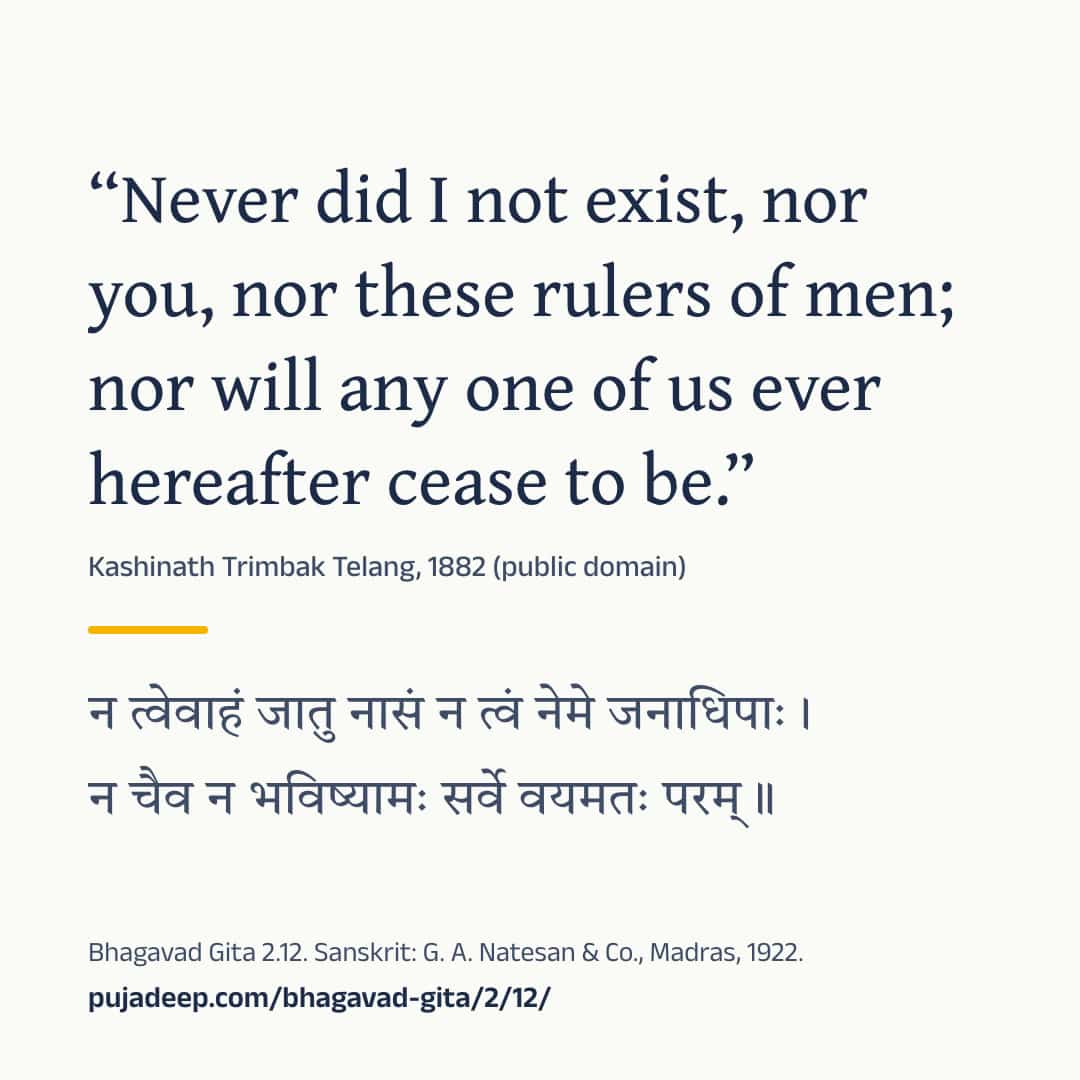
Send one picture or the text to one chat. The picture names its source and the address of this page.
Send as text
The words and the link only. Many elders prefer this.
Bhagavad Gita 2.12

न त्वेवाहं जातु नासं न त्वं नेमे जनाधिपाः ।
न चैव न भविष्यामः सर्वे वयमतः परम् ॥

“Never did I not exist, nor you, nor these rulers of men; nor will any one of us ever hereafter cease to be.”
(Kashinath Trimbak Telang, 1882, public domain)

“Nor at any time verily was I not, nor thou, nor these princes of men, nor verily shall we ever cease to be, hereafter.”
(Annie Besant, 1895, public domain)

“There was no time when I did not exist, nor thou, nor these kings. There will also be no time when we all shall not exist.”
(Swami Swarupananda, 1909 (first printed 1907), public domain)

Sanskrit: G. A. Natesan & Co., Madras, 1922.
https://pujadeep.com/bhagavad-gita/2/12/?s=copy Nothing is sent from this site. Your own app sends it, to the chat you choose. The picture quotes Telang (1882). If you chose another translation above, the text quotes yours and no picture is offered.
Sanskrit text: The Bhagavad-Gita, or The Lord's Song, with the text in Devanagari and an English translation, 1922. Meanings: written for Pujadeep with AI help and reviewed. Source and changes
Questions families ask
Who speaks Bhagavad Gita 2.12?
Krishna speaks this verse, in chapter 2 (Sankhya Yoga).
Where does the Sanskrit text come from?
Sanskrit text: The Bhagavad-Gita, or The Lord's Song, with the text in Devanagari and an English translation, 1922. Meanings: written for Pujadeep with AI help and reviewed. See the source
Is the meaning on this page a translation?
Explanation written for this site with AI help from the sources listed here, and reviewed. It is not a translation and not the only way to read the text. Free to quote with credit.
Source and licence
- Sanskrit text
- The Bhagavad-Gita, or The Lord's Song, with the text in Devanagari and an English translation (Annie Besant, G. A. Natesan & Co., Madras, 1922). Public domain. The Sanskrit on these pages was read from this printing’s page images.
- Translation
- The Bhagavadgîtâ with the Sanatsugâtîya and the Anugîtâ, translated by Kâshinâth Trimbak Telang (The Sacred Books of the East, vol. VIII, ed. F. Max Müller) (Kashinath Trimbak Telang, F. Max Müller, Clarendon Press, Oxford, 1882). Public domain. Shown verbatim, as printed.
- Translation
- The Bhagavad Gîtâ, or The Lord's Song, translated by Annie Besant (Annie Besant, Theosophical Publishing Society, London, 1895). Public domain. Shown verbatim, as printed.
- Sanskrit text
- Srimad-Bhagavad-Gita, with Sanskrit Text; Paraphrase with Word-by-word Literal Translation; English Rendering and Comments, Index, &c., by the Swami Swarupananda (Himalayan Series, No. XX) (Swami Swarupananda, The Editors and Publishers, Advaita Ashrama, Mayavati, Prabuddha Bharata Press, Mayavati, Almora, Himalayas, 1909). Public domain. Used only to date the text. The Devanagari on this page is a reading text and is not copied from this printing.
- Commentary
- The Bhagavad-Gita, with the commentary of Sri Sankaracharya, translated by A. Mahadeva Sastri (2nd ed., Mysore: G. T. A. Printing Works, 1901) (Public-domain scan, University of California Libraries). Summarised in our own words; none of its text is reproduced.
- Commentary
- Sri Bhagavad-Gita with Sri Ramanujacharya's Visishtadvaita commentary, translated by A. Govindacharya (Madras, 1898) (Scan uploaded to archive.org (folkscanomy collection)). Summarised in our own words; none of its text is reproduced.
- Common wording
- In this text, 32 words follow today's common wording, checked against sanskritdocuments.org; Sanskrit Wikisource; Gita Press, Gorakhpur; GRETIL, Göttingen and Bhaktivedanta Book Trust.
- Our explanation
- Explanation written for this site with AI help from the sources listed here, and reviewed. It is not a translation and not the only way to read the text. Free to quote with credit.
- Review
- AI review: 2 independent reviews against the cited edition, October 15, 2026.