Bhagavad Gita · Chapter 2: Sankhya Yoga · Speaker: Krishna
Bhagavad Gita 2.26: Atha chainam nityajatam nityam
Krishna adds a second argument.
Bhagavad Gita 2.26
अथ चैनं नित्यजातं नित्यं वा मन्यसे मृतम् ।तथापि त्वं महाबाहो नैवं शोचितुमर्हसि ॥
Atha chainam nityajatam nityam va manyase mritam
Tathapi tvam mahabaho naivam shochitumarhasi
atha cainaṃ nityajātaṃ nityaṃ vā manyase mṛtam |
tathāpi tvaṃ mahābāho naivaṃ śocitumarhasi ||
Our meaning Krishna adds a second argument. Even if Arjuna believes the self is born and dies again and again, he still should not grieve like this.
हिंदी अर्थ कृष्ण दूसरा तर्क देते हैं। यदि अर्जुन यह भी मानें कि आत्मा बार-बार जन्म लेती और मरती है, तब भी उन्हें इस तरह शोक नहीं करना चाहिए।
Word by word
Every word, with its dictionary page
Word by word
- अथ atha now, if (indeclinable) Dictionary: atha, Monier-Williams 1899, p. 17, col. 3
now; then; moreover; rather; certainly
- च ca and (indeclinable) Dictionary: 2. ca, Monier-Williams 1899, p. 380, col. 1
ind. and, both, also, moreover, as well as
- एनम् enam this (Self) (pronoun (masculine), accusative singular) Dictionary: 1. ena, Monier-Williams 1899, p. 232, col. 1
he, she, it; this, that
- नित्यजातम् nityajātam always being born (compound (masculine), accusative singular) Dictionary: nitya, Monier-Williams 1899, p. 547, col. 2
continual, perpetual, eternal
; jāta, Monier-Williams 1899, p. 417, col. 2born, brought into existence
- नित्यम् nityam always (adverb) Dictionary: nitya, Monier-Williams 1899, p. 547, col. 2
continual, perpetual, eternal
- वा vā or (indeclinable) Dictionary: 1. vā, Monier-Williams 1899, p. 934, col. 2
ind. or
- मन्यसे manyase you think (present, 2nd person singular) Dictionary: man, Monier-Williams 1899, p. 783, col. 1
to think, believe, imagine, suppose, conjecture
- मृतम् mṛtam dying, dead (past participle (masculine), accusative singular) Dictionary: mṛta, Monier-Williams 1899, p. 827, col. 2
dead, deceased
- तथा tathā so (indeclinable) Dictionary: tathā, Monier-Williams 1899, p. 433, col. 3
in that manner, so, thus
- अपि api even (indeclinable) Dictionary: api, Monier-Williams 1899, p. 55, col. 1
in the sense of even, also, very
- त्वम् tvam you (pronoun, nominative singular) Dictionary: 2. tva, Monier-Williams 1899, p. 463, col. 2
base of the 2nd personal pron.
- महाबाहो mahābāho O mighty-armed one (compound (masculine), vocative singular) Dictionary: mahā-bāhu, Monier-Williams 1899, p. 798, col. 1
long-armed
- न na not (indeclinable) Dictionary: 2. na, Monier-Williams 1899, p. 523, col. 1
ind. not, no, nor, neither
- एवम् evam thus, like this (indeclinable) Dictionary: evam, Monier-Williams 1899, p. 232, col. 2
thus, in this way, in such a manner
- शोचितुम् śocitum to grieve (infinitive (to do)) Dictionary: 1. śuc, Monier-Williams 1899, p. 1081, col. 1
be sorrowful or afflicted, grieve, mourn at or for
- अर्हसि arhasi you ought (present, 2nd person singular) Dictionary: arh, Monier-Williams 1899, p. 93, col. 3
to be able
2 printings differ
Public-domain translations
Kashinath Trimbak Telang, 1882. Public domain. Page 45.
But even if you think that it is constantly born, and constantly dies, still, O you of mighty arms! you ought not to grieve thus.
Compare 3 translations
Kashinath Trimbak Telang, 1882. Public domain. Page 45.
But even if you think that it is constantly born, and constantly dies, still, O you of mighty arms! you ought not to grieve thus.
You are reading this one
Annie Besant, 1895. Public domain. Page 29.
And if thou thinkest of It as constantly being born and constantly dying, even then, O mighty-armed, thou shouldst not grieve.
You are reading this one
Swami Swarupananda, 1909 (first printed 1907). Public domain. Page 38.
But if thou shouldst take This to have constant birth and death, even in that case, O mighty-armed, thou oughtest not to mourn for This.
You are reading this one
Share
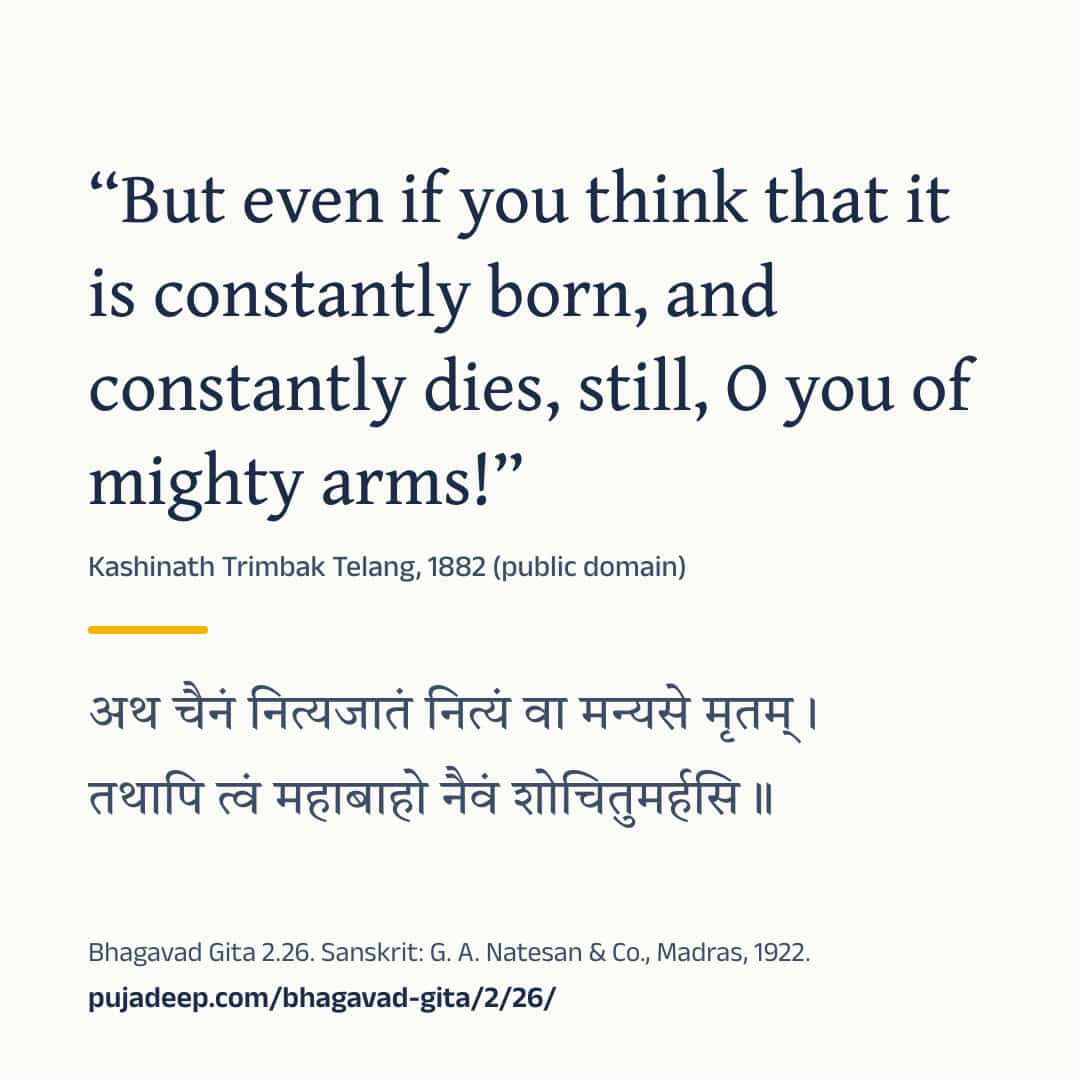
Send one picture or the text to one chat. The picture names its source and the address of this page.
Send as text
The words and the link only. Many elders prefer this.
Bhagavad Gita 2.26

अथ चैनं नित्यजातं नित्यं वा मन्यसे मृतम् ।
तथापि त्वं महाबाहो नैवं शोचितुमर्हसि ॥

“But even if you think that it is constantly born, and constantly dies, still, O you of mighty arms! you ought not to grieve thus.”
(Kashinath Trimbak Telang, 1882, public domain)

“And if thou thinkest of It as constantly being born and constantly dying, even then, O mighty-armed, thou shouldst not grieve.”
(Annie Besant, 1895, public domain)

“But if thou shouldst take This to have constant birth and death, even in that case, O mighty-armed, thou oughtest not to mourn for This.”
(Swami Swarupananda, 1909 (first printed 1907), public domain)

Sanskrit: G. A. Natesan & Co., Madras, 1922.
https://pujadeep.com/bhagavad-gita/2/26/?s=copy Nothing is sent from this site. Your own app sends it, to the chat you choose. The picture quotes Telang (1882). If you chose another translation above, the text quotes yours and no picture is offered.
Sanskrit text: The Bhagavad-Gita, or The Lord's Song, with the text in Devanagari and an English translation, 1922. Meanings: written for Pujadeep with AI help and reviewed. Source and changes
Questions families ask
Who speaks Bhagavad Gita 2.26?
Krishna speaks this verse, in chapter 2 (Sankhya Yoga).
Where does the Sanskrit text come from?
Sanskrit text: The Bhagavad-Gita, or The Lord's Song, with the text in Devanagari and an English translation, 1922. Meanings: written for Pujadeep with AI help and reviewed. See the source
Is the meaning on this page a translation?
Explanation written for this site with AI help from the sources listed here, and reviewed. It is not a translation and not the only way to read the text. Free to quote with credit.
Source and licence
- Sanskrit text
- The Bhagavad-Gita, or The Lord's Song, with the text in Devanagari and an English translation (Annie Besant, G. A. Natesan & Co., Madras, 1922). Public domain. The Sanskrit on these pages was read from this printing’s page images.
- Translation
- The Bhagavadgîtâ with the Sanatsugâtîya and the Anugîtâ, translated by Kâshinâth Trimbak Telang (The Sacred Books of the East, vol. VIII, ed. F. Max Müller) (Kashinath Trimbak Telang, F. Max Müller, Clarendon Press, Oxford, 1882). Public domain. Shown verbatim, as printed.
- Translation
- The Bhagavad Gîtâ, or The Lord's Song, translated by Annie Besant (Annie Besant, Theosophical Publishing Society, London, 1895). Public domain. Shown verbatim, as printed.
- Sanskrit text
- Srimad-Bhagavad-Gita, with Sanskrit Text; Paraphrase with Word-by-word Literal Translation; English Rendering and Comments, Index, &c., by the Swami Swarupananda (Himalayan Series, No. XX) (Swami Swarupananda, The Editors and Publishers, Advaita Ashrama, Mayavati, Prabuddha Bharata Press, Mayavati, Almora, Himalayas, 1909). Public domain. Used only to date the text. The Devanagari on this page is a reading text and is not copied from this printing.
- Common wording
- In this text, 32 words follow today's common wording, checked against sanskritdocuments.org; Sanskrit Wikisource; Gita Press, Gorakhpur; GRETIL, Göttingen and Bhaktivedanta Book Trust.
- Our explanation
- Explanation written for this site with AI help from the sources listed here, and reviewed. It is not a translation and not the only way to read the text. Free to quote with credit.
- Review
- AI review: 2 independent reviews against the cited edition, October 15, 2026.