Bhagavad Gita · Chapter 2: Sankhya Yoga · Speaker: Krishna
Bhagavad Gita 2.29: Ashcharyavatpashyati
Krishna says that some look on the self as a wonder, some speak of it as a wonder, and some hear of it as a wonder.
Bhagavad Gita 2.29
आश्चर्यवत्पश्यति कश्चिदेनमाश्चर्यवद्वदति तथैव चान्यः ।आश्चर्यवच्चैनमन्यः शृणोति श्रुत्वाऽप्येनं वेद न चैव कश्चित् ॥
Ashcharyavatpashyati kashchidenamashcharyavadvadati tathaiva chanyah
Ashcharyavachchainamanyah shrinoti shrutvapyenam veda na chaiva kashchit
āścaryavatpaśyati kaścidenamāścaryavadvadati tathaiva cānyaḥ |
āścaryavaccainamanyaḥ śṛṇoti śrutvā’pyenaṃ veda na caiva kaścit ||
Our meaning Krishna says that some look on the self as a wonder, some speak of it as a wonder, and some hear of it as a wonder. Yet even after hearing about it, he says, no one truly knows it.
हिंदी अर्थ कृष्ण कहते हैं कि कोई आत्मा को आश्चर्य की तरह देखता है, कोई आश्चर्य की तरह उसके बारे में बोलता है, और कोई आश्चर्य की तरह उसके बारे में सुनता है। वे कहते हैं कि सुनकर भी कोई उसे पूरी तरह नहीं जानता।
Word by word
Every word, with its dictionary page
Word by word
- आश्चर्यवत् āścaryavat as a wonder (adverb (-vat: like)) Dictionary: 1. āścarya, Monier-Williams 1899, p. 158, col. 1
a wonder, miracle, marvel, prodigy
; 1. vat, Monier-Williams 1899, p. 915, col. 2added to words to imply likeness or resemblance
- पश्यति paśyati sees (present, 3rd person singular) Dictionary: 1. paś, Monier-Williams 1899, p. 611, col. 2
behold, look at, observe, perceive, notice
- कश्चित् kaścit someone (pronoun (masculine), nominative singular) Dictionary: kim, Monier-Williams 1899, p. 282, col. 2
what? how? whence? wherefore? why?
- एनम् enam this (Self) (pronoun (masculine), accusative singular) Dictionary: 1. ena, Monier-Williams 1899, p. 232, col. 1
he, she, it; this, that
- आश्चर्यवत् āścaryavat as a wonder (adverb (-vat: like)) Dictionary: 1. āścarya, Monier-Williams 1899, p. 158, col. 1
a wonder, miracle, marvel, prodigy
; 1. vat, Monier-Williams 1899, p. 915, col. 2added to words to imply likeness or resemblance
- वदति vadati speaks of (present, 3rd person singular) Dictionary: vad, Monier-Williams 1899, p. 916, col. 1
to speak, say, utter, tell, report
- तथा tathā so (indeclinable) Dictionary: tathā, Monier-Williams 1899, p. 433, col. 3
in that manner, so, thus
- एव eva also (indeclinable) Dictionary: 1. eva, Monier-Williams 1899, p. 232, col. 2
just, exactly, very, same, only, even, alone, merely
- च ca and (indeclinable) Dictionary: 2. ca, Monier-Williams 1899, p. 380, col. 1
ind. and, both, also, moreover, as well as
- अन्यः anyaḥ another (pronoun (masculine), nominative singular) Dictionary: 2. anya, Monier-Williams 1899, p. 45, col. 2
other, different
- आश्चर्यवत् āścaryavat as a wonder (adverb (-vat: like)) Dictionary: 1. āścarya, Monier-Williams 1899, p. 158, col. 1
a wonder, miracle, marvel, prodigy
; 1. vat, Monier-Williams 1899, p. 915, col. 2added to words to imply likeness or resemblance
- च ca and (indeclinable) Dictionary: 2. ca, Monier-Williams 1899, p. 380, col. 1
ind. and, both, also, moreover, as well as
- एनम् enam this (pronoun (masculine), accusative singular) Dictionary: 1. ena, Monier-Williams 1899, p. 232, col. 1
he, she, it; this, that
- अन्यः anyaḥ another (pronoun (masculine), nominative singular) Dictionary: 2. anya, Monier-Williams 1899, p. 45, col. 2
other, different
- शृणोति śṛṇoti hears (present, 3rd person singular) Dictionary: 1. śru, Monier-Williams 1899, p. 1100, col. 3
- श्रुत्वा śrutvā having heard (absolutive (having done)) Dictionary: 1. śru, Monier-Williams 1899, p. 1100, col. 3
- अपि api even (indeclinable) Dictionary: api, Monier-Williams 1899, p. 55, col. 1
in the sense of even, also, very
- एनम् enam this (pronoun (masculine), accusative singular) Dictionary: 1. ena, Monier-Williams 1899, p. 232, col. 1
he, she, it; this, that
- वेद veda knows (perfect with present sense, 3rd person singular) Dictionary: 1. vid, Monier-Williams 1899, p. 963, col. 2
to know, understand, perceive, learn
- न na not (indeclinable) Dictionary: 2. na, Monier-Williams 1899, p. 523, col. 1
ind. not, no, nor, neither
- च ca and (indeclinable) Dictionary: 2. ca, Monier-Williams 1899, p. 380, col. 1
ind. and, both, also, moreover, as well as
- एव eva indeed (indeclinable) Dictionary: 1. eva, Monier-Williams 1899, p. 232, col. 2
just, exactly, very, same, only, even, alone, merely
- कश्चित् kaścit anyone (pronoun (masculine), nominative singular) Dictionary: kim, Monier-Williams 1899, p. 282, col. 2
what? how? whence? wherefore? why?
1 printing differs
Public-domain translations
Kashinath Trimbak Telang, 1882. Public domain. Page 46.
One looks upon it1 as a wonder; another similarly speaks of it as a wonder; another too hears of it as a wonder; and even after having heard of it, no one does really know it2.
Footnotes (the translator’s own) Compare 3 translations
Kashinath Trimbak Telang, 1882. Public domain. Page 46.
One looks upon it1 as a wonder; another similarly speaks of it as a wonder; another too hears of it as a wonder; and even after having heard of it, no one does really know it2.
Footnotes (the translator’s own) You are reading this one
Annie Besant, 1895. Public domain. Page 30.
As marvellous one regardeth It; as marvellous another speaketh thereof; as marvellous another heareth thereof; yet, having heard, none indeed understandeth.
You are reading this one
Swami Swarupananda, 1909 (first printed 1907). Public domain. Page 40.
Some look upon the Self as marvellous. Others speak of It as wonderful. Others again hear of It as a wonder. And still others, though hearing, do not understand It at all.
You are reading this one
Share
Send one picture or the text to one chat. The picture names its source and the address of this page.
Send as text
The words and the link only. Many elders prefer this.
Bhagavad Gita 2.29

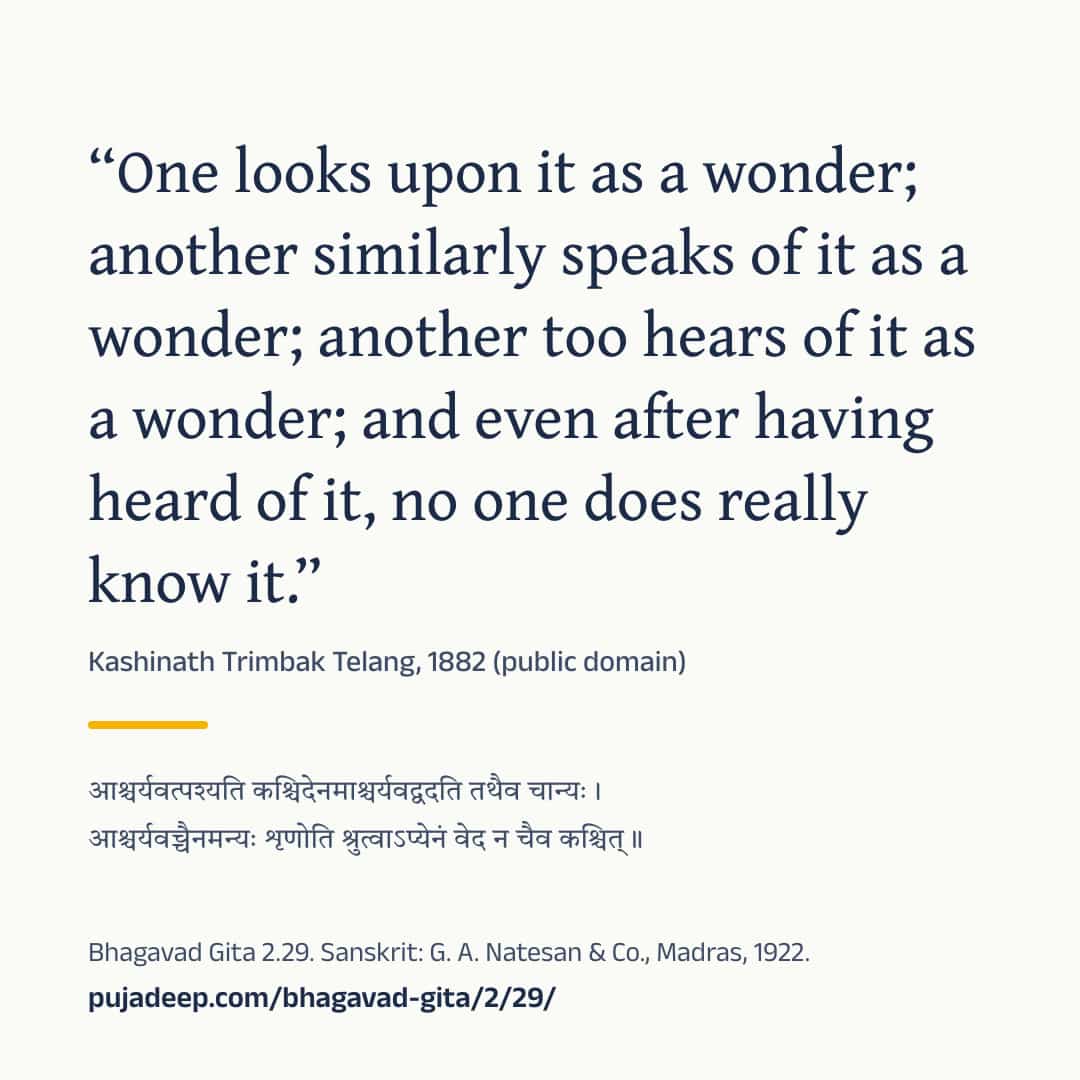
आश्चर्यवत्पश्यति कश्चिदेनमाश्चर्यवद्वदति तथैव चान्यः ।
आश्चर्यवच्चैनमन्यः शृणोति श्रुत्वाऽप्येनं वेद न चैव कश्चित् ॥

“One looks upon it as a wonder; another similarly speaks of it as a wonder; another too hears of it as a wonder; and even after having heard of it, no one does really know it.”
(Kashinath Trimbak Telang, 1882, public domain)

“As marvellous one regardeth It; as marvellous another speaketh thereof; as marvellous another heareth thereof; yet, having heard, none indeed understandeth.”
(Annie Besant, 1895, public domain)

“Some look upon the Self as marvellous. Others speak of It as wonderful. Others again hear of It as a wonder. And still others, though hearing, do not understand It at all.”
(Swami Swarupananda, 1909 (first printed 1907), public domain)

Sanskrit: G. A. Natesan & Co., Madras, 1922.
https://pujadeep.com/bhagavad-gita/2/29/?s=copy Nothing is sent from this site. Your own app sends it, to the chat you choose. The picture quotes Telang (1882). If you chose another translation above, the text quotes yours and no picture is offered.
Sanskrit text: The Bhagavad-Gita, or The Lord's Song, with the text in Devanagari and an English translation, 1922. Meanings: written for Pujadeep with AI help and reviewed. Source and changes
Questions families ask
Who speaks Bhagavad Gita 2.29?
Krishna speaks this verse, in chapter 2 (Sankhya Yoga).
Where does the Sanskrit text come from?
Sanskrit text: The Bhagavad-Gita, or The Lord's Song, with the text in Devanagari and an English translation, 1922. Meanings: written for Pujadeep with AI help and reviewed. See the source
Is the meaning on this page a translation?
Explanation written for this site with AI help from the sources listed here, and reviewed. It is not a translation and not the only way to read the text. Free to quote with credit.
Source and licence
- Sanskrit text
- The Bhagavad-Gita, or The Lord's Song, with the text in Devanagari and an English translation (Annie Besant, G. A. Natesan & Co., Madras, 1922). Public domain. The Sanskrit on these pages was read from this printing’s page images.
- Translation
- The Bhagavadgîtâ with the Sanatsugâtîya and the Anugîtâ, translated by Kâshinâth Trimbak Telang (The Sacred Books of the East, vol. VIII, ed. F. Max Müller) (Kashinath Trimbak Telang, F. Max Müller, Clarendon Press, Oxford, 1882). Public domain. Shown verbatim, as printed.
- Translation
- The Bhagavad Gîtâ, or The Lord's Song, translated by Annie Besant (Annie Besant, Theosophical Publishing Society, London, 1895). Public domain. Shown verbatim, as printed.
- Sanskrit text
- Srimad-Bhagavad-Gita, with Sanskrit Text; Paraphrase with Word-by-word Literal Translation; English Rendering and Comments, Index, &c., by the Swami Swarupananda (Himalayan Series, No. XX) (Swami Swarupananda, The Editors and Publishers, Advaita Ashrama, Mayavati, Prabuddha Bharata Press, Mayavati, Almora, Himalayas, 1909). Public domain. Used only to date the text. The Devanagari on this page is a reading text and is not copied from this printing.
- Common wording
- In this text, 32 words follow today's common wording, checked against sanskritdocuments.org; Sanskrit Wikisource; Gita Press, Gorakhpur; GRETIL, Göttingen and Bhaktivedanta Book Trust.
- Our explanation
- Explanation written for this site with AI help from the sources listed here, and reviewed. It is not a translation and not the only way to read the text. Free to quote with credit.
- Review
- AI review: 2 independent reviews against the cited edition, October 15, 2026.