श्रीमद्भगवद्गीता · अध्याय 2: सांख्ययोग · वक्ता: कृष्ण
श्रीमद्भगवद्गीता 2.27 का अर्थ
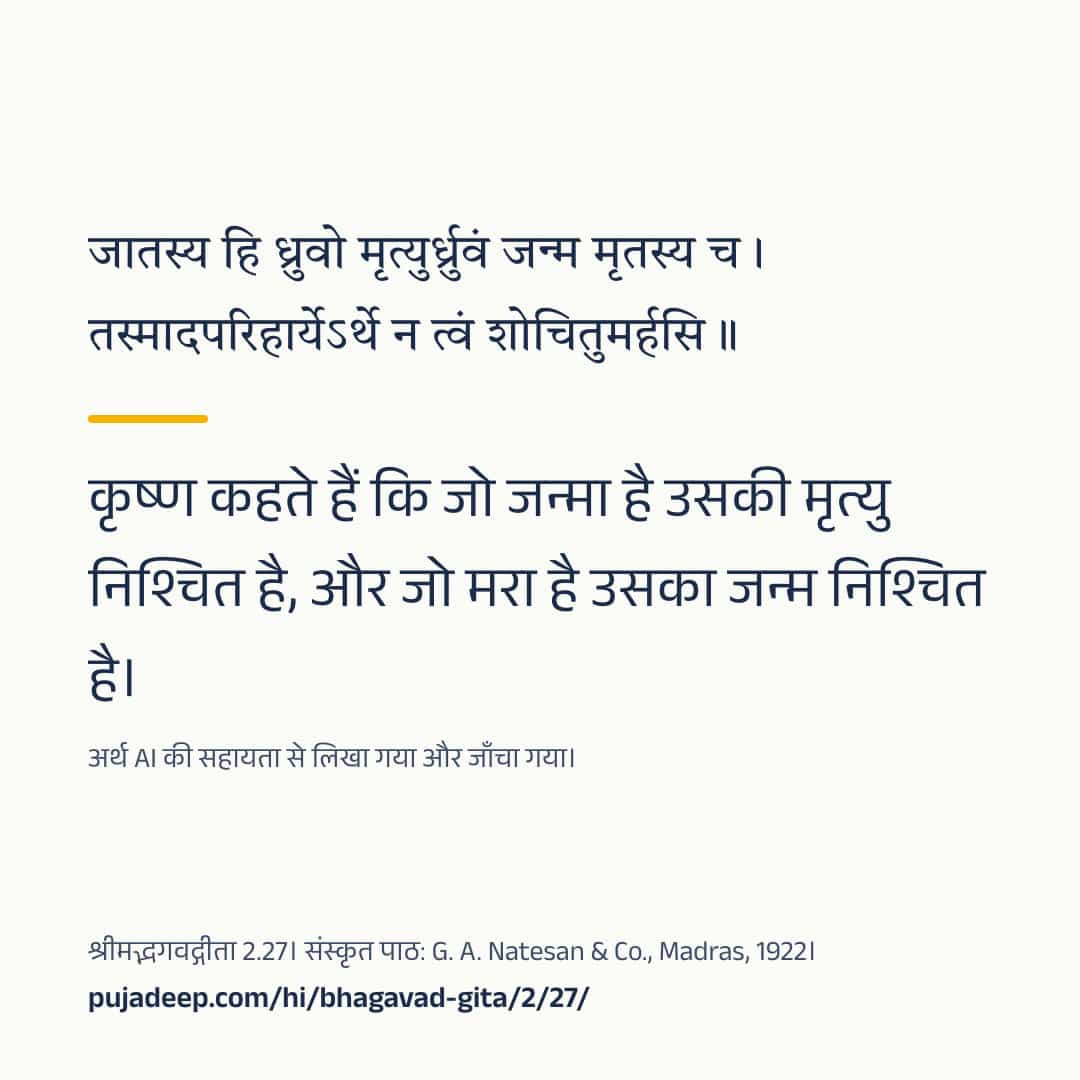
श्रीमद्भगवद्गीता (Bhagavad Gita) 2.27: कृष्ण कहते हैं कि जो जन्मा है उसकी मृत्यु निश्चित है, और जो मरा है उसका जन्म निश्चित है।
श्रीमद्भगवद्गीता 2.27
जातस्य हि ध्रुवो मृत्युर्ध्रुवं जन्म मृतस्य च ।तस्मादपरिहार्येऽर्थे न त्वं शोचितुमर्हसि ॥
Jatasya hi dhruvo mrityurdhruvam janma mritasya cha
Tasmadapariharyerthe na tvam shochitumarhasi
jātasya hi dhruvo mṛtyurdhruvaṃ janma mṛtasya ca |
tasmādaparihārye’rthe na tvaṃ śocitumarhasi ||
हमारा अर्थ कृष्ण कहते हैं कि जो जन्मा है उसकी मृत्यु निश्चित है, और जो मरा है उसका जन्म निश्चित है। इसलिए, वे कहते हैं, जिस बात को टाला नहीं जा सकता, उस पर अर्जुन को शोक नहीं करना चाहिए।
English meaning Krishna says that death is certain for whoever is born, and birth is certain for whoever dies. So, he says, Arjuna should not grieve over what cannot be avoided.
शब्दार्थ
हर शब्द, शब्दकोश के पृष्ठ के साथ
शब्दार्थ
- जातस्य jātasya जन्मे हुए का (भूतकालिक कृदन्त (पुंलिंग), षष्ठी एकवचन) शब्दकोश: jāta, मोनियर-विलियम्स 1899, पृ. 417, स्तंभ 2
born, brought into existence
- हि hi क्योंकि (अव्यय) शब्दकोश: 2. hi, मोनियर-विलियम्स 1899, पृ. 1297, स्तंभ 3
for, because, on account of
- ध्रुवः dhruvaḥ निश्चित (विशेषण (पुंलिंग), प्रथमा एकवचन) शब्दकोश: dhruva, मोनियर-विलियम्स 1899, पृ. 521, स्तंभ 2
fixed, firm, immovable, unchangeable, constant, lasting
- मृत्युः mṛtyuḥ मृत्यु (संज्ञा (पुंलिंग), प्रथमा एकवचन) शब्दकोश: mṛtyu, मोनियर-विलियम्स 1899, पृ. 827, स्तंभ 3
death, dying
- ध्रुवम् dhruvam निश्चित (विशेषण (नपुंसकलिंग), प्रथमा एकवचन) शब्दकोश: dhruva, मोनियर-विलियम्स 1899, पृ. 521, स्तंभ 2
fixed, firm, immovable, unchangeable, constant, lasting
- जन्म janma जन्म (संज्ञा (नपुंसकलिंग), प्रथमा एकवचन) शब्दकोश: janman, मोनियर-विलियम्स 1899, पृ. 411, स्तंभ 3
birth, production
- मृतस्य mṛtasya मरे हुए का (भूतकालिक कृदन्त (पुंलिंग), षष्ठी एकवचन) शब्दकोश: mṛta, मोनियर-विलियम्स 1899, पृ. 827, स्तंभ 2
dead, deceased
- च ca और (अव्यय) शब्दकोश: 2. ca, मोनियर-विलियम्स 1899, पृ. 380, स्तंभ 1
ind. and, both, also, moreover, as well as
- तस्मात् tasmāt इसलिए (अव्यय) शब्दकोश: tasmāt, मोनियर-विलियम्स 1899, पृ. 441, स्तंभ 2
from that, on that account, therefore
- अपरिहार्ये aparihārye अनिवार्य, जिसे टाला न जा सके (कृत्य प्रत्यय (योग्यता) (पुंलिंग), सप्तमी एकवचन) शब्दकोश: a-parihārya, मोनियर-विलियम्स 1899, पृ. 51, स्तंभ 2
- अर्थे arthe विषय में (संज्ञा (पुंलिंग), सप्तमी एकवचन) शब्दकोश: artha, मोनियर-विलियम्स 1899, पृ. 90, स्तंभ 3
aim, purpose
- न na नहीं (अव्यय) शब्दकोश: 2. na, मोनियर-विलियम्स 1899, पृ. 523, स्तंभ 1
ind. not, no, nor, neither
- त्वम् tvam तुम (सर्वनाम, प्रथमा एकवचन) शब्दकोश: 2. tva, मोनियर-विलियम्स 1899, पृ. 463, स्तंभ 2
base of the 2nd personal pron.
- शोचितुम् śocitum शोक करना (तुमुन् कृदन्त (करने को)) शब्दकोश: 1. śuc, मोनियर-विलियम्स 1899, पृ. 1081, स्तंभ 1
be sorrowful or afflicted, grieve, mourn at or for
- अर्हसि arhasi तुम्हें उचित है (वर्तमान काल (लट्), मध्यम पुरुष एकवचन) शब्दकोश: arh, मोनियर-विलियम्स 1899, पृ. 93, स्तंभ 3
to be able
सार्वजनिक डोमेन (कॉपीराइट-मुक्त) के अनुवाद
Kashinath Trimbak Telang, 1882। सार्वजनिक डोमेन (कॉपीराइट-मुक्त)। पृष्ठ 45–46।
For to one that is born, death is certain; and to one that dies, birth is certain1. Therefore about (this) unavoidable thing, you ought not to grieve.
पाद-टिप्पणियाँ (अनुवादक की अपनी) - Cf. the following from the Sutta Nipâta (Sir M. C. Swamy's translation), pp. 124, 125: 'There is, indeed, no means by which those born could be prevented from dying.' 'Even thus the world is afflicted with death and decay; therefore wise men, knowing the course of things in the world, do not give way to grief.' ↩
3 अनुवादों की तुलना करें
Kashinath Trimbak Telang, 1882। सार्वजनिक डोमेन (कॉपीराइट-मुक्त)। पृष्ठ 45–46।
For to one that is born, death is certain; and to one that dies, birth is certain1. Therefore about (this) unavoidable thing, you ought not to grieve.
पाद-टिप्पणियाँ (अनुवादक की अपनी) - Cf. the following from the Sutta Nipâta (Sir M. C. Swamy's translation), pp. 124, 125: 'There is, indeed, no means by which those born could be prevented from dying.' 'Even thus the world is afflicted with death and decay; therefore wise men, knowing the course of things in the world, do not give way to grief.' ↩
आप यही पढ़ रहे हैं
Annie Besant, 1895। सार्वजनिक डोमेन (कॉपीराइट-मुक्त)। पृष्ठ 29।
For sure is the death of him that is born, and sure the birth of him that is dead; therefore over the inevitable thou shouldst not grieve.
आप यही पढ़ रहे हैं
Swami Swarupananda, 1909 (पहली बार 1907 में छपा)। सार्वजनिक डोमेन (कॉपीराइट-मुक्त)। पृष्ठ 39।
Of that which is born, death is certain, of that which is dead, birth is certain. Over the unavoidable, therefore, thou oughtest not to grieve.
आप यही पढ़ रहे हैं
भेजें
एक तस्वीर या पाठ एक चैट में भेजें। तस्वीर पर उसका स्रोत और इस पृष्ठ का पता लिखा है।
पाठ के रूप में भेजें
केवल शब्द और लिंक। कई बड़े-बुज़ुर्ग यही पसंद करते हैं।
श्रीमद्भगवद्गीता 2.27

जातस्य हि ध्रुवो मृत्युर्ध्रुवं जन्म मृतस्य च ।
तस्मादपरिहार्येऽर्थे न त्वं शोचितुमर्हसि ॥

“For to one that is born, death is certain; and to one that dies, birth is certain. Therefore about (this) unavoidable thing, you ought not to grieve.”
(Kashinath Trimbak Telang, 1882, public domain)

“For sure is the death of him that is born, and sure the birth of him that is dead; therefore over the inevitable thou shouldst not grieve.”
(Annie Besant, 1895, public domain)

“Of that which is born, death is certain, of that which is dead, birth is certain. Over the unavoidable, therefore, thou oughtest not to grieve.”
(Swami Swarupananda, 1909 (first printed 1907), public domain)

संस्कृत पाठ: G. A. Natesan & Co., Madras, 1922।
https://pujadeep.com/hi/bhagavad-gita/2/27/?s=copy
इस साइट से कुछ नहीं भेजा जाता। आपका अपना ऐप उसे आपकी चुनी हुई चैट में भेजता है। तस्वीर में तेलंग (1882) का अनुवाद है। अगर आपने ऊपर कोई और अनुवाद चुना है, तो पाठ में वही आता है और तस्वीर नहीं दी जाती।
संस्कृत पाठ: The Bhagavad-Gita, or The Lord's Song, with the text in Devanagari and an English translation, 1922। अर्थ: पूजादीप के लिए AI की सहायता से लिखे और जाँचे गए। स्रोत और बदलाव
परिवार जो प्रश्न पूछते हैं
गीता 2.27 कौन कहता है?
यह श्लोक कृष्ण कहते हैं, अध्याय 2 (सांख्ययोग) में।
संस्कृत पाठ कहाँ से लिया गया है?
संस्कृत पाठ: The Bhagavad-Gita, or The Lord's Song, with the text in Devanagari and an English translation, 1922। अर्थ: पूजादीप के लिए AI की सहायता से लिखे और जाँचे गए। स्रोत देखें
क्या इस पृष्ठ का अर्थ अनुवाद है?
इस साइट के लिए यहाँ दिए स्रोतों के आधार पर AI की सहायता से लिखी और जाँची गई व्याख्या। यह अनुवाद नहीं है, और पाठ को पढ़ने का एकमात्र तरीका भी नहीं है। श्रेय देकर उद्धृत करने के लिए स्वतंत्र।
स्रोत और लाइसेंस
- संस्कृत पाठ
- The Bhagavad-Gita, or The Lord's Song, with the text in Devanagari and an English translation (Annie Besant, G. A. Natesan & Co., Madras, 1922). सार्वजनिक डोमेन (कॉपीराइट-मुक्त)। इन पृष्ठों का संस्कृत पाठ इसी मुद्रण के पृष्ठ-चित्रों से पढ़ा गया है।
- अनुवाद
- The Bhagavadgîtâ with the Sanatsugâtîya and the Anugîtâ, translated by Kâshinâth Trimbak Telang (The Sacred Books of the East, vol. VIII, ed. F. Max Müller) (Kashinath Trimbak Telang, F. Max Müller, Clarendon Press, Oxford, 1882). सार्वजनिक डोमेन (कॉपीराइट-मुक्त)। जैसा छपा है, वैसा ही दिखाया गया।
- अनुवाद
- The Bhagavad Gîtâ, or The Lord's Song, translated by Annie Besant (Annie Besant, Theosophical Publishing Society, London, 1895). सार्वजनिक डोमेन (कॉपीराइट-मुक्त)। जैसा छपा है, वैसा ही दिखाया गया।
- संस्कृत पाठ
- Srimad-Bhagavad-Gita, with Sanskrit Text; Paraphrase with Word-by-word Literal Translation; English Rendering and Comments, Index, &c., by the Swami Swarupananda (Himalayan Series, No. XX) (Swami Swarupananda, The Editors and Publishers, Advaita Ashrama, Mayavati, Prabuddha Bharata Press, Mayavati, Almora, Himalayas, 1909). सार्वजनिक डोमेन (कॉपीराइट-मुक्त)। केवल यह दिखाने के लिए कि पाठ कितना पुराना है। इस पृष्ठ का देवनागरी पाठ एक पठन-पाठ है, इस मुद्रण से नहीं लिया गया।
- प्रचलित पाठ
- इस पाठ में 32 शब्द आज के प्रचलित रूप में हैं; इन्हें sanskritdocuments.org; संस्कृत विकिस्रोत; गीता प्रेस, गोरखपुर; ग्रेटिल, गॉटिंगेन और भक्तिवेदांत बुक ट्रस्ट के पाठ से मिलाकर जाँचा गया।
- हमारी व्याख्या
- इस साइट के लिए यहाँ दिए स्रोतों के आधार पर AI की सहायता से लिखी और जाँची गई व्याख्या। यह अनुवाद नहीं है, और पाठ को पढ़ने का एकमात्र तरीका भी नहीं है। श्रेय देकर उद्धृत करने के लिए स्वतंत्र।
- समीक्षा
- AI समीक्षा: उद्धृत संस्करण के विरुद्ध 2 स्वतंत्र समीक्षाएँ, 15 अक्टूबर 2026।