Bhagavad Gita · Chapter 2: Sankhya Yoga · Speaker: Krishna
Bhagavad Gita 2.15: Yam hi na vyathayantyete
Krishna says that the steady person whom these do not shake, who stays the same in pain and in pleasure, becomes fit for immortality (amṛtatva).
Bhagavad Gita 2.15
यं हि न व्यथयन्त्येते पुरुषं पुरुषर्षभ ।समदुःखसुखं धीरं सोऽमृतत्वाय कल्पते ॥
Yam hi na vyathayantyete purusham purusharshabha
Samaduhkhasukham dhiram somritatvaya kalpate
yaṃ hi na vyathayantyete puruṣaṃ puruṣarṣabha |
samaduḥkhasukhaṃ dhīraṃ so’mṛtatvāya kalpate ||
Our meaning Krishna says that the steady person whom these do not shake, who stays the same in pain and in pleasure, becomes fit for immortality (amṛtatva).
हिंदी अर्थ कृष्ण कहते हैं कि जिस धीर पुरुष को ये विचलित नहीं करते, जो सुख और दुःख में समान रहता है, वह अमृतत्व (अमरता) के योग्य होता है।
Word by word
Every word, with its dictionary page
Word by word
- यम् yam whom (pronoun (masculine), accusative singular) Dictionary: yad, Monier-Williams 1899, p. 844, col. 2
who, which, what, whichever, whatever, that
- हि hi indeed (indeclinable) Dictionary: 2. hi, Monier-Williams 1899, p. 1297, col. 3
for, because, on account of
- न na not (indeclinable) Dictionary: 2. na, Monier-Williams 1899, p. 523, col. 1
ind. not, no, nor, neither
- व्यथयन्ति vyathayanti trouble, disturb (causative, present, 3rd person plural) Dictionary: vyath, Monier-Williams 1899, p. 1031, col. 1
to cause to tremble or fall
- एते ete these (pronoun (masculine), nominative plural) Dictionary: etad, Monier-Williams 1899, p. 231, col. 2
this, this here, here
- पुरुषम् puruṣam person (noun (masculine), accusative singular) Dictionary: puruṣa, Monier-Williams 1899, p. 637, col. 1
a person
- पुरुषर्षभ puruṣarṣabha O best of men (noun (masculine), vocative singular) Dictionary: puruṣa, Monier-Williams 1899, p. 637, col. 1
a person
; ṛṣabha, Monier-Williams 1899, p. 226, col. 3a bull
- समदुःखसुखम् samaduḥkhasukham same in pain and pleasure (compound (masculine), accusative singular) Dictionary: 2. sama, Monier-Williams 1899, p. 1152, col. 1
same, equal, similar, like, equivalent
; 1. duḥkha, Monier-Williams 1899, p. 483, col. 2uneasiness, pain, sorrow, trouble, difficulty
; sukha, Monier-Williams 1899, p. 1221, col. 1ease, easiness, comfort, prosperity, pleasure, happiness
- धीरम् dhīram steady, wise (adjective (masculine), accusative singular) Dictionary: 2. dhīra, Monier-Williams 1899, p. 517, col. 1
steady, constant, firm, resolute, brave
- सः saḥ he (pronoun (masculine), nominative singular) Dictionary: tad, Monier-Williams 1899, p. 434, col. 1
m. he, f. she, n. it, that, this
- अमृतत्वाय amṛtatvāya for immortality (noun (neuter), dative singular) Dictionary: amṛta-tva, Monier-Williams 1899, p. 82, col. 2
- कल्पते kalpate becomes fit (present, 3rd person singular) Dictionary: kḷp, Monier-Williams 1899, p. 308, col. 2
to be fit for
Public-domain translations
Kashinath Trimbak Telang, 1882. Public domain. Page 44.
For, O chief of men! that sensible man whom they1 (pain and pleasure being alike to him) afflict not, he merits immortality.
Footnotes (the translator’s own) - I. e. the 'contacts.' ↩
Compare 3 translations
Kashinath Trimbak Telang, 1882. Public domain. Page 44.
For, O chief of men! that sensible man whom they1 (pain and pleasure being alike to him) afflict not, he merits immortality.
Footnotes (the translator’s own) - I. e. the 'contacts.' ↩
You are reading this one
Annie Besant, 1895. Public domain. Page 27.
The man whom these torment not, O chief of men, balanced in pain and pleasure, tranquil, he is fitted for immortality.
You are reading this one
Swami Swarupananda, 1909 (first printed 1907). Public domain. Page 32–33.
That calm man who is the same in pain and pleasure, whom these cannot disturb, alone is able, O great amongst men, to attain to immortality.
You are reading this one
Share
Send one picture or the text to one chat. The picture names its source and the address of this page.
Send as text
The words and the link only. Many elders prefer this.
Bhagavad Gita 2.15

यं हि न व्यथयन्त्येते पुरुषं पुरुषर्षभ ।
समदुःखसुखं धीरं सोऽमृतत्वाय कल्पते ॥

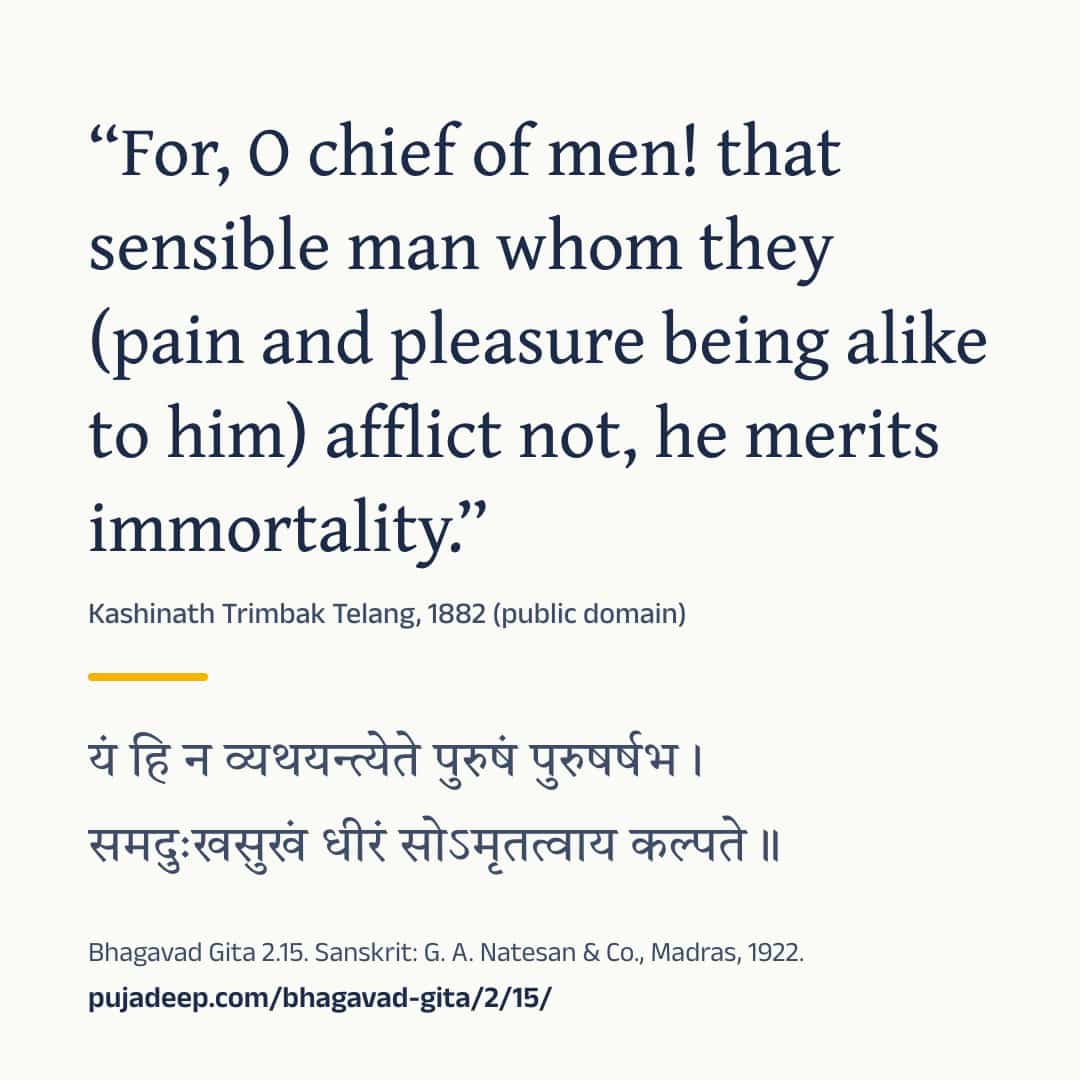
“For, O chief of men! that sensible man whom they (pain and pleasure being alike to him) afflict not, he merits immortality.”
(Kashinath Trimbak Telang, 1882, public domain)

“The man whom these torment not, O chief of men, balanced in pain and pleasure, tranquil, he is fitted for immortality.”
(Annie Besant, 1895, public domain)

“That calm man who is the same in pain and pleasure, whom these cannot disturb, alone is able, O great amongst men, to attain to immortality.”
(Swami Swarupananda, 1909 (first printed 1907), public domain)

Sanskrit: G. A. Natesan & Co., Madras, 1922.
https://pujadeep.com/bhagavad-gita/2/15/?s=copy Nothing is sent from this site. Your own app sends it, to the chat you choose. The picture quotes Telang (1882). If you chose another translation above, the text quotes yours and no picture is offered.
Sanskrit text: The Bhagavad-Gita, or The Lord's Song, with the text in Devanagari and an English translation, 1922. Meanings: written for Pujadeep with AI help and reviewed. Source and changes
Questions families ask
Who speaks Bhagavad Gita 2.15?
Krishna speaks this verse, in chapter 2 (Sankhya Yoga).
Where does the Sanskrit text come from?
Sanskrit text: The Bhagavad-Gita, or The Lord's Song, with the text in Devanagari and an English translation, 1922. Meanings: written for Pujadeep with AI help and reviewed. See the source
Is the meaning on this page a translation?
Explanation written for this site with AI help from the sources listed here, and reviewed. It is not a translation and not the only way to read the text. Free to quote with credit.
Source and licence
- Sanskrit text
- The Bhagavad-Gita, or The Lord's Song, with the text in Devanagari and an English translation (Annie Besant, G. A. Natesan & Co., Madras, 1922). Public domain. The Sanskrit on these pages was read from this printing’s page images.
- Translation
- The Bhagavadgîtâ with the Sanatsugâtîya and the Anugîtâ, translated by Kâshinâth Trimbak Telang (The Sacred Books of the East, vol. VIII, ed. F. Max Müller) (Kashinath Trimbak Telang, F. Max Müller, Clarendon Press, Oxford, 1882). Public domain. Shown verbatim, as printed.
- Translation
- The Bhagavad Gîtâ, or The Lord's Song, translated by Annie Besant (Annie Besant, Theosophical Publishing Society, London, 1895). Public domain. Shown verbatim, as printed.
- Sanskrit text
- Srimad-Bhagavad-Gita, with Sanskrit Text; Paraphrase with Word-by-word Literal Translation; English Rendering and Comments, Index, &c., by the Swami Swarupananda (Himalayan Series, No. XX) (Swami Swarupananda, The Editors and Publishers, Advaita Ashrama, Mayavati, Prabuddha Bharata Press, Mayavati, Almora, Himalayas, 1909). Public domain. Used only to date the text. The Devanagari on this page is a reading text and is not copied from this printing.
- Common wording
- In this text, 32 words follow today's common wording, checked against sanskritdocuments.org; Sanskrit Wikisource; Gita Press, Gorakhpur; GRETIL, Göttingen and Bhaktivedanta Book Trust.
- Our explanation
- Explanation written for this site with AI help from the sources listed here, and reviewed. It is not a translation and not the only way to read the text. Free to quote with credit.
- Review
- AI review: 2 independent reviews against the cited edition, October 15, 2026.