Bhagavad Gita · Chapter 2: Sankhya Yoga · Speaker: Krishna
Bhagavad Gita 2.16: Nasato vidyate bhavo nabhavo
Krishna says that what is unreal (asat) has no being, and what is real (sat) never stops being.
Bhagavad Gita 2.16
नासतो विद्यते भावो नाभावो विद्यते सतः ।उभयोरपि दृष्टोऽन्तस्त्वनयोस्तत्त्वदर्शिभिः ॥
Nasato vidyate bhavo nabhavo vidyate satah
Ubhayorapi drishtontastvanayostattvadarshibhih
nāsato vidyate bhāvo nābhāvo vidyate sataḥ |
ubhayorapi dṛṣṭo’ntastvanayostattvadarśibhiḥ ||
Our meaning Krishna says that what is unreal (asat) has no being, and what is real (sat) never stops being. Those who see the truth have understood the nature of both. The schools of Vedanta explain sat and asat in different ways.
हिंदी अर्थ कृष्ण कहते हैं कि असत् (जो वास्तविक नहीं है) का अस्तित्व नहीं होता, और सत् (जो वास्तविक है) का कभी अभाव नहीं होता। तत्त्व को जानने वालों ने इन दोनों का सच देख लिया है। वेदांत की अलग-अलग परंपराएँ सत् और असत् को अलग ढंग से समझाती हैं।
Word by word
Every word, with its dictionary page
Word by word
- न na not (indeclinable) Dictionary: 2. na, Monier-Williams 1899, p. 523, col. 1
ind. not, no, nor, neither
- असतः asataḥ of the unreal (noun (neuter), genitive singular) Dictionary: a-sat, Monier-Williams 1899, p. 118, col. 2
not being, not existing, unreal
- विद्यते vidyate is found, exists (present passive, 3rd person singular) Dictionary: 1. vid, Monier-Williams 1899, p. 963, col. 2
to know, understand, perceive, learn
- भावः bhāvaḥ being, existence (noun (masculine), nominative singular) Dictionary: bhāva, Monier-Williams 1899, p. 754, col. 1
becoming, being
- न na not (indeclinable) Dictionary: 2. na, Monier-Williams 1899, p. 523, col. 1
ind. not, no, nor, neither
- अभावः abhāvaḥ non-being (noun (masculine), nominative singular) Dictionary: a-bhāva, Monier-Williams 1899, p. 60, col. 3
non-existence, nullity, absence
- विद्यते vidyate is found, exists (present passive, 3rd person singular) Dictionary: 1. vid, Monier-Williams 1899, p. 963, col. 2
to know, understand, perceive, learn
- सतः sataḥ of the real (noun (neuter), genitive singular) Dictionary: sat, Monier-Williams 1899, p. 1134, col. 2
real, actual, as any one or anything ought to be
- उभयोः ubhayoḥ of both (pronoun (masculine), genitive dual) Dictionary: ubhaya, Monier-Williams 1899, p. 216, col. 2
both, of both kinds
- अपि api also (indeclinable) Dictionary: api, Monier-Williams 1899, p. 55, col. 1
in the sense of even, also, very
- दृष्टः dṛṣṭaḥ is seen (past participle (masculine), nominative singular) Dictionary: dṛṣṭa, Monier-Williams 1899, p. 491, col. 3
seen, looked at, beheld, perceived, noticed
- अन्तः antaḥ the end, the conclusion (noun (masculine), nominative singular) Dictionary: anta, Monier-Williams 1899, p. 42, col. 3
end, limit, boundary, term
- तु tu indeed (indeclinable) Dictionary: 2. tu, Monier-Williams 1899, p. 449, col. 3
but
- अनयोः anayoḥ of these two (pronoun (masculine), genitive dual) Dictionary: 1. idam, Monier-Williams 1899, p. 165, col. 2
- तत्त्वदर्शिभिः tattvadarśibhiḥ by those who see the truth (compound (masculine), instrumental plural) Dictionary: tattva-darśin, Monier-Williams 1899, p. 433, col. 1
Public-domain translations
Kashinath Trimbak Telang, 1882. Public domain. Page 44.
There is no existence for that which is unreal; there is no non-existence for that which is real. And the (correct) conclusion about both1 is perceived by those who perceive the truth.
Footnotes (the translator’s own) - The sense is this—there are two things apparently, the soul which is indestructible, and the feelings of pain &c. which 'come and go.' The true philosopher knows that the former only is real and exists; and that the latter is unreal and non-existent. He therefore does not mind the latter. ↩
Compare 3 translations
Kashinath Trimbak Telang, 1882. Public domain. Page 44.
There is no existence for that which is unreal; there is no non-existence for that which is real. And the (correct) conclusion about both1 is perceived by those who perceive the truth.
Footnotes (the translator’s own) - The sense is this—there are two things apparently, the soul which is indestructible, and the feelings of pain &c. which 'come and go.' The true philosopher knows that the former only is real and exists; and that the latter is unreal and non-existent. He therefore does not mind the latter. ↩
You are reading this one
Annie Besant, 1895. Public domain. Page 27.
The unreal hath no being; the real never ceaseth to be; the truth about both hath been perceived by the Seers of the Essence of things.1
Footnotes (the translator’s own) - Tattva. ↩
You are reading this one
Swami Swarupananda, 1909 (first printed 1907). Public domain. Page 33.
The Unreal never is. The Real never is not. Men possessed of the knowledge of the Truth fully know both these.
You are reading this one
Classical readings, by school
Each reading is named by its school. None is presented as the only meaning.
Shankara Advaita
Shankara takes the unreal (asat) to be heat, cold and every other changing thing, together with their causes. He says these have no real being at all; they are like a mirage. The real (sat) is the Self, which never ceases to be.
Source: The Bhagavad-Gita, with the commentary of Sri Sankaracharya, translated by A. Mahadeva Sastri (2nd ed., Mysore: G. T. A. Printing Works, 1901), commentary on 2.16. Summarised in our own words; none of its text is reproduced.
Ramanuja Vishishtadvaita
Ramanuja takes asat to mean the body, unconscious matter that never stays the same, and sat to mean the self (ātman), which is conscious and constant. The verse states the different natures of the two.
Source: Sri Bhagavad-Gita with Sri Ramanujacharya's Visishtadvaita commentary, translated by A. Govindacharya (Madras, 1898), commentary on 2.16. Summarised in our own words; none of its text is reproduced.
Share
Send one picture or the text to one chat. The picture names its source and the address of this page.
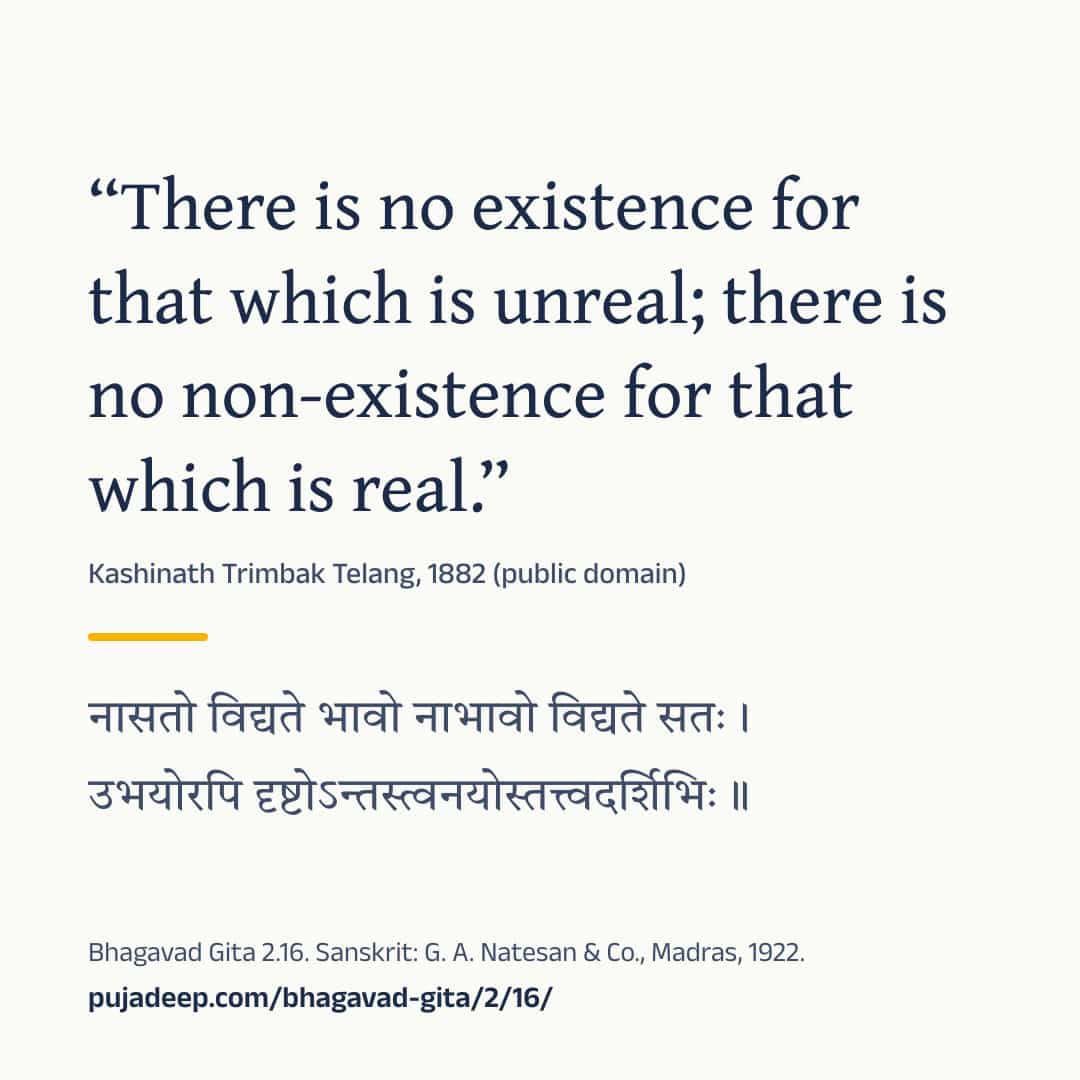
Send as text
The words and the link only. Many elders prefer this.
Bhagavad Gita 2.16

नासतो विद्यते भावो नाभावो विद्यते सतः ।
उभयोरपि दृष्टोऽन्तस्त्वनयोस्तत्त्वदर्शिभिः ॥

“There is no existence for that which is unreal; there is no non-existence for that which is real. And the (correct) conclusion about both is perceived by those who perceive the truth.”
(Kashinath Trimbak Telang, 1882, public domain)

“The unreal hath no being; the real never ceaseth to be; the truth about both hath been perceived by the Seers of the Essence of things.”
(Annie Besant, 1895, public domain)

“The Unreal never is. The Real never is not. Men possessed of the knowledge of the Truth fully know both these.”
(Swami Swarupananda, 1909 (first printed 1907), public domain)

Sanskrit: G. A. Natesan & Co., Madras, 1922.
https://pujadeep.com/bhagavad-gita/2/16/?s=copy Nothing is sent from this site. Your own app sends it, to the chat you choose. The picture quotes Telang (1882). If you chose another translation above, the text quotes yours and no picture is offered.
Sanskrit text: The Bhagavad-Gita, or The Lord's Song, with the text in Devanagari and an English translation, 1922. Meanings: written for Pujadeep with AI help and reviewed. Source and changes
Questions families ask
Who speaks Bhagavad Gita 2.16?
Krishna speaks this verse, in chapter 2 (Sankhya Yoga).
Where does the Sanskrit text come from?
Sanskrit text: The Bhagavad-Gita, or The Lord's Song, with the text in Devanagari and an English translation, 1922. Meanings: written for Pujadeep with AI help and reviewed. See the source
Is the meaning on this page a translation?
Explanation written for this site with AI help from the sources listed here, and reviewed. It is not a translation and not the only way to read the text. Free to quote with credit.
Source and licence
- Sanskrit text
- The Bhagavad-Gita, or The Lord's Song, with the text in Devanagari and an English translation (Annie Besant, G. A. Natesan & Co., Madras, 1922). Public domain. The Sanskrit on these pages was read from this printing’s page images.
- Translation
- The Bhagavadgîtâ with the Sanatsugâtîya and the Anugîtâ, translated by Kâshinâth Trimbak Telang (The Sacred Books of the East, vol. VIII, ed. F. Max Müller) (Kashinath Trimbak Telang, F. Max Müller, Clarendon Press, Oxford, 1882). Public domain. Shown verbatim, as printed.
- Translation
- The Bhagavad Gîtâ, or The Lord's Song, translated by Annie Besant (Annie Besant, Theosophical Publishing Society, London, 1895). Public domain. Shown verbatim, as printed.
- Sanskrit text
- Srimad-Bhagavad-Gita, with Sanskrit Text; Paraphrase with Word-by-word Literal Translation; English Rendering and Comments, Index, &c., by the Swami Swarupananda (Himalayan Series, No. XX) (Swami Swarupananda, The Editors and Publishers, Advaita Ashrama, Mayavati, Prabuddha Bharata Press, Mayavati, Almora, Himalayas, 1909). Public domain. Used only to date the text. The Devanagari on this page is a reading text and is not copied from this printing.
- Commentary
- The Bhagavad-Gita, with the commentary of Sri Sankaracharya, translated by A. Mahadeva Sastri (2nd ed., Mysore: G. T. A. Printing Works, 1901) (Public-domain scan, University of California Libraries). Summarised in our own words; none of its text is reproduced.
- Commentary
- Sri Bhagavad-Gita with Sri Ramanujacharya's Visishtadvaita commentary, translated by A. Govindacharya (Madras, 1898) (Scan uploaded to archive.org (folkscanomy collection)). Summarised in our own words; none of its text is reproduced.
- Common wording
- In this text, 32 words follow today's common wording, checked against sanskritdocuments.org; Sanskrit Wikisource; Gita Press, Gorakhpur; GRETIL, Göttingen and Bhaktivedanta Book Trust.
- Our explanation
- Explanation written for this site with AI help from the sources listed here, and reviewed. It is not a translation and not the only way to read the text. Free to quote with credit.
- Review
- AI review: 2 independent reviews against the cited edition, October 15, 2026.