Bhagavad Gita · Chapter 2: Sankhya Yoga · Speaker: Krishna
Bhagavad Gita 2.18: Antavanta ime deha
Krishna says that these bodies come to an end, but the one who dwells in them is eternal, cannot be destroyed and cannot be measured.
Bhagavad Gita 2.18
अन्तवन्त इमे देहा नित्यस्योक्ताः शरीरिणः ।अनाशिनोऽप्रमेयस्य तस्माद्युध्यस्व भारत ॥
Antavanta ime deha nityasyoktah sharirinah
Anashinoprameyasya tasmadyudhyasva bharata
antavanta ime dehā nityasyoktāḥ śarīriṇaḥ |
anāśino’prameyasya tasmādyudhyasva bhārata ||
Our meaning Krishna says that these bodies come to an end, but the one who dwells in them is eternal, cannot be destroyed and cannot be measured. So he tells Arjuna to fight.
हिंदी अर्थ कृष्ण कहते हैं कि ये शरीर नाशवान हैं, पर इनमें रहने वाली आत्मा नित्य, अविनाशी और अप्रमेय (जिसे मापा न जा सके) है। इसलिए वे अर्जुन से युद्ध करने को कहते हैं।
Word by word
Every word, with its dictionary page
Word by word
- अन्तवन्तः antavantaḥ having an end (adjective (masculine), nominative plural) Dictionary: anta-vat, Monier-Williams 1899, p. 43, col. 1
having an end or term, limited, perishable
- इमे ime these (pronoun (masculine), nominative plural) Dictionary: 1. idam, Monier-Williams 1899, p. 165, col. 2
- देहाः dehāḥ bodies (noun (masculine), nominative plural) Dictionary: deha, Monier-Williams 1899, p. 496, col. 3
the body
- नित्यस्य nityasya of the eternal (adjective (masculine), genitive singular) Dictionary: nitya, Monier-Williams 1899, p. 547, col. 2
continual, perpetual, eternal
- उक्ताः uktāḥ are said (past participle (masculine), nominative plural) Dictionary: ukta, Monier-Williams 1899, p. 171, col. 3
uttered, said, spoken
- शरीरिणः śarīriṇaḥ of the embodied one (noun (masculine), genitive singular) Dictionary: śarīrin, Monier-Williams 1899, p. 1058, col. 1
having a body, embodied, corporeal
- अनाशिनः anāśinaḥ of the indestructible (adjective (masculine), genitive singular) Dictionary: 1. a-nāśin, Monier-Williams 1899, p. 29, col. 1
imperishable
- अप्रमेयस्य aprameyasya of the immeasurable (adjective (masculine), genitive singular) Dictionary: a-prameya, Monier-Williams 1899, p. 58, col. 3
immeasurable, unlimited, unfathomable
- तस्मात् tasmāt therefore (indeclinable) Dictionary: tasmāt, Monier-Williams 1899, p. 441, col. 2
from that, on that account, therefore
- युध्यस्व yudhyasva fight (imperative, 2nd person singular) Dictionary: 1. yudh, Monier-Williams 1899, p. 854, col. 3
to fight, wage war
- भारत bhārata O Bharata (Arjuna) (noun (masculine), vocative singular) Dictionary: bhārata, Monier-Williams 1899, p. 753, col. 1
Public-domain translations
Kashinath Trimbak Telang, 1882. Public domain. Page 44.
These bodies appertaining to the embodied (self) which is eternal, indestructible, and indefinable, are said1 to be perishable; therefore do engage in battle, O descendant of Bharata!
Footnotes (the translator’s own) - Scil. by those who are possessed of true knowledge. ↩
Compare 3 translations
Kashinath Trimbak Telang, 1882. Public domain. Page 44.
These bodies appertaining to the embodied (self) which is eternal, indestructible, and indefinable, are said1 to be perishable; therefore do engage in battle, O descendant of Bharata!
Footnotes (the translator’s own) - Scil. by those who are possessed of true knowledge. ↩
You are reading this one
Annie Besant, 1895. Public domain. Page 28.
These bodies of the Embodied One, which is eternal, indestructible, and boundless, are known as finite. Therefore fight, O Bhârata.
You are reading this one
Swami Swarupananda, 1909 (first printed 1907). Public domain. Page 34.
Of this indwelling Self,—the Ever-changeless, the indestructible, the Illimitable,—these bodies are said to have an end. Fight therefore, O descendant of Bharata.
You are reading this one
Share
Send one picture or the text to one chat. The picture names its source and the address of this page.
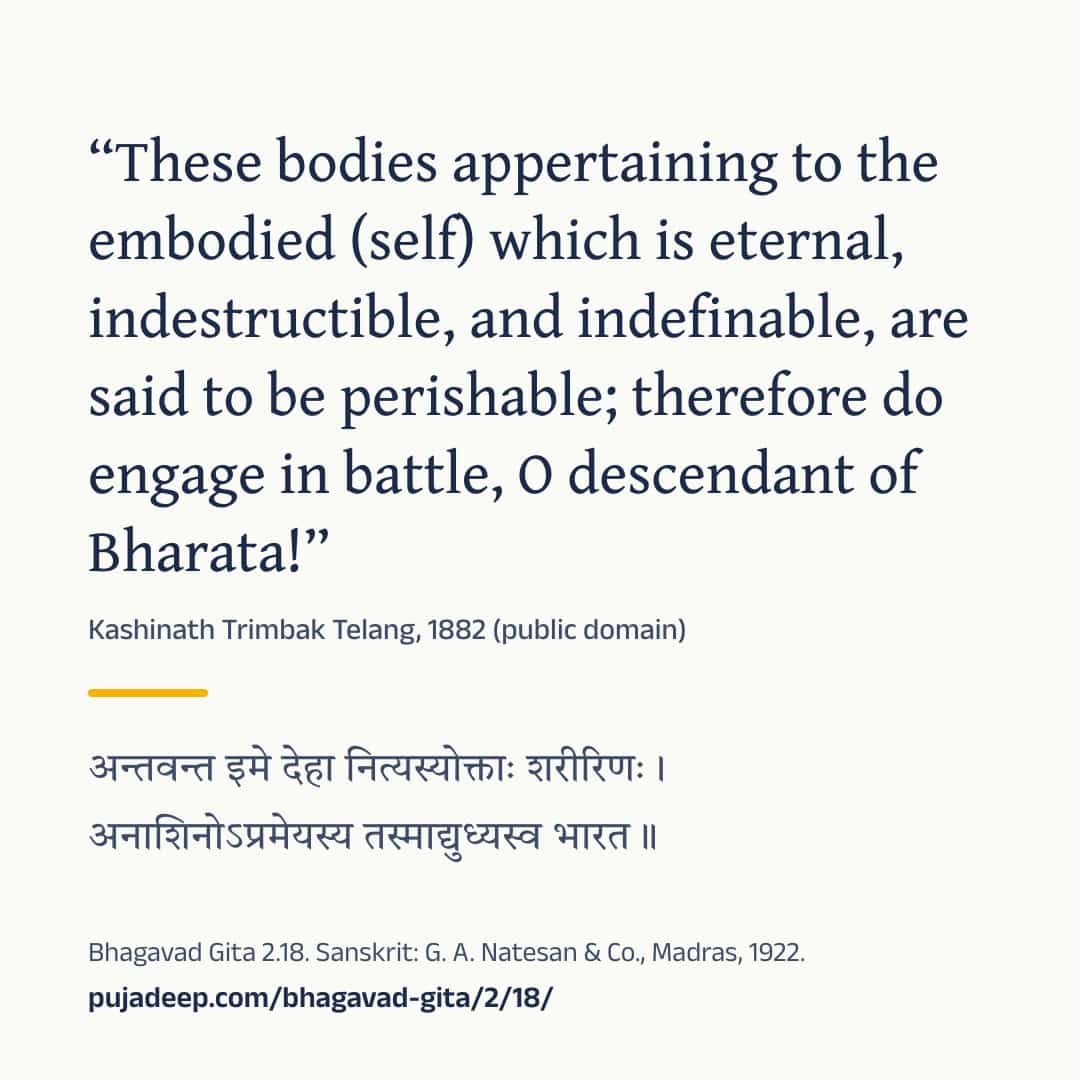
Send as text
The words and the link only. Many elders prefer this.
Bhagavad Gita 2.18

अन्तवन्त इमे देहा नित्यस्योक्ताः शरीरिणः ।
अनाशिनोऽप्रमेयस्य तस्माद्युध्यस्व भारत ॥

“These bodies appertaining to the embodied (self) which is eternal, indestructible, and indefinable, are said to be perishable; therefore do engage in battle, O descendant of Bharata!”
(Kashinath Trimbak Telang, 1882, public domain)

“These bodies of the Embodied One, which is eternal, indestructible, and boundless, are known as finite. Therefore fight, O Bhârata.”
(Annie Besant, 1895, public domain)

“Of this indwelling Self,—the Ever-changeless, the indestructible, the Illimitable,—these bodies are said to have an end. Fight therefore, O descendant of Bharata.”
(Swami Swarupananda, 1909 (first printed 1907), public domain)

Sanskrit: G. A. Natesan & Co., Madras, 1922.
https://pujadeep.com/bhagavad-gita/2/18/?s=copy Nothing is sent from this site. Your own app sends it, to the chat you choose. The picture quotes Telang (1882). If you chose another translation above, the text quotes yours and no picture is offered.
Sanskrit text: The Bhagavad-Gita, or The Lord's Song, with the text in Devanagari and an English translation, 1922. Meanings: written for Pujadeep with AI help and reviewed. Source and changes
Questions families ask
Who speaks Bhagavad Gita 2.18?
Krishna speaks this verse, in chapter 2 (Sankhya Yoga).
Where does the Sanskrit text come from?
Sanskrit text: The Bhagavad-Gita, or The Lord's Song, with the text in Devanagari and an English translation, 1922. Meanings: written for Pujadeep with AI help and reviewed. See the source
Is the meaning on this page a translation?
Explanation written for this site with AI help from the sources listed here, and reviewed. It is not a translation and not the only way to read the text. Free to quote with credit.
Source and licence
- Sanskrit text
- The Bhagavad-Gita, or The Lord's Song, with the text in Devanagari and an English translation (Annie Besant, G. A. Natesan & Co., Madras, 1922). Public domain. The Sanskrit on these pages was read from this printing’s page images.
- Translation
- The Bhagavadgîtâ with the Sanatsugâtîya and the Anugîtâ, translated by Kâshinâth Trimbak Telang (The Sacred Books of the East, vol. VIII, ed. F. Max Müller) (Kashinath Trimbak Telang, F. Max Müller, Clarendon Press, Oxford, 1882). Public domain. Shown verbatim, as printed.
- Translation
- The Bhagavad Gîtâ, or The Lord's Song, translated by Annie Besant (Annie Besant, Theosophical Publishing Society, London, 1895). Public domain. Shown verbatim, as printed.
- Sanskrit text
- Srimad-Bhagavad-Gita, with Sanskrit Text; Paraphrase with Word-by-word Literal Translation; English Rendering and Comments, Index, &c., by the Swami Swarupananda (Himalayan Series, No. XX) (Swami Swarupananda, The Editors and Publishers, Advaita Ashrama, Mayavati, Prabuddha Bharata Press, Mayavati, Almora, Himalayas, 1909). Public domain. Used only to date the text. The Devanagari on this page is a reading text and is not copied from this printing.
- Common wording
- In this text, 32 words follow today's common wording, checked against sanskritdocuments.org; Sanskrit Wikisource; Gita Press, Gorakhpur; GRETIL, Göttingen and Bhaktivedanta Book Trust.
- Our explanation
- Explanation written for this site with AI help from the sources listed here, and reviewed. It is not a translation and not the only way to read the text. Free to quote with credit.
- Review
- AI review: 2 independent reviews against the cited edition, October 15, 2026.