Bhagavad Gita · Chapter 2: Sankhya Yoga · Speaker: Krishna
Bhagavad Gita 2.20: Na jayate mriyate
Krishna says that the self is never born and never dies.
Bhagavad Gita 2.20
न जायते म्रियते वा कदाचिन्नायं भूत्वा भविता वा न भूयः ।अजो नित्यः शाश्वतोऽयं पुराणो न हन्यते हन्यमाने शरीरे ॥
Na jayate mriyate va kadachinnayam bhutva bhavita va na bhuyah
Ajo nityah shashvatoyam purano na hanyate hanyamane sharire
na jāyate mriyate vā kadācinnāyaṃ bhūtvā bhavitā vā na bhūyaḥ |
ajo nityaḥ śāśvato’yaṃ purāṇo na hanyate hanyamāne śarīre ||
Our meaning Krishna says that the self is never born and never dies. It did not come into being at some point, and it will not stop being. It is unborn, eternal, lasting and ancient. When the body is killed, it is not killed.
हिंदी अर्थ कृष्ण कहते हैं कि आत्मा न कभी जन्म लेती है, न मरती है। ऐसा नहीं कि वह एक बार होकर फिर न रहे। वह अजन्मा, नित्य, शाश्वत और पुरातन है। शरीर के मारे जाने पर भी वह नहीं मारी जाती।
Word by word
Every word, with its dictionary page
Word by word
- न na not (indeclinable) Dictionary: 2. na, Monier-Williams 1899, p. 523, col. 1
ind. not, no, nor, neither
- जायते jāyate is born (present, 3rd person singular) Dictionary: jan, Monier-Williams 1899, p. 410, col. 1
to be born or produced, come into existence
- म्रियते mriyate dies (present, 3rd person singular) Dictionary: mṛ, Monier-Williams 1899, p. 827, col. 2
to die, decease
- वा vā or (indeclinable) Dictionary: 1. vā, Monier-Williams 1899, p. 934, col. 2
ind. or
- कदाचित् kadācit at any time (indeclinable) Dictionary: kadā, Monier-Williams 1899, p. 248, col. 1
at some time, one day
- न na not (indeclinable) Dictionary: 2. na, Monier-Williams 1899, p. 523, col. 1
ind. not, no, nor, neither
- अयम् ayam this (Self) (pronoun (masculine), nominative singular) Dictionary: 1. idam, Monier-Williams 1899, p. 165, col. 2
- भूत्वा bhūtvā having come to be (absolutive (having done)) Dictionary: 1. bhū, Monier-Williams 1899, p. 760, col. 2
arise, come into being, exist
- भविता bhavitā will come to be (periphrastic future, 3rd person singular) Dictionary: 1. bhū, Monier-Williams 1899, p. 760, col. 2
arise, come into being, exist
- वा vā or (indeclinable) Dictionary: 1. vā, Monier-Williams 1899, p. 934, col. 2
ind. or
- न na not (indeclinable) Dictionary: 2. na, Monier-Williams 1899, p. 523, col. 1
ind. not, no, nor, neither
- भूयः bhūyaḥ again (indeclinable) Dictionary: bhūyas, Monier-Williams 1899, p. 763, col. 3
more, more numerous or abundant
- अजः ajaḥ unborn (adjective (masculine), nominative singular) Dictionary: 2. a-ja, Monier-Williams 1899, p. 9, col. 3
not born, existing from all eternity
- नित्यः nityaḥ eternal (adjective (masculine), nominative singular) Dictionary: nitya, Monier-Williams 1899, p. 547, col. 2
continual, perpetual, eternal
- शाश्वतः śāśvataḥ everlasting (adjective (masculine), nominative singular) Dictionary: śāśvata, Monier-Williams 1899, p. 1068, col. 3
eternal, constant, perpetual
- अयम् ayam this (Self) (pronoun (masculine), nominative singular) Dictionary: 1. idam, Monier-Williams 1899, p. 165, col. 2
- पुराणः purāṇaḥ ancient (adjective (masculine), nominative singular) Dictionary: purāṇa, Monier-Williams 1899, p. 635, col. 1
belonging to ancient or olden times, ancient, old
- न na not (indeclinable) Dictionary: 2. na, Monier-Williams 1899, p. 523, col. 1
ind. not, no, nor, neither
- हन्यते hanyate is killed (present passive, 3rd person singular) Dictionary: 1. han, Monier-Williams 1899, p. 1287, col. 2
to smite, slay, hit, kill, mar, destroy
- हन्यमाने hanyamāne when being killed (present passive participle, locative singular) Dictionary: hanyamāna, Monier-Williams 1899, p. 1288, col. 1
(pr. p. Pass.) being killed or slain
- शरीरे śarīre the body (noun (neuter), locative singular) Dictionary: śarīra, Monier-Williams 1899, p. 1057, col. 3
the body, bodily frame
Public-domain translations
Kashinath Trimbak Telang, 1882. Public domain. Page 45.
It is not born, nor does it ever die, nor, having existed, does it exist no more. Unborn, everlasting, unchangeable, and primeval, it is not killed when the body is killed1.
Footnotes (the translator’s own) - Katha-upanishad, pp. 103, 104. ↩
Compare 3 translations
Kashinath Trimbak Telang, 1882. Public domain. Page 45.
It is not born, nor does it ever die, nor, having existed, does it exist no more. Unborn, everlasting, unchangeable, and primeval, it is not killed when the body is killed1.
Footnotes (the translator’s own) - Katha-upanishad, pp. 103, 104. ↩
You are reading this one
Annie Besant, 1895. Public domain. Page 28.
It is not born, nor doth It die: nor having been, ceaseth It any more to be: unborn, perpetual, eternal and ancient, It is not slain when the body is slaughtered.
You are reading this one
Swami Swarupananda, 1909 (first printed 1907). Public domain. Page 35.
This is never born, nor does It die. It is not that not having been It again comes into being. (Or according to another view: It is not that having been It again ceases to be). This is unborn, eternal, changeless, ever-itself. It is not killed when the body is killed.
You are reading this one
Share
Send one picture or the text to one chat. The picture names its source and the address of this page.
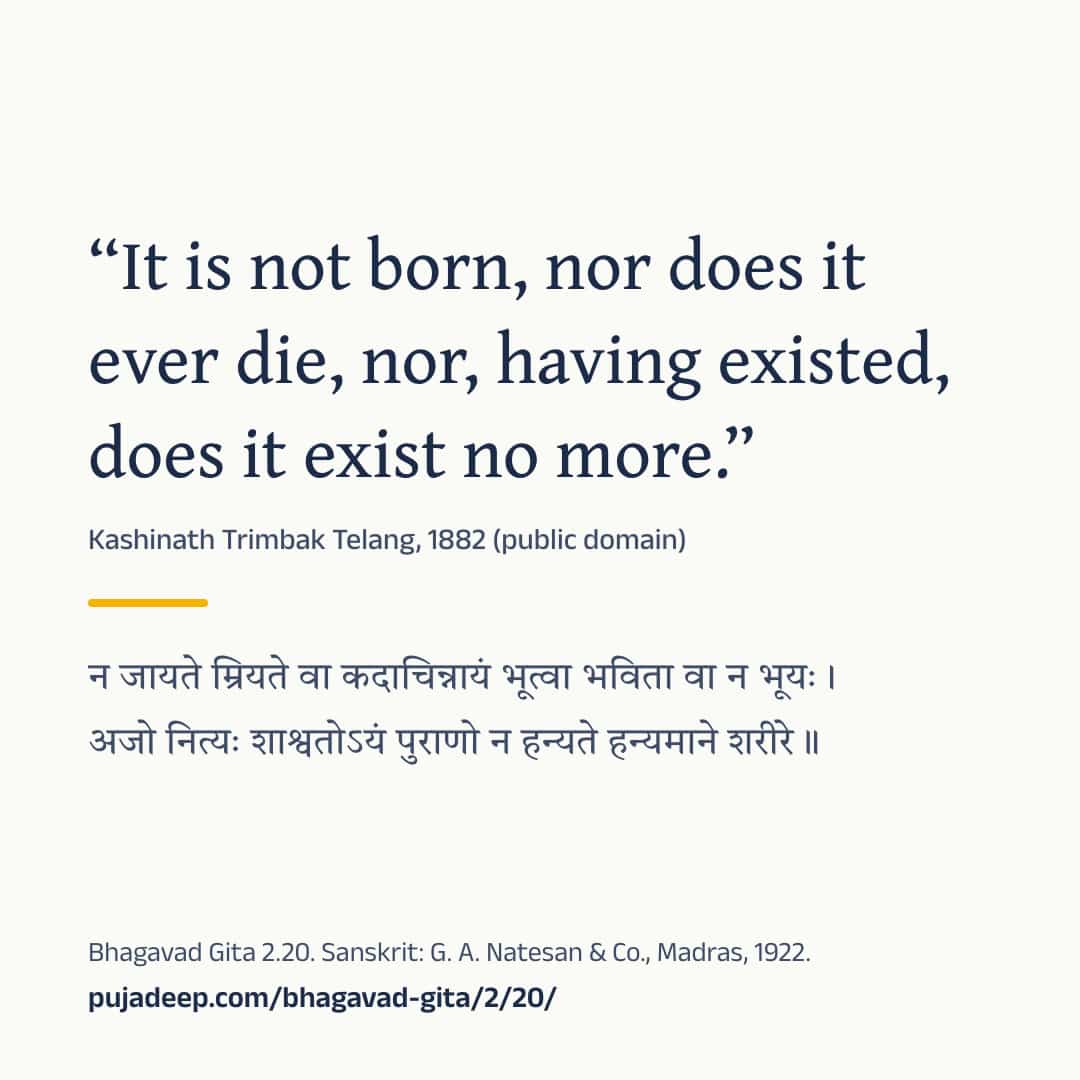
Send as text
The words and the link only. Many elders prefer this.
Bhagavad Gita 2.20

न जायते म्रियते वा कदाचिन्नायं भूत्वा भविता वा न भूयः ।
अजो नित्यः शाश्वतोऽयं पुराणो न हन्यते हन्यमाने शरीरे ॥

“It is not born, nor does it ever die, nor, having existed, does it exist no more. Unborn, everlasting, unchangeable, and primeval, it is not killed when the body is killed.”
(Kashinath Trimbak Telang, 1882, public domain)

“It is not born, nor doth It die: nor having been, ceaseth It any more to be: unborn, perpetual, eternal and ancient, It is not slain when the body is slaughtered.”
(Annie Besant, 1895, public domain)

“This is never born, nor does It die. It is not that not having been It again comes into being. (Or according to another view: It is not that having been It again ceases to be). This is unborn, eternal, changeless, ever-itself. It is not killed when the body is killed.”
(Swami Swarupananda, 1909 (first printed 1907), public domain)

Sanskrit: G. A. Natesan & Co., Madras, 1922.
https://pujadeep.com/bhagavad-gita/2/20/?s=copy Nothing is sent from this site. Your own app sends it, to the chat you choose. The picture quotes Telang (1882). If you chose another translation above, the text quotes yours and no picture is offered.
Sanskrit text: The Bhagavad-Gita, or The Lord's Song, with the text in Devanagari and an English translation, 1922. Meanings: written for Pujadeep with AI help and reviewed. Source and changes
Questions families ask
Who speaks Bhagavad Gita 2.20?
Krishna speaks this verse, in chapter 2 (Sankhya Yoga).
Where does the Sanskrit text come from?
Sanskrit text: The Bhagavad-Gita, or The Lord's Song, with the text in Devanagari and an English translation, 1922. Meanings: written for Pujadeep with AI help and reviewed. See the source
Is the meaning on this page a translation?
Explanation written for this site with AI help from the sources listed here, and reviewed. It is not a translation and not the only way to read the text. Free to quote with credit.
Source and licence
- Sanskrit text
- The Bhagavad-Gita, or The Lord's Song, with the text in Devanagari and an English translation (Annie Besant, G. A. Natesan & Co., Madras, 1922). Public domain. The Sanskrit on these pages was read from this printing’s page images.
- Translation
- The Bhagavadgîtâ with the Sanatsugâtîya and the Anugîtâ, translated by Kâshinâth Trimbak Telang (The Sacred Books of the East, vol. VIII, ed. F. Max Müller) (Kashinath Trimbak Telang, F. Max Müller, Clarendon Press, Oxford, 1882). Public domain. Shown verbatim, as printed.
- Translation
- The Bhagavad Gîtâ, or The Lord's Song, translated by Annie Besant (Annie Besant, Theosophical Publishing Society, London, 1895). Public domain. Shown verbatim, as printed.
- Sanskrit text
- Srimad-Bhagavad-Gita, with Sanskrit Text; Paraphrase with Word-by-word Literal Translation; English Rendering and Comments, Index, &c., by the Swami Swarupananda (Himalayan Series, No. XX) (Swami Swarupananda, The Editors and Publishers, Advaita Ashrama, Mayavati, Prabuddha Bharata Press, Mayavati, Almora, Himalayas, 1909). Public domain. Used only to date the text. The Devanagari on this page is a reading text and is not copied from this printing.
- Common wording
- In this text, 32 words follow today's common wording, checked against sanskritdocuments.org; Sanskrit Wikisource; Gita Press, Gorakhpur; GRETIL, Göttingen and Bhaktivedanta Book Trust.
- Our explanation
- Explanation written for this site with AI help from the sources listed here, and reviewed. It is not a translation and not the only way to read the text. Free to quote with credit.
- Review
- AI review: 2 independent reviews against the cited edition, October 15, 2026.