Bhagavad Gita · Chapter 2: Sankhya Yoga · Speaker: Krishna
Bhagavad Gita 2.24
The self cannot be cut, burnt, wetted or dried, Krishna says.
Bhagavad Gita 2.24
अच्छेद्योऽयमदाह्योऽयमक्लेद्योऽशोष्य एव च ।नित्यः सर्वगतः स्थाणुरचलोऽयं सनातनः ॥
Achchhedyoyamadahyoyamakledyoshoshya eva cha
Nityah sarvagatah sthanurachaloyam sanatanah
acchedyo’yamadāhyo’yamakledyo’śoṣya eva ca |
nityaḥ sarvagataḥ sthāṇuracalo’yaṃ sanātanaḥ ||
Our meaning The self cannot be cut, burnt, wetted or dried, Krishna says. It is eternal and present everywhere. It is firm, unmoving and everlasting.
हिंदी अर्थ कृष्ण कहते हैं कि आत्मा को न काटा जा सकता है, न जलाया, न गीला किया, न सुखाया जा सकता है। वह नित्य, सर्वव्यापी, स्थिर, अचल और सनातन है।
Word by word
Every word, with its dictionary page
Word by word
- अच्छेद्यः acchedyaḥ cannot be cut (gerundive (to be done) (masculine), nominative singular) Dictionary: a-cchedya, Monier-Williams 1899, p. 9, col. 2
improper or impossible to be cut, indivisible
- अयम् ayam this (Self) (pronoun (masculine), nominative singular) Dictionary: 1. idam, Monier-Williams 1899, p. 165, col. 2
- अदाह्यः adāhyaḥ cannot be burnt (gerundive (to be done) (masculine), nominative singular) Dictionary: a-dāhya, Monier-Williams 1899, p. 18, col. 2
incombustible
- अयम् ayam this (pronoun (masculine), nominative singular) Dictionary: 1. idam, Monier-Williams 1899, p. 165, col. 2
- अक्लेद्यः akledyaḥ cannot be wetted (gerundive (to be done) (masculine), nominative singular) Dictionary: a-kledya, Monier-Williams 1899, p. 3, col. 1
not to be wetted
- अशोष्यः aśoṣyaḥ cannot be dried (gerundive (to be done) (masculine), nominative singular) Dictionary: a-śoṣya, Monier-Williams 1899, p. 113, col. 3
not to be dried up
- एव eva indeed (indeclinable) Dictionary: 1. eva, Monier-Williams 1899, p. 232, col. 2
just, exactly, very, same, only, even, alone, merely
- च ca and (indeclinable) Dictionary: 2. ca, Monier-Williams 1899, p. 380, col. 1
ind. and, both, also, moreover, as well as
- नित्यः nityaḥ eternal (adjective (masculine), nominative singular) Dictionary: nitya, Monier-Williams 1899, p. 547, col. 2
continual, perpetual, eternal
- सर्वगतः sarvagataḥ present everywhere (compound (masculine), nominative singular) Dictionary: sarva-gata, Monier-Williams 1899, p. 1185, col. 1
- स्थाणुः sthāṇuḥ firm, unmoving (adjective (masculine), nominative singular) Dictionary: sthāṇu, Monier-Williams 1899, p. 1262, col. 3
standing firmly, stationary, firm, fixed, immovable, motionless
- अचलः acalaḥ immovable (adjective (masculine), nominative singular) Dictionary: a-cala, Monier-Williams 1899, p. 8, col. 3
not moving, immovable
- अयम् ayam this (pronoun (masculine), nominative singular) Dictionary: 1. idam, Monier-Williams 1899, p. 165, col. 2
- सनातनः sanātanaḥ everlasting, primeval (adjective (masculine), nominative singular) Dictionary: sanātana, Monier-Williams 1899, p. 1141, col. 1
eternal, perpetual, permanent, everlasting, primeval, ancient
Public-domain translations
Kashinath Trimbak Telang, 1882. Public domain. Page 45.
It is not divisible; it is not combustible; it is not to be moistened; it is not to be dried up. It is everlasting, all-pervading, stable, firm, and eternal1.
Footnotes (the translator’s own) - 'Eternal.' Nîlakantha explains this by 'unlimited by time, place,' &c. Saṅkara and others as 'uncreated,' 'without cause.' Stable=not assuming new forms; firm=not abandoning the original form. (Srîdhara.) The latter signifies a slight change; the former a total change. ↩
Compare 3 translations
Kashinath Trimbak Telang, 1882. Public domain. Page 45.
It is not divisible; it is not combustible; it is not to be moistened; it is not to be dried up. It is everlasting, all-pervading, stable, firm, and eternal1.
Footnotes (the translator’s own) - 'Eternal.' Nîlakantha explains this by 'unlimited by time, place,' &c. Saṅkara and others as 'uncreated,' 'without cause.' Stable=not assuming new forms; firm=not abandoning the original form. (Srîdhara.) The latter signifies a slight change; the former a total change. ↩
You are reading this one
Annie Besant, 1895. Public domain. Page 29.
Uncleavable It, incombustible It, and indeed neither to be wetted nor dried away; perpetual, all-pervasive, stable, immovable, ancient,
You are reading this one
Swami Swarupananda, 1909 (first printed 1907). Public domain. Page 37.
This Self cannot be cut, nor burnt, nor wetted, nor dried. Changeless, all-pervading, unmoving, immovable, the Self is Eternal.
You are reading this one
Share
Send one picture or the text to one chat. The picture names its source and the address of this page.
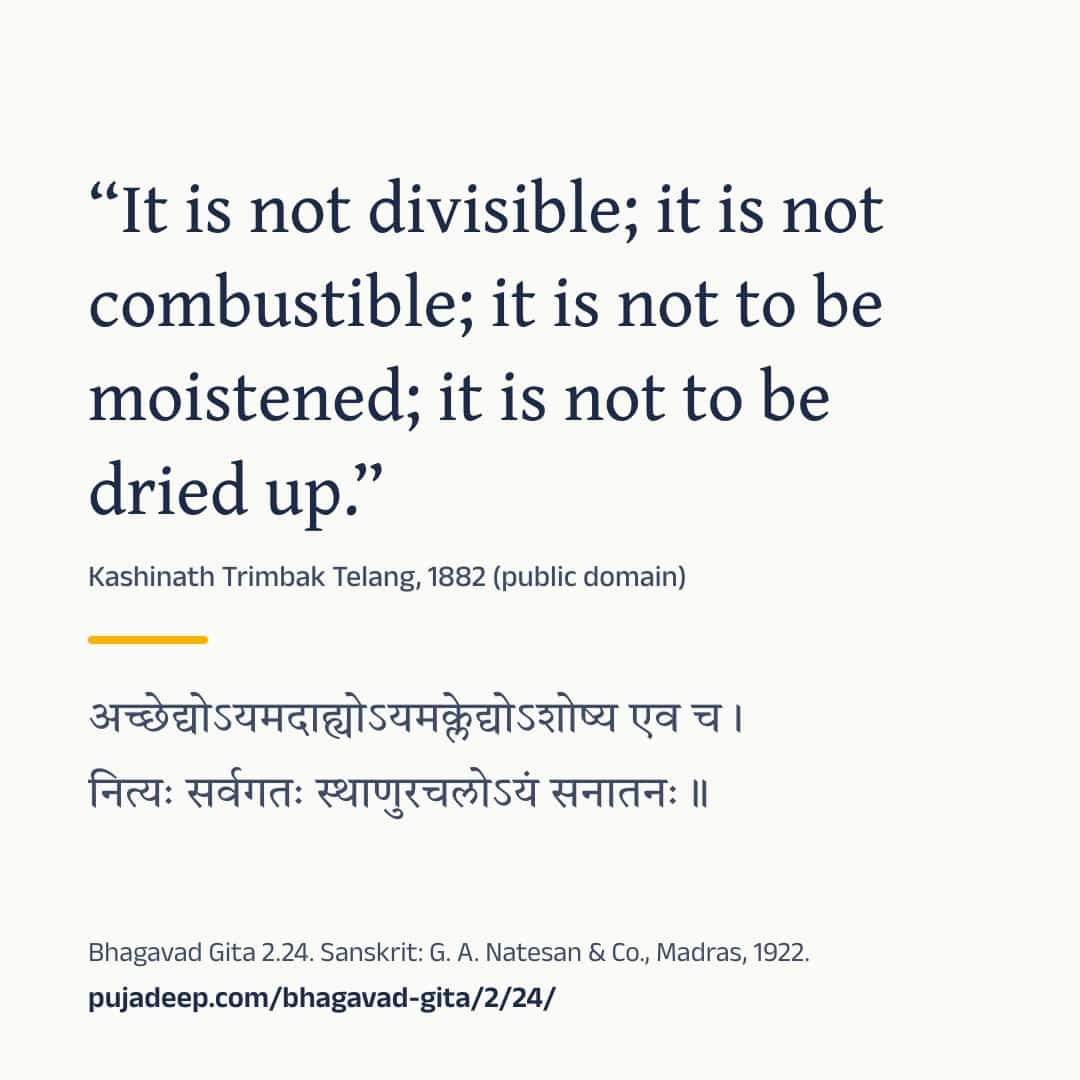
Send as text
The words and the link only. Many elders prefer this.
Bhagavad Gita 2.24

अच्छेद्योऽयमदाह्योऽयमक्लेद्योऽशोष्य एव च ।
नित्यः सर्वगतः स्थाणुरचलोऽयं सनातनः ॥

“It is not divisible; it is not combustible; it is not to be moistened; it is not to be dried up. It is everlasting, all-pervading, stable, firm, and eternal.”
(Kashinath Trimbak Telang, 1882, public domain)

“Uncleavable It, incombustible It, and indeed neither to be wetted nor dried away; perpetual, all-pervasive, stable, immovable, ancient,”
(Annie Besant, 1895, public domain)

“This Self cannot be cut, nor burnt, nor wetted, nor dried. Changeless, all-pervading, unmoving, immovable, the Self is Eternal.”
(Swami Swarupananda, 1909 (first printed 1907), public domain)

Sanskrit: G. A. Natesan & Co., Madras, 1922.
https://pujadeep.com/bhagavad-gita/2/24/?s=copy Nothing is sent from this site. Your own app sends it, to the chat you choose. The picture quotes Telang (1882). If you chose another translation above, the text quotes yours and no picture is offered.
Sanskrit text: The Bhagavad-Gita, or The Lord's Song, with the text in Devanagari and an English translation, 1922. Meanings: written for Pujadeep with AI help and reviewed. Source and changes
Questions families ask
Who speaks Bhagavad Gita 2.24?
Krishna speaks this verse, in chapter 2 (Sankhya Yoga).
Where does the Sanskrit text come from?
Sanskrit text: The Bhagavad-Gita, or The Lord's Song, with the text in Devanagari and an English translation, 1922. Meanings: written for Pujadeep with AI help and reviewed. See the source
Is the meaning on this page a translation?
Explanation written for this site with AI help from the sources listed here, and reviewed. It is not a translation and not the only way to read the text. Free to quote with credit.
Source and licence
- Sanskrit text
- The Bhagavad-Gita, or The Lord's Song, with the text in Devanagari and an English translation (Annie Besant, G. A. Natesan & Co., Madras, 1922). Public domain. The Sanskrit on these pages was read from this printing’s page images.
- Translation
- The Bhagavadgîtâ with the Sanatsugâtîya and the Anugîtâ, translated by Kâshinâth Trimbak Telang (The Sacred Books of the East, vol. VIII, ed. F. Max Müller) (Kashinath Trimbak Telang, F. Max Müller, Clarendon Press, Oxford, 1882). Public domain. Shown verbatim, as printed.
- Translation
- The Bhagavad Gîtâ, or The Lord's Song, translated by Annie Besant (Annie Besant, Theosophical Publishing Society, London, 1895). Public domain. Shown verbatim, as printed.
- Sanskrit text
- Srimad-Bhagavad-Gita, with Sanskrit Text; Paraphrase with Word-by-word Literal Translation; English Rendering and Comments, Index, &c., by the Swami Swarupananda (Himalayan Series, No. XX) (Swami Swarupananda, The Editors and Publishers, Advaita Ashrama, Mayavati, Prabuddha Bharata Press, Mayavati, Almora, Himalayas, 1909). Public domain. Used only to date the text. The Devanagari on this page is a reading text and is not copied from this printing.
- Common wording
- In this text, 32 words follow today's common wording, checked against sanskritdocuments.org; Sanskrit Wikisource; Gita Press, Gorakhpur; GRETIL, Göttingen and Bhaktivedanta Book Trust.
- Our explanation
- Explanation written for this site with AI help from the sources listed here, and reviewed. It is not a translation and not the only way to read the text. Free to quote with credit.
- Review
- AI review: 2 independent reviews against the cited edition, October 15, 2026.