Bhagavad Gita · Chapter 2: Sankhya Yoga · Speaker: Krishna
Bhagavad Gita 2.31: Svadharmamapi chavekshya
Krishna now speaks of Arjuna's own duty (svadharma).
Bhagavad Gita 2.31
स्वधर्ममपि चावेक्ष्य न विकम्पितुमर्हसि ।धर्म्याद्धि युद्धाच्छ्रेयोऽन्यत्क्षत्रियस्य न विद्यते ॥
Svadharmamapi chavekshya na vikampitumarhasi
Dharmyaddhi yuddhachchhreyonyatkshatriyasya na vidyate
svadharmamapi cāvekṣya na vikampitumarhasi |
dharmyāddhi yuddhācchreyo’nyatkṣatriyasya na vidyate ||
Our meaning Krishna now speaks of Arjuna's own duty (svadharma). Arjuna is a kshatriya, a warrior whose duty is to protect others. For such a person, Krishna says, nothing is better than a war fought for what is right, so he should not waver. This is said to a warrior on the eve of a war; the traditions read the idea of svadharma in different ways.
हिंदी अर्थ अब कृष्ण अर्जुन के स्वधर्म (अपने कर्तव्य) की बात करते हैं। अर्जुन क्षत्रिय हैं, जिनका कर्तव्य दूसरों की रक्षा करना है। कृष्ण कहते हैं कि क्षत्रिय के लिए धर्मयुक्त युद्ध से बढ़कर कुछ नहीं, इसलिए उन्हें डगमगाना नहीं चाहिए। यह बात एक योद्धा से युद्ध शुरू होने से ठीक पहले कही गई है; स्वधर्म के विचार को अलग-अलग परंपराएँ अलग ढंग से समझती हैं।
Word by word
Every word, with its dictionary page
Word by word
- स्वधर्मम् svadharmam one's own duty (compound (masculine), accusative singular) Dictionary: sva-dharma, Monier-Williams 1899, p. 1275, col. 3
o° own duty
- अपि api also (indeclinable) Dictionary: api, Monier-Williams 1899, p. 55, col. 1
in the sense of even, also, very
- च ca and (indeclinable) Dictionary: 2. ca, Monier-Williams 1899, p. 380, col. 1
ind. and, both, also, moreover, as well as
- अवेक्ष्य avekṣya having regard to (absolutive (having done)) Dictionary: avekṣ, Monier-Williams 1899, p. 111, col. 1
have regard to, take into consideration
- न na not (indeclinable) Dictionary: 2. na, Monier-Williams 1899, p. 523, col. 1
ind. not, no, nor, neither
- विकम्पितुम् vikampitum to waver (infinitive (to do)) Dictionary: vi-kamp, Monier-Williams 1899, p. 953, col. 3
to tremble greatly, quiver, move about
- अर्हसि arhasi you ought (present, 2nd person singular) Dictionary: arh, Monier-Williams 1899, p. 93, col. 3
to be able
- धर्म्यात् dharmyāt than a righteous (battle) (adjective (neuter), ablative singular) Dictionary: dharmya, Monier-Williams 1899, p. 513, col. 1
just, virtuous, righteous
- हि hi for (indeclinable) Dictionary: 2. hi, Monier-Williams 1899, p. 1297, col. 3
for, because, on account of
- युद्धात् yuddhāt than battle (noun (neuter), ablative singular) Dictionary: yuddha, Monier-Williams 1899, p. 854, col. 3
battle, fight, war
- श्रेयः śreyaḥ better (noun (neuter), nominative singular) Dictionary: śreyas, Monier-Williams 1899, p. 1102, col. 2
superior, preferable, better
- अन्यत् anyat other (pronoun (neuter), nominative singular) Dictionary: 2. anya, Monier-Williams 1899, p. 45, col. 2
other, different
- क्षत्रियस्य kṣatriyasya for a kshatriya (warrior) (noun (masculine), genitive singular) Dictionary: kṣatriya, Monier-Williams 1899, p. 325, col. 2
governing, endowed with sovereignty
- न na not (indeclinable) Dictionary: 2. na, Monier-Williams 1899, p. 523, col. 1
ind. not, no, nor, neither
- विद्यते vidyate is found, exists (present passive, 3rd person singular) Dictionary: 1. vid, Monier-Williams 1899, p. 963, col. 2
to know, understand, perceive, learn
Public-domain translations
Kashinath Trimbak Telang, 1882. Public domain. Page 46.
Having regard to your own duty also, you ought not to falter, for there is nothing better for a Kshatriya1 than a righteous battle.
Footnotes (the translator’s own) - One of the warrior caste. ↩
Compare 3 translations
Kashinath Trimbak Telang, 1882. Public domain. Page 46.
Having regard to your own duty also, you ought not to falter, for there is nothing better for a Kshatriya1 than a righteous battle.
Footnotes (the translator’s own) - One of the warrior caste. ↩
You are reading this one
Annie Besant, 1895. Public domain. Page 30.
Further, looking upon thine own Dharma, thou shouldst not tremble; for there is nothing more welcome to a Kshattriya than righteous war.
You are reading this one
Swami Swarupananda, 1909 (first printed 1907). Public domain. Page 41.
Looking at thine own Dharma, also, thou oughtest not to waver, for there is nothing higher for a Kshatriya than a righteous war.
You are reading this one
Share
Send one picture or the text to one chat. The picture names its source and the address of this page.
Send as text
The words and the link only. Many elders prefer this.
Bhagavad Gita 2.31

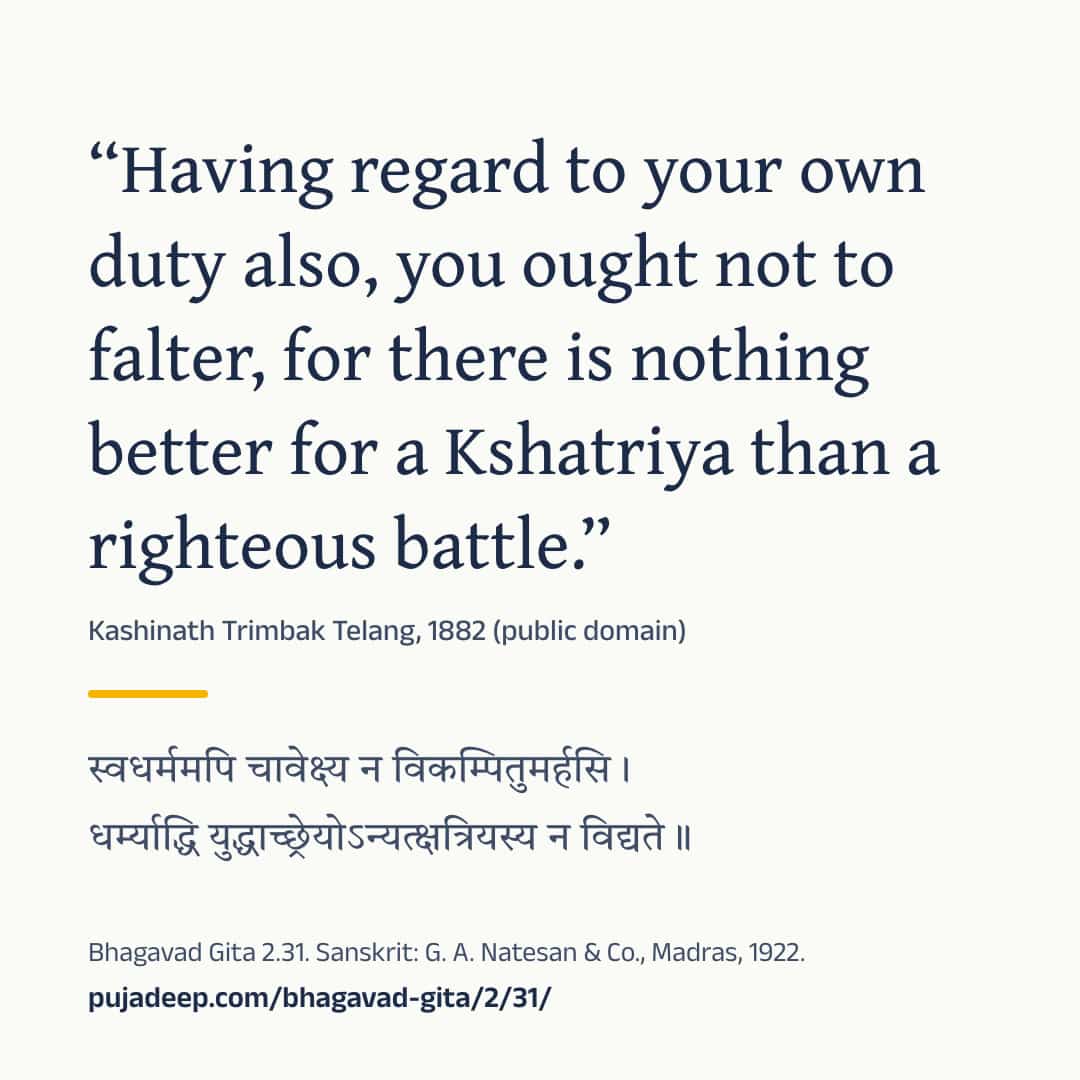
स्वधर्ममपि चावेक्ष्य न विकम्पितुमर्हसि ।
धर्म्याद्धि युद्धाच्छ्रेयोऽन्यत्क्षत्रियस्य न विद्यते ॥

“Having regard to your own duty also, you ought not to falter, for there is nothing better for a Kshatriya than a righteous battle.”
(Kashinath Trimbak Telang, 1882, public domain)

“Further, looking upon thine own Dharma, thou shouldst not tremble; for there is nothing more welcome to a Kshattriya than righteous war.”
(Annie Besant, 1895, public domain)

“Looking at thine own Dharma, also, thou oughtest not to waver, for there is nothing higher for a Kshatriya than a righteous war.”
(Swami Swarupananda, 1909 (first printed 1907), public domain)

Sanskrit: G. A. Natesan & Co., Madras, 1922.
https://pujadeep.com/bhagavad-gita/2/31/?s=copy Nothing is sent from this site. Your own app sends it, to the chat you choose. The picture quotes Telang (1882). If you chose another translation above, the text quotes yours and no picture is offered.
Sanskrit text: The Bhagavad-Gita, or The Lord's Song, with the text in Devanagari and an English translation, 1922. Meanings: written for Pujadeep with AI help and reviewed. Source and changes
Questions families ask
Who speaks Bhagavad Gita 2.31?
Krishna speaks this verse, in chapter 2 (Sankhya Yoga).
Where does the Sanskrit text come from?
Sanskrit text: The Bhagavad-Gita, or The Lord's Song, with the text in Devanagari and an English translation, 1922. Meanings: written for Pujadeep with AI help and reviewed. See the source
Is the meaning on this page a translation?
Explanation written for this site with AI help from the sources listed here, and reviewed. It is not a translation and not the only way to read the text. Free to quote with credit.
Source and licence
- Sanskrit text
- The Bhagavad-Gita, or The Lord's Song, with the text in Devanagari and an English translation (Annie Besant, G. A. Natesan & Co., Madras, 1922). Public domain. The Sanskrit on these pages was read from this printing’s page images.
- Translation
- The Bhagavadgîtâ with the Sanatsugâtîya and the Anugîtâ, translated by Kâshinâth Trimbak Telang (The Sacred Books of the East, vol. VIII, ed. F. Max Müller) (Kashinath Trimbak Telang, F. Max Müller, Clarendon Press, Oxford, 1882). Public domain. Shown verbatim, as printed.
- Translation
- The Bhagavad Gîtâ, or The Lord's Song, translated by Annie Besant (Annie Besant, Theosophical Publishing Society, London, 1895). Public domain. Shown verbatim, as printed.
- Sanskrit text
- Srimad-Bhagavad-Gita, with Sanskrit Text; Paraphrase with Word-by-word Literal Translation; English Rendering and Comments, Index, &c., by the Swami Swarupananda (Himalayan Series, No. XX) (Swami Swarupananda, The Editors and Publishers, Advaita Ashrama, Mayavati, Prabuddha Bharata Press, Mayavati, Almora, Himalayas, 1909). Public domain. Used only to date the text. The Devanagari on this page is a reading text and is not copied from this printing.
- Common wording
- In this text, 32 words follow today's common wording, checked against sanskritdocuments.org; Sanskrit Wikisource; Gita Press, Gorakhpur; GRETIL, Göttingen and Bhaktivedanta Book Trust.
- Our explanation
- Explanation written for this site with AI help from the sources listed here, and reviewed. It is not a translation and not the only way to read the text. Free to quote with credit.
- Review
- AI review: 2 independent reviews against the cited edition, October 15, 2026.