Bhagavad Gita · Chapter 2: Sankhya Yoga · Speaker: Krishna
Bhagavad Gita 2.33: Atha chettvamimam dharmyam
If Arjuna refuses this righteous battle, Krishna says, he will be giving up his duty and his good name, and he will incur sin (pāpa).
Bhagavad Gita 2.33
अथ चेत्त्वमिमं धर्म्यं सङ्ग्रामं न करिष्यसि ।ततः स्वधर्मं कीर्तिं च हित्वा पापमवाप्स्यसि ॥
Atha chettvamimam dharmyam sangramam na karishyasi
Tatah svadharmam kirtim cha hitva papamavapsyasi
atha cettvamimaṃ dharmyaṃ saṅgrāmaṃ na kariṣyasi |
tataḥ svadharmaṃ kīrtiṃ ca hitvā pāpamavāpsyasi ||
Our meaning If Arjuna refuses this righteous battle, Krishna says, he will be giving up his duty and his good name, and he will incur sin (pāpa).
हिंदी अर्थ कृष्ण कहते हैं कि यदि अर्जुन यह धर्मयुद्ध नहीं करेंगे, तो वे अपना स्वधर्म और यश दोनों खो देंगे और पाप के भागी होंगे।
Word by word
Every word, with its dictionary page
Word by word
- अथ atha but (indeclinable) Dictionary: atha, Monier-Williams 1899, p. 17, col. 3
now; then; moreover; rather; certainly
- चेत् cet if (indeclinable) Dictionary: ced, Monier-Williams 1899, p. 401, col. 3
if
- त्वम् tvam you (pronoun, nominative singular) Dictionary: 2. tva, Monier-Williams 1899, p. 463, col. 2
base of the 2nd personal pron.
- इमम् imam this (pronoun (masculine), accusative singular) Dictionary: 1. idam, Monier-Williams 1899, p. 165, col. 2
- धर्म्यम् dharmyam righteous (adjective (masculine), accusative singular) Dictionary: dharmya, Monier-Williams 1899, p. 513, col. 1
just, virtuous, righteous
- सङ्ग्रामम् saṅgrāmam battle (noun (masculine), accusative singular) Dictionary: saṃ-grāma, Monier-Williams 1899, p. 1129, col. 3
battle, war, fight, combat, conflict
- न na not (indeclinable) Dictionary: 2. na, Monier-Williams 1899, p. 523, col. 1
ind. not, no, nor, neither
- करिष्यसि kariṣyasi you will do (fight) (future, 2nd person singular) Dictionary: 1. kṛ, Monier-Williams 1899, p. 301, col. 1
to do, make, perform, accomplish, cause, effect, prepare
- ततः tataḥ then (indeclinable) Dictionary: tatas, Monier-Williams 1899, p. 432, col. 2
thereupon, then, after that
- स्वधर्मम् svadharmam your own duty (compound (masculine), accusative singular) Dictionary: sva-dharma, Monier-Williams 1899, p. 1275, col. 3
o° own duty
- कीर्तिम् kīrtim honour, good name (noun (feminine), accusative singular) Dictionary: kīrti, Monier-Williams 1899, p. 285, col. 1
good report, fame, renown
- च ca and (indeclinable) Dictionary: 2. ca, Monier-Williams 1899, p. 380, col. 1
ind. and, both, also, moreover, as well as
- हित्वा hitvā having given up (absolutive (having done)) Dictionary: 3. hā, Monier-Williams 1899, p. 1296, col. 2
to leave, abandon, desert, quit, forsake, relinquish
- पापम् pāpam wrong, sin (noun (neuter), accusative singular) Dictionary: pāpa, Monier-Williams 1899, p. 618, col. 2
sin, vice, crime, guilt
- अवाप्स्यसि avāpsyasi you will incur (future, 2nd person singular) Dictionary: avāp, Monier-Williams 1899, p. 107, col. 1
to reach, attain, obtain, gain, get
Public-domain translations
Kashinath Trimbak Telang, 1882. Public domain. Page 46.
But if you will not fight this righteous battle, then you will have abandoned your own duty and your fame, and you will incur sin.
Compare 3 translations
Kashinath Trimbak Telang, 1882. Public domain. Page 46.
But if you will not fight this righteous battle, then you will have abandoned your own duty and your fame, and you will incur sin.
You are reading this one
Annie Besant, 1895. Public domain. Page 30.
But if thou wilt not carry on this righteous warfare, then, casting away thine own Dharma and thine honour, thou wilt incur sin.
You are reading this one
Swami Swarupananda, 1909 (first printed 1907). Public domain. Page 42.
But if thou refusest to engage in this righteous warfare, then, forfeiting thine own Dharma and honour, thou shalt incur sin.
You are reading this one
Share
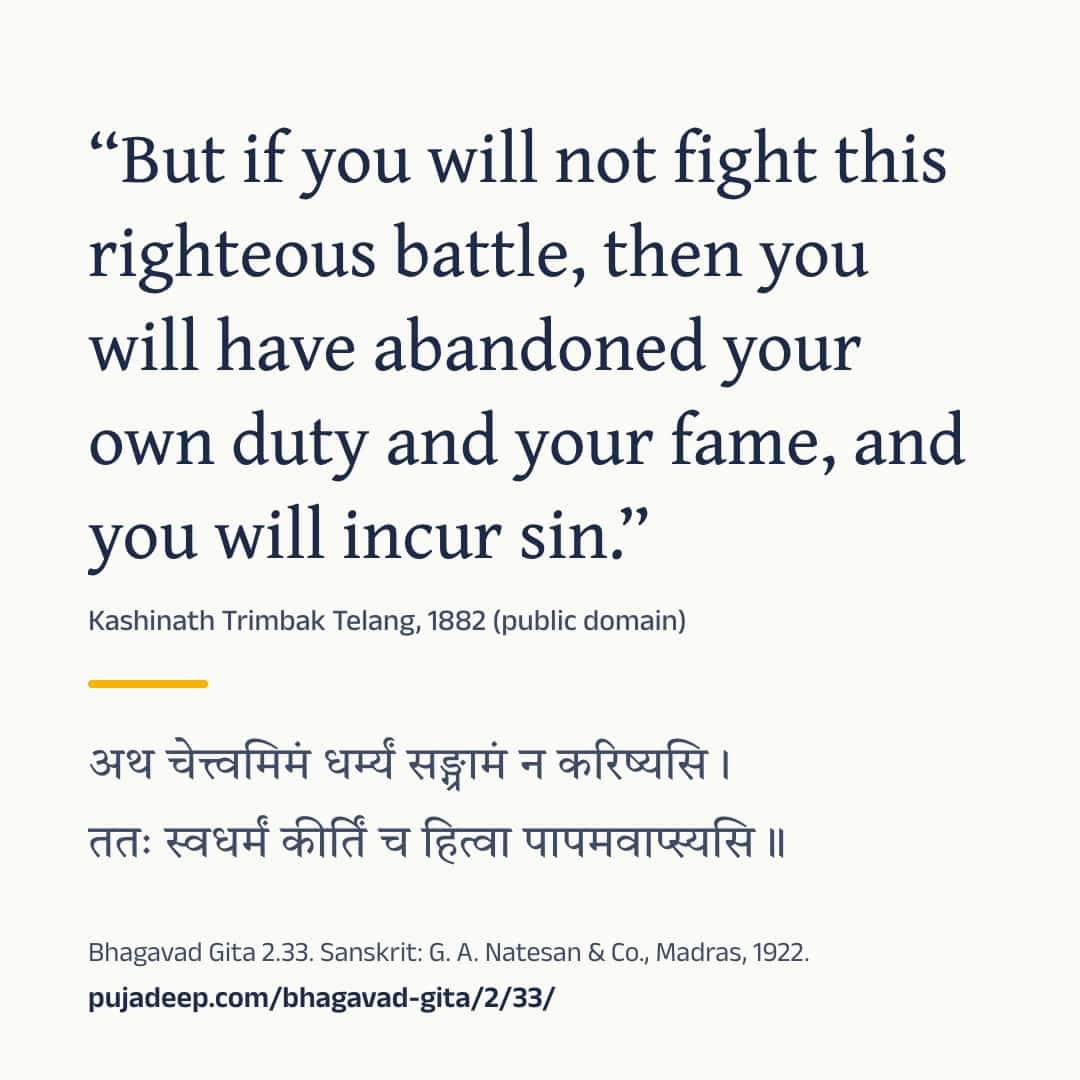
Send one picture or the text to one chat. The picture names its source and the address of this page.
Send as text
The words and the link only. Many elders prefer this.
Bhagavad Gita 2.33

अथ चेत्त्वमिमं धर्म्यं सङ्ग्रामं न करिष्यसि ।
ततः स्वधर्मं कीर्तिं च हित्वा पापमवाप्स्यसि ॥

“But if you will not fight this righteous battle, then you will have abandoned your own duty and your fame, and you will incur sin.”
(Kashinath Trimbak Telang, 1882, public domain)

“But if thou wilt not carry on this righteous warfare, then, casting away thine own Dharma and thine honour, thou wilt incur sin.”
(Annie Besant, 1895, public domain)

“But if thou refusest to engage in this righteous warfare, then, forfeiting thine own Dharma and honour, thou shalt incur sin.”
(Swami Swarupananda, 1909 (first printed 1907), public domain)

Sanskrit: G. A. Natesan & Co., Madras, 1922.
https://pujadeep.com/bhagavad-gita/2/33/?s=copy Nothing is sent from this site. Your own app sends it, to the chat you choose. The picture quotes Telang (1882). If you chose another translation above, the text quotes yours and no picture is offered.
Sanskrit text: The Bhagavad-Gita, or The Lord's Song, with the text in Devanagari and an English translation, 1922. Meanings: written for Pujadeep with AI help and reviewed. Source and changes
Questions families ask
Who speaks Bhagavad Gita 2.33?
Krishna speaks this verse, in chapter 2 (Sankhya Yoga).
Where does the Sanskrit text come from?
Sanskrit text: The Bhagavad-Gita, or The Lord's Song, with the text in Devanagari and an English translation, 1922. Meanings: written for Pujadeep with AI help and reviewed. See the source
Is the meaning on this page a translation?
Explanation written for this site with AI help from the sources listed here, and reviewed. It is not a translation and not the only way to read the text. Free to quote with credit.
Source and licence
- Sanskrit text
- The Bhagavad-Gita, or The Lord's Song, with the text in Devanagari and an English translation (Annie Besant, G. A. Natesan & Co., Madras, 1922). Public domain. The Sanskrit on these pages was read from this printing’s page images.
- Translation
- The Bhagavadgîtâ with the Sanatsugâtîya and the Anugîtâ, translated by Kâshinâth Trimbak Telang (The Sacred Books of the East, vol. VIII, ed. F. Max Müller) (Kashinath Trimbak Telang, F. Max Müller, Clarendon Press, Oxford, 1882). Public domain. Shown verbatim, as printed.
- Translation
- The Bhagavad Gîtâ, or The Lord's Song, translated by Annie Besant (Annie Besant, Theosophical Publishing Society, London, 1895). Public domain. Shown verbatim, as printed.
- Sanskrit text
- Srimad-Bhagavad-Gita, with Sanskrit Text; Paraphrase with Word-by-word Literal Translation; English Rendering and Comments, Index, &c., by the Swami Swarupananda (Himalayan Series, No. XX) (Swami Swarupananda, The Editors and Publishers, Advaita Ashrama, Mayavati, Prabuddha Bharata Press, Mayavati, Almora, Himalayas, 1909). Public domain. Used only to date the text. The Devanagari on this page is a reading text and is not copied from this printing.
- Common wording
- In this text, 32 words follow today's common wording, checked against sanskritdocuments.org; Sanskrit Wikisource; Gita Press, Gorakhpur; GRETIL, Göttingen and Bhaktivedanta Book Trust.
- Our explanation
- Explanation written for this site with AI help from the sources listed here, and reviewed. It is not a translation and not the only way to read the text. Free to quote with credit.
- Review
- AI review: 2 independent reviews against the cited edition, October 15, 2026.