Bhagavad Gita · Chapter 2: Sankhya Yoga · Speaker: Krishna
Bhagavad Gita 2.34: Akirtim chapi bhutani
Krishna says that people will speak of Arjuna's dishonour for ever, and that for someone who has been held in honour, disgrace is worse than death.
Bhagavad Gita 2.34
अकीर्तिं चापि भूतानि कथयिष्यन्ति तेऽव्ययाम् ।सम्भावितस्य चाकीर्तिर्मरणादतिरिच्यते ॥
Akirtim chapi bhutani kathayishyanti tevyayam
Sambhavitasya chakirtirmaranadatirichyate
akīrtiṃ cāpi bhūtāni kathayiṣyanti te’vyayām |
sambhāvitasya cākīrtirmaraṇādatiricyate ||
Our meaning Krishna says that people will speak of Arjuna's dishonour for ever, and that for someone who has been held in honour, disgrace is worse than death.
हिंदी अर्थ कृष्ण कहते हैं कि लोग सदा अर्जुन की अपकीर्ति की बातें करेंगे, और सम्मानित व्यक्ति के लिए अपयश मृत्यु से भी बढ़कर है।
Word by word
Every word, with its dictionary page
Word by word
- अकीर्तिम् akīrtim dishonour (noun (feminine), accusative singular) Dictionary: a-kīrti, Monier-Williams 1899, p. 2, col. 2
ill-fame, disgrace
- च ca and (indeclinable) Dictionary: 2. ca, Monier-Williams 1899, p. 380, col. 1
ind. and, both, also, moreover, as well as
- अपि api also (indeclinable) Dictionary: api, Monier-Williams 1899, p. 55, col. 1
in the sense of even, also, very
- भूतानि bhūtāni people, beings (noun (neuter), nominative plural) Dictionary: bhūta, Monier-Williams 1899, p. 761, col. 3
that which is or exists, any living being
- कथयिष्यन्ति kathayiṣyanti will tell (future, 3rd person plural) Dictionary: kath, Monier-Williams 1899, p. 247, col. 1
to tell, relate, narrate, report, inform, speak about, declare
- ते te your (pronoun, genitive singular) Dictionary: 2. tva, Monier-Williams 1899, p. 463, col. 2
base of the 2nd personal pron.
- अव्ययाम् avyayām lasting (adjective (feminine), accusative singular) Dictionary: 2. a-vyaya, Monier-Williams 1899, p. 111, col. 3
not liable to change, imperishable, undecaying
- सम्भावितस्य sambhāvitasya for one who is honoured (past participle (masculine), genitive singular) Dictionary: sam-bhāvita, Monier-Williams 1899, p. 1179, col. 1
thought highly of, esteemed, honoured, respected
- च ca and (indeclinable) Dictionary: 2. ca, Monier-Williams 1899, p. 380, col. 1
ind. and, both, also, moreover, as well as
- अकीर्तिः akīrtiḥ dishonour (noun (feminine), nominative singular) Dictionary: a-kīrti, Monier-Williams 1899, p. 2, col. 2
ill-fame, disgrace
- मरणात् maraṇāt than death (noun (neuter), ablative singular) Dictionary: maraṇa, Monier-Williams 1899, p. 789, col. 3
the act of dying, death
- अतिरिच्यते atiricyate is worse, exceeds (present passive, 3rd person singular) Dictionary: ati-ric, Monier-Williams 1899, p. 15, col. 2
to be left with a surplus, to surpass
Public-domain translations
Kashinath Trimbak Telang, 1882. Public domain. Page 46.
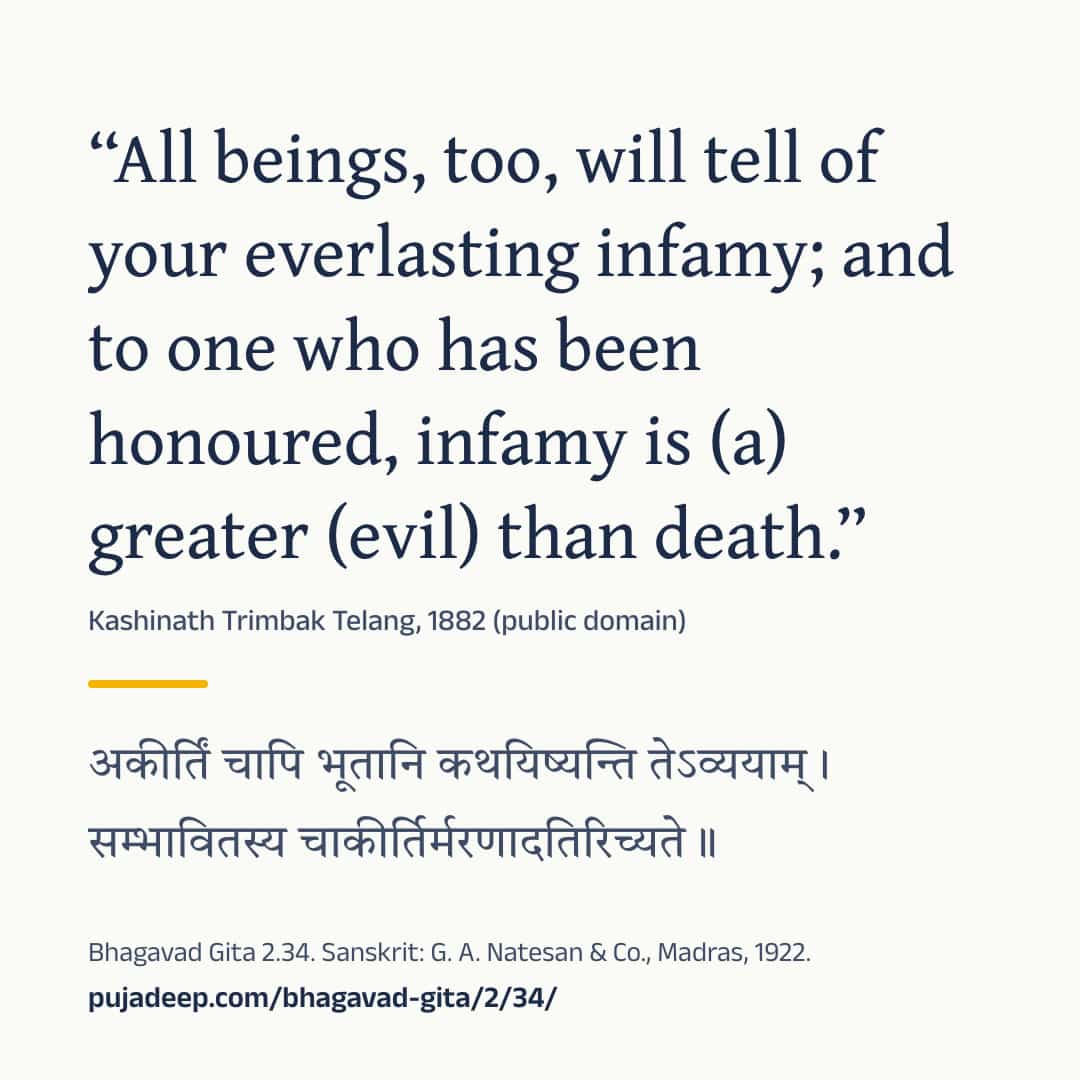
All beings, too, will tell of your everlasting infamy; and to one who has been honoured, infamy is (a) greater (evil) than death.
Compare 3 translations
Kashinath Trimbak Telang, 1882. Public domain. Page 46.
All beings, too, will tell of your everlasting infamy; and to one who has been honoured, infamy is (a) greater (evil) than death.
You are reading this one
Annie Besant, 1895. Public domain. Page 30–31.
Men will recount thy perpetual dishonour, and, to a noble nature, dishonour is worse than death.
You are reading this one
Swami Swarupananda, 1909 (first printed 1907). Public domain. Page 42.
The world also will ever hold thee in reprobation. To the honoured, disrepute is surely worse than death.
You are reading this one
Share
Send one picture or the text to one chat. The picture names its source and the address of this page.
Send as text
The words and the link only. Many elders prefer this.
Bhagavad Gita 2.34

अकीर्तिं चापि भूतानि कथयिष्यन्ति तेऽव्ययाम् ।
सम्भावितस्य चाकीर्तिर्मरणादतिरिच्यते ॥

“All beings, too, will tell of your everlasting infamy; and to one who has been honoured, infamy is (a) greater (evil) than death.”
(Kashinath Trimbak Telang, 1882, public domain)

“Men will recount thy perpetual dishonour, and, to a noble nature, dishonour is worse than death.”
(Annie Besant, 1895, public domain)

“The world also will ever hold thee in reprobation. To the honoured, disrepute is surely worse than death.”
(Swami Swarupananda, 1909 (first printed 1907), public domain)

Sanskrit: G. A. Natesan & Co., Madras, 1922.
https://pujadeep.com/bhagavad-gita/2/34/?s=copy Nothing is sent from this site. Your own app sends it, to the chat you choose. The picture quotes Telang (1882). If you chose another translation above, the text quotes yours and no picture is offered.
Sanskrit text: The Bhagavad-Gita, or The Lord's Song, with the text in Devanagari and an English translation, 1922. Meanings: written for Pujadeep with AI help and reviewed. Source and changes
Questions families ask
Who speaks Bhagavad Gita 2.34?
Krishna speaks this verse, in chapter 2 (Sankhya Yoga).
Where does the Sanskrit text come from?
Sanskrit text: The Bhagavad-Gita, or The Lord's Song, with the text in Devanagari and an English translation, 1922. Meanings: written for Pujadeep with AI help and reviewed. See the source
Is the meaning on this page a translation?
Explanation written for this site with AI help from the sources listed here, and reviewed. It is not a translation and not the only way to read the text. Free to quote with credit.
Source and licence
- Sanskrit text
- The Bhagavad-Gita, or The Lord's Song, with the text in Devanagari and an English translation (Annie Besant, G. A. Natesan & Co., Madras, 1922). Public domain. The Sanskrit on these pages was read from this printing’s page images.
- Translation
- The Bhagavadgîtâ with the Sanatsugâtîya and the Anugîtâ, translated by Kâshinâth Trimbak Telang (The Sacred Books of the East, vol. VIII, ed. F. Max Müller) (Kashinath Trimbak Telang, F. Max Müller, Clarendon Press, Oxford, 1882). Public domain. Shown verbatim, as printed.
- Translation
- The Bhagavad Gîtâ, or The Lord's Song, translated by Annie Besant (Annie Besant, Theosophical Publishing Society, London, 1895). Public domain. Shown verbatim, as printed.
- Sanskrit text
- Srimad-Bhagavad-Gita, with Sanskrit Text; Paraphrase with Word-by-word Literal Translation; English Rendering and Comments, Index, &c., by the Swami Swarupananda (Himalayan Series, No. XX) (Swami Swarupananda, The Editors and Publishers, Advaita Ashrama, Mayavati, Prabuddha Bharata Press, Mayavati, Almora, Himalayas, 1909). Public domain. Used only to date the text. The Devanagari on this page is a reading text and is not copied from this printing.
- Common wording
- In this text, 32 words follow today's common wording, checked against sanskritdocuments.org; Sanskrit Wikisource; Gita Press, Gorakhpur; GRETIL, Göttingen and Bhaktivedanta Book Trust.
- Our explanation
- Explanation written for this site with AI help from the sources listed here, and reviewed. It is not a translation and not the only way to read the text. Free to quote with credit.
- Review
- AI review: 2 independent reviews against the cited edition, October 15, 2026.