Bhagavad Gita · Chapter 2: Sankhya Yoga · Speaker: Arjuna
Bhagavad Gita 2.54: Sthitaprajnasya ka bhasha
Arjuna asks Krishna to describe a person of steady wisdom (sthitaprajña), settled in samadhi.
Bhagavad Gita 2.54
अर्जुन उवाच ।
स्थितप्रज्ञस्य का भाषा समाधिस्थस्य केशव ।स्थितधीः किं प्रभाषेत किमासीत व्रजेत किम् ॥
Sthitaprajnasya ka bhasha samadhisthasya keshava
Sthitadhih kim prabhasheta kimasita vrajeta kim
sthitaprajñasya kā bhāṣā samādhisthasya keśava |
sthitadhīḥ kiṃ prabhāṣeta kimāsīta vrajeta kim ||
Our meaning Arjuna asks Krishna to describe a person of steady wisdom (sthitaprajña), settled in samadhi. How does such a person speak? How do they sit, and how do they move about?
हिंदी अर्थ अर्जुन कृष्ण से पूछते हैं कि स्थितप्रज्ञ (जिसकी बुद्धि स्थिर हो) और समाधि में स्थित व्यक्ति के लक्षण क्या हैं? ऐसा व्यक्ति कैसे बोलता है, कैसे बैठता है और कैसे चलता है?
Word by word
Every word, with its dictionary page
Word by word
- स्थितप्रज्ञस्य sthitaprajñasya of one steady in wisdom (compound (masculine), genitive singular) Dictionary: sthita-prajña, Monier-Williams 1899, p. 1264, col. 2
firm in judgment and wisdom, calm, contented
- का kā what (pronoun (feminine), nominative singular) Dictionary: kim, Monier-Williams 1899, p. 282, col. 2
what? how? whence? wherefore? why?
- भाषा bhāṣā description, sign (noun (feminine), nominative singular) Dictionary: bhāṣā, Monier-Williams 1899, p. 755, col. 3
speech, language
- समाधिस्थस्य samādhisthasya of one settled in samadhi (compound (masculine), genitive singular) Dictionary: samādhi-stha, Monier-Williams 1899, p. 1160, col. 1
absorbed in m°
- केशव keśava O Keshava (Krishna) (noun (masculine), vocative singular) Dictionary: keśava, Monier-Williams 1899, p. 310, col. 3
N. of Vishṇu or Kṛishṇa
- स्थितधीः sthitadhīḥ one of steady mind (compound (masculine), nominative singular) Dictionary: sthita-dhī, Monier-Williams 1899, p. 1264, col. 2
steady-minded, firm, unmoved, calm
- किम् kim how, what (pronoun (neuter), accusative singular) Dictionary: kim, Monier-Williams 1899, p. 282, col. 2
what? how? whence? wherefore? why?
- प्रभाषेत prabhāṣeta would speak (optative, 3rd person singular) Dictionary: pra-bhāṣ, Monier-Williams 1899, p. 684, col. 1
to speak, tell, declare
- किम् kim how (pronoun (neuter), accusative singular) Dictionary: kim, Monier-Williams 1899, p. 282, col. 2
what? how? whence? wherefore? why?
- आसीत āsīta would sit (optative, 3rd person singular) Dictionary: 2. ās, Monier-Williams 1899, p. 159, col. 3
to sit, sit down, rest, lie
- व्रजेत vrajeta would walk (optative, 3rd person singular) Dictionary: vraj, Monier-Williams 1899, p. 1041, col. 3
to go, walk, proceed, travel, wander, move
- किम् kim how (pronoun (neuter), accusative singular) Dictionary: kim, Monier-Williams 1899, p. 282, col. 2
what? how? whence? wherefore? why?
Public-domain translations
Kashinath Trimbak Telang, 1882. Public domain. Page 49.
Arguna said:
What are the characteristics, O Kesava! of one whose mind is steady, and who is intent on contemplation? How should one of steady mind speak, how sit, how move?
Compare 3 translations
Kashinath Trimbak Telang, 1882. Public domain. Page 49.
Arguna said:
What are the characteristics, O Kesava! of one whose mind is steady, and who is intent on contemplation? How should one of steady mind speak, how sit, how move?
You are reading this one
Annie Besant, 1895. Public domain. Page 35.
Arjuna said:
What is the mark of him who is stable of mind, steadfast in contemplation, O Keshava? how doth the stable-minded talk, how doth he sit, how walk?
You are reading this one
Swami Swarupananda, 1909 (first printed 1907). Public domain. Page 53.
Arjuna said:
What, O Keshava, is the description of the man of steady wisdom, merged in Samadhi? How (on the other hand) does the man of steady wisdom speak, how sit, how walk?
You are reading this one
Share
Send one picture or the text to one chat. The picture names its source and the address of this page.
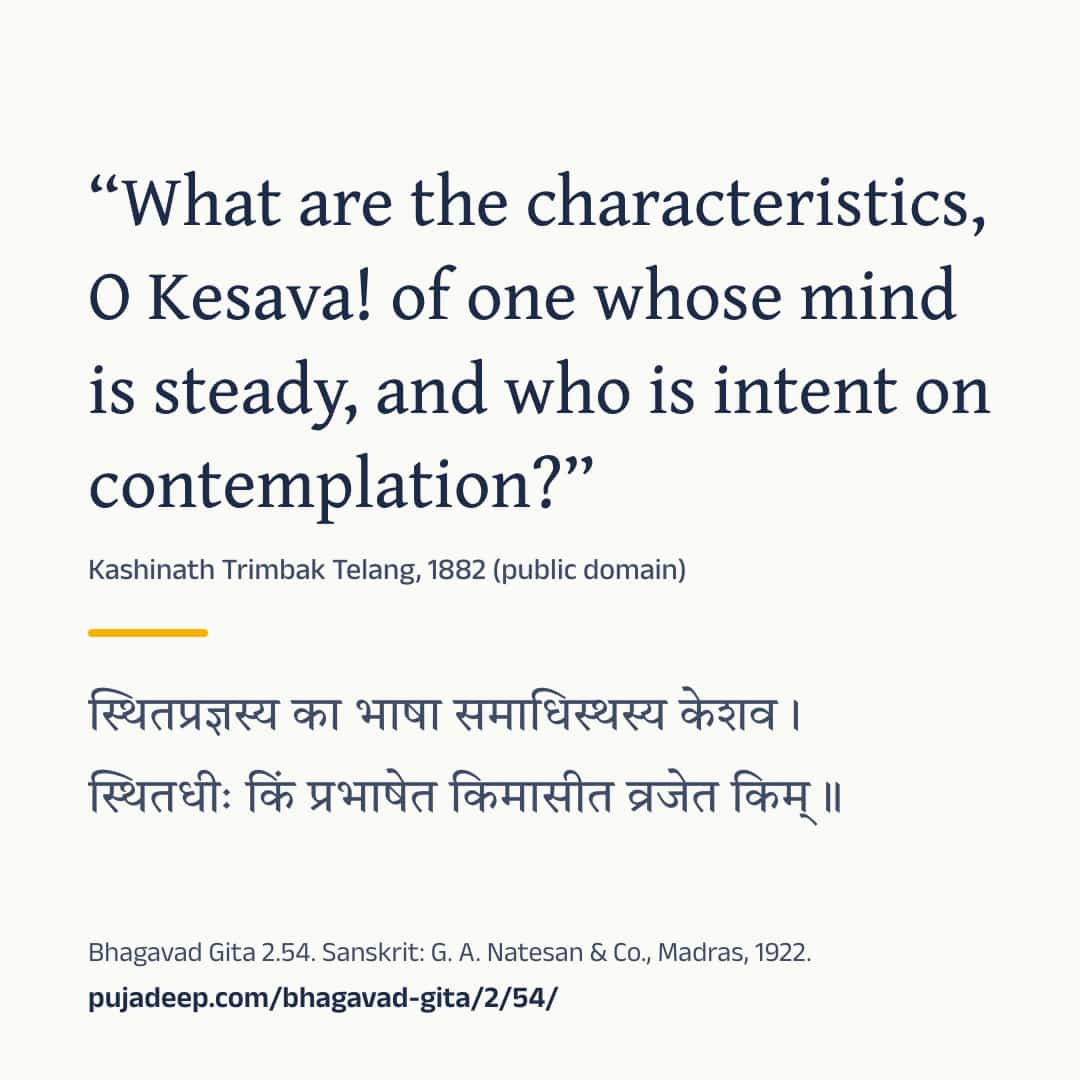
Send as text
The words and the link only. Many elders prefer this.
Bhagavad Gita 2.54

स्थितप्रज्ञस्य का भाषा समाधिस्थस्य केशव ।
स्थितधीः किं प्रभाषेत किमासीत व्रजेत किम् ॥

“What are the characteristics, O Kesava! of one whose mind is steady, and who is intent on contemplation? How should one of steady mind speak, how sit, how move?”
(Kashinath Trimbak Telang, 1882, public domain)

“What is the mark of him who is stable of mind, steadfast in contemplation, O Keshava? how doth the stable-minded talk, how doth he sit, how walk?”
(Annie Besant, 1895, public domain)

“What, O Keshava, is the description of the man of steady wisdom, merged in Samadhi? How (on the other hand) does the man of steady wisdom speak, how sit, how walk?”
(Swami Swarupananda, 1909 (first printed 1907), public domain)

Sanskrit: G. A. Natesan & Co., Madras, 1922.
https://pujadeep.com/bhagavad-gita/2/54/?s=copy Nothing is sent from this site. Your own app sends it, to the chat you choose. The picture quotes Telang (1882). If you chose another translation above, the text quotes yours and no picture is offered.
Sanskrit text: The Bhagavad-Gita, or The Lord's Song, with the text in Devanagari and an English translation, 1922. Meanings: written for Pujadeep with AI help and reviewed. Source and changes
Questions families ask
Who speaks Bhagavad Gita 2.54?
Arjuna speaks this verse, in chapter 2 (Sankhya Yoga).
Where does the Sanskrit text come from?
Sanskrit text: The Bhagavad-Gita, or The Lord's Song, with the text in Devanagari and an English translation, 1922. Meanings: written for Pujadeep with AI help and reviewed. See the source
Is the meaning on this page a translation?
Explanation written for this site with AI help from the sources listed here, and reviewed. It is not a translation and not the only way to read the text. Free to quote with credit.
Source and licence
- Sanskrit text
- The Bhagavad-Gita, or The Lord's Song, with the text in Devanagari and an English translation (Annie Besant, G. A. Natesan & Co., Madras, 1922). Public domain. The Sanskrit on these pages was read from this printing’s page images.
- Translation
- The Bhagavadgîtâ with the Sanatsugâtîya and the Anugîtâ, translated by Kâshinâth Trimbak Telang (The Sacred Books of the East, vol. VIII, ed. F. Max Müller) (Kashinath Trimbak Telang, F. Max Müller, Clarendon Press, Oxford, 1882). Public domain. Shown verbatim, as printed.
- Translation
- The Bhagavad Gîtâ, or The Lord's Song, translated by Annie Besant (Annie Besant, Theosophical Publishing Society, London, 1895). Public domain. Shown verbatim, as printed.
- Sanskrit text
- Srimad-Bhagavad-Gita, with Sanskrit Text; Paraphrase with Word-by-word Literal Translation; English Rendering and Comments, Index, &c., by the Swami Swarupananda (Himalayan Series, No. XX) (Swami Swarupananda, The Editors and Publishers, Advaita Ashrama, Mayavati, Prabuddha Bharata Press, Mayavati, Almora, Himalayas, 1909). Public domain. Used only to date the text. The Devanagari on this page is a reading text and is not copied from this printing.
- Common wording
- In this text, 32 words follow today's common wording, checked against sanskritdocuments.org; Sanskrit Wikisource; Gita Press, Gorakhpur; GRETIL, Göttingen and Bhaktivedanta Book Trust.
- Our explanation
- Explanation written for this site with AI help from the sources listed here, and reviewed. It is not a translation and not the only way to read the text. Free to quote with credit.
- Review
- AI review: 2 independent reviews against the cited edition, October 15, 2026.