Bhagavad Gita · Chapter 2: Sankhya Yoga · Speaker: Krishna
Bhagavad Gita 2.53: Shrutivipratipanna te yada
Krishna says that Arjuna's understanding is now confused by the many teachings he has heard, and that when it becomes steady and unmoving in samadhi, he will reach yoga.
Bhagavad Gita 2.53
श्रुतिविप्रतिपन्ना ते यदा स्थास्यति निश्चला ।समाधावचला बुद्धिस्तदा योगमवाप्स्यसि ॥
Shrutivipratipanna te yada sthasyati nishchala
Samadhavachala buddhistada yogamavapsyasi
śrutivipratipannā te yadā sthāsyati niścalā |
samādhāvacalā buddhistadā yogamavāpsyasi ||
Our meaning Krishna says that Arjuna's understanding is now confused by the many teachings he has heard, and that when it becomes steady and unmoving in samadhi, he will reach yoga.
हिंदी अर्थ कृष्ण कहते हैं कि अभी अर्जुन की बुद्धि तरह-तरह की बातें सुनकर भ्रमित है, और जब वह समाधि में अचल और स्थिर हो जाएगी, तब वे योग को प्राप्त करेंगे।
Word by word
Every word, with its dictionary page
Word by word
- श्रुतिविप्रतिपन्ना śrutivipratipannā confused by what it has heard (compound (feminine), nominative singular) Dictionary: 1. śruti, Monier-Williams 1899, p. 1101, col. 2
hearing, listening
; vi-pratipanna, Monier-Williams 1899, p. 975, col. 2perplexed, confounded, uncertain
- ते te your (pronoun, genitive singular) Dictionary: 2. tva, Monier-Williams 1899, p. 463, col. 2
base of the 2nd personal pron.
- यदा yadā when (indeclinable) Dictionary: yadā, Monier-Williams 1899, p. 844, col. 1
when, at what time, whenever
- स्थास्यति sthāsyati will stand (future, 3rd person singular) Dictionary: 1. sthā, Monier-Williams 1899, p. 1262, col. 2
to stand, stand firmly, station one's self
- निश्चला niścalā unmoving (adjective (feminine), nominative singular) Dictionary: niś-cala, Monier-Williams 1899, p. 542, col. 3
motionless, immovable, fixed, steady, invariable, unchangeable
- समाधौ samādhau in samadhi (noun (masculine), locative singular) Dictionary: sam-ādhi, Monier-Williams 1899, p. 1159, col. 3
concentration of the thoughts
- अचला acalā steady (adjective (feminine), nominative singular) Dictionary: a-cala, Monier-Williams 1899, p. 8, col. 3
not moving, immovable
- बुद्धिः buddhiḥ understanding (noun (feminine), nominative singular) Dictionary: buddhi, Monier-Williams 1899, p. 733, col. 3
intelligence, reason, intellect, mind, discernment, judgment
- तदा tadā then (indeclinable) Dictionary: tadā, Monier-Williams 1899, p. 434, col. 3
at that time, then, in that case
- योगम् yogam yoga (noun (masculine), accusative singular) Dictionary: yoga, Monier-Williams 1899, p. 856, col. 2
the act of yoking, joining, attaching
- अवाप्स्यसि avāpsyasi you will attain (future, 2nd person singular) Dictionary: avāp, Monier-Williams 1899, p. 107, col. 1
to reach, attain, obtain, gain, get
Public-domain translations
Kashinath Trimbak Telang, 1882. Public domain. Page 49.
When your mind, confounded by what you have heard1, will stand firm and steady in contemplation2, then will you acquire devotion.
Footnotes (the translator’s own) Compare 3 translations
Kashinath Trimbak Telang, 1882. Public domain. Page 49.
When your mind, confounded by what you have heard1, will stand firm and steady in contemplation2, then will you acquire devotion.
Footnotes (the translator’s own) You are reading this one
Annie Besant, 1895. Public domain. Page 34–35.
When thy Buddhi, bewildered by the Shruti, shall stand immovable, fixed in contemplation, then shalt thou attain to Yoga1.
Footnotes (the translator’s own) - To union with Âtmâ, the SELF; Yoga, or union, means harmony with the Divine Will. The word translated contemplation is, as before, Sâmâdhi. ↩
You are reading this one
Swami Swarupananda, 1909 (first printed 1907). Public domain. Page 52.
When thy intellect,—tossed about by the conflict of opinions—has become firmly established in the Self, then thou shalt attain Self-realisation.
You are reading this one
Share
Send one picture or the text to one chat. The picture names its source and the address of this page.
Send as text
The words and the link only. Many elders prefer this.
Bhagavad Gita 2.53

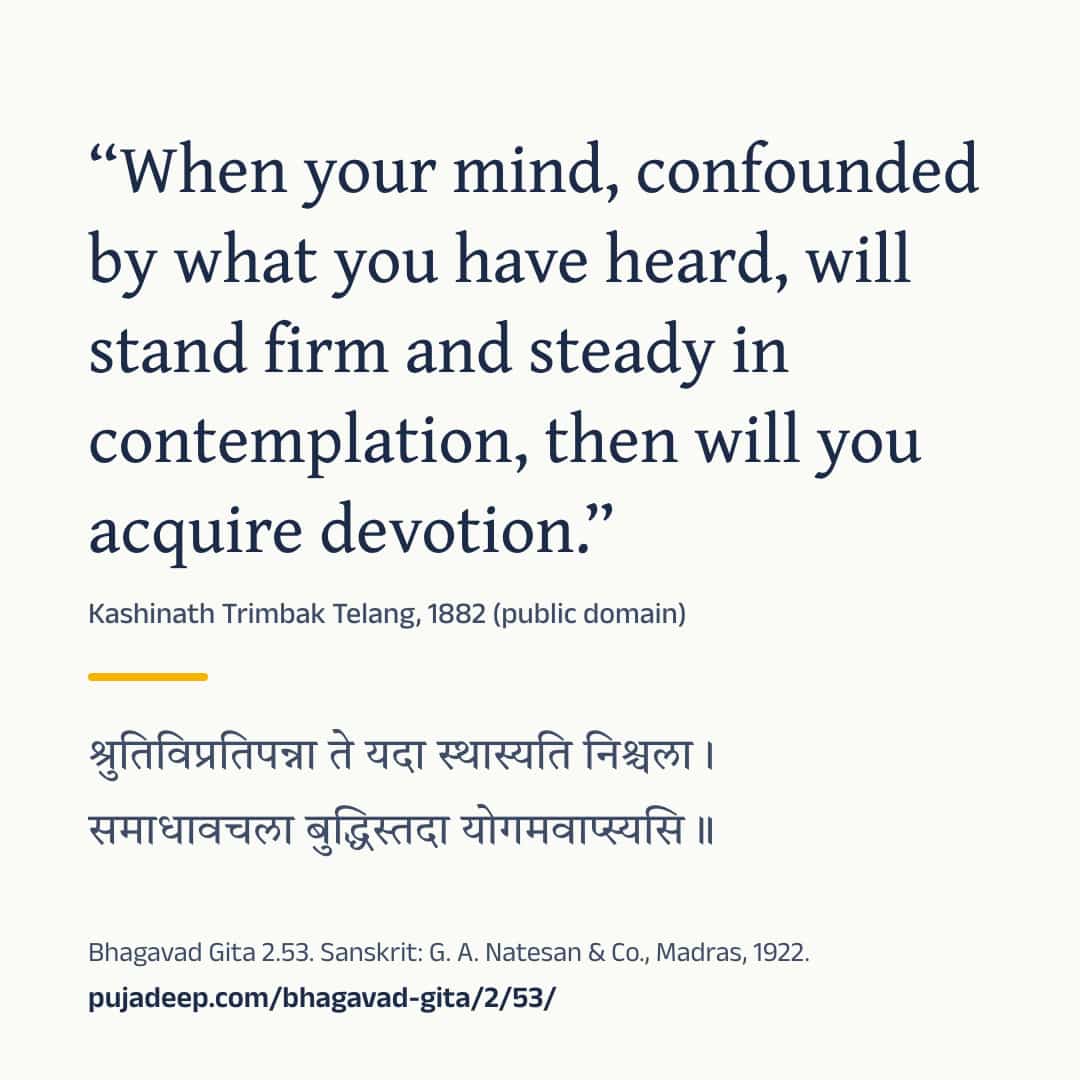
श्रुतिविप्रतिपन्ना ते यदा स्थास्यति निश्चला ।
समाधावचला बुद्धिस्तदा योगमवाप्स्यसि ॥

“When your mind, confounded by what you have heard, will stand firm and steady in contemplation, then will you acquire devotion.”
(Kashinath Trimbak Telang, 1882, public domain)

“When thy Buddhi, bewildered by the Shruti, shall stand immovable, fixed in contemplation, then shalt thou attain to Yoga.”
(Annie Besant, 1895, public domain)

“When thy intellect,—tossed about by the conflict of opinions—has become firmly established in the Self, then thou shalt attain Self-realisation.”
(Swami Swarupananda, 1909 (first printed 1907), public domain)

Sanskrit: G. A. Natesan & Co., Madras, 1922.
https://pujadeep.com/bhagavad-gita/2/53/?s=copy Nothing is sent from this site. Your own app sends it, to the chat you choose. The picture quotes Telang (1882). If you chose another translation above, the text quotes yours and no picture is offered.
Sanskrit text: The Bhagavad-Gita, or The Lord's Song, with the text in Devanagari and an English translation, 1922. Meanings: written for Pujadeep with AI help and reviewed. Source and changes
Questions families ask
Who speaks Bhagavad Gita 2.53?
Krishna speaks this verse, in chapter 2 (Sankhya Yoga).
Where does the Sanskrit text come from?
Sanskrit text: The Bhagavad-Gita, or The Lord's Song, with the text in Devanagari and an English translation, 1922. Meanings: written for Pujadeep with AI help and reviewed. See the source
Is the meaning on this page a translation?
Explanation written for this site with AI help from the sources listed here, and reviewed. It is not a translation and not the only way to read the text. Free to quote with credit.
Source and licence
- Sanskrit text
- The Bhagavad-Gita, or The Lord's Song, with the text in Devanagari and an English translation (Annie Besant, G. A. Natesan & Co., Madras, 1922). Public domain. The Sanskrit on these pages was read from this printing’s page images.
- Translation
- The Bhagavadgîtâ with the Sanatsugâtîya and the Anugîtâ, translated by Kâshinâth Trimbak Telang (The Sacred Books of the East, vol. VIII, ed. F. Max Müller) (Kashinath Trimbak Telang, F. Max Müller, Clarendon Press, Oxford, 1882). Public domain. Shown verbatim, as printed.
- Translation
- The Bhagavad Gîtâ, or The Lord's Song, translated by Annie Besant (Annie Besant, Theosophical Publishing Society, London, 1895). Public domain. Shown verbatim, as printed.
- Sanskrit text
- Srimad-Bhagavad-Gita, with Sanskrit Text; Paraphrase with Word-by-word Literal Translation; English Rendering and Comments, Index, &c., by the Swami Swarupananda (Himalayan Series, No. XX) (Swami Swarupananda, The Editors and Publishers, Advaita Ashrama, Mayavati, Prabuddha Bharata Press, Mayavati, Almora, Himalayas, 1909). Public domain. Used only to date the text. The Devanagari on this page is a reading text and is not copied from this printing.
- Common wording
- In this text, 32 words follow today's common wording, checked against sanskritdocuments.org; Sanskrit Wikisource; Gita Press, Gorakhpur; GRETIL, Göttingen and Bhaktivedanta Book Trust.
- Our explanation
- Explanation written for this site with AI help from the sources listed here, and reviewed. It is not a translation and not the only way to read the text. Free to quote with credit.
- Review
- AI review: 2 independent reviews against the cited edition, October 15, 2026.