Bhagavad Gita · Chapter 2: Sankhya Yoga · Speaker: Krishna
Bhagavad Gita 2.52: Yada te mohakalilam
When Arjuna's understanding crosses the swamp of confusion, Krishna says, he will become indifferent to all he has heard and all he has yet to hear.
Bhagavad Gita 2.52
यदा ते मोहकलिलं बुद्धिर्व्यतितरिष्यति ।तदा गन्तासि निर्वेदं श्रोतव्यस्य श्रुतस्य च ॥
Yada te mohakalilam buddhirvyatitarishyati
Tada gantasi nirvedam shrotavyasya shrutasya cha
yadā te mohakalilaṃ buddhirvyatitariṣyati |
tadā gantāsi nirvedaṃ śrotavyasya śrutasya ca ||
Our meaning When Arjuna's understanding crosses the swamp of confusion, Krishna says, he will become indifferent to all he has heard and all he has yet to hear.
हिंदी अर्थ कृष्ण कहते हैं कि जब अर्जुन की बुद्धि मोह के दलदल को पार कर लेगी, तब वे जो सुन चुके हैं और जो सुनना बाकी है, उन सबसे विरक्त हो जाएँगे।
Word by word
Every word, with its dictionary page
Word by word
- यदा yadā when (indeclinable) Dictionary: yadā, Monier-Williams 1899, p. 844, col. 1
when, at what time, whenever
- ते te your (pronoun, genitive singular) Dictionary: 2. tva, Monier-Williams 1899, p. 463, col. 2
base of the 2nd personal pron.
- मोहकलिलम् mohakalilam the thicket of delusion (compound (neuter), accusative singular) Dictionary: moha-kalila, Monier-Williams 1899, p. 836, col. 1
thicket or snare of illusion
- बुद्धिः buddhiḥ understanding (noun (feminine), nominative singular) Dictionary: buddhi, Monier-Williams 1899, p. 733, col. 3
intelligence, reason, intellect, mind, discernment, judgment
- व्यतितरिष्यति vyatitariṣyati will cross beyond (future, 3rd person singular) Dictionary: vy-ati-tṛ, Monier-Williams 1899, p. 1030, col. 1
to pass completely across, overcome
- तदा tadā then (indeclinable) Dictionary: tadā, Monier-Williams 1899, p. 434, col. 3
at that time, then, in that case
- गन्तासि gantāsi you will come to (periphrastic future, 2nd person singular) Dictionary: 1. gam, Monier-Williams 1899, p. 347, col. 1
to go to any state or condition, undergo
- निर्वेदम् nirvedam indifference (noun (masculine), accusative singular) Dictionary: nir-veda, Monier-Williams 1899, p. 557, col. 3
complete indifference, disregard of worldly objects
- श्रोतव्यस्य śrotavyasya to what is yet to be heard (gerundive (to be done) (neuter), genitive singular) Dictionary: śrotavya, Monier-Williams 1899, p. 1103, col. 1
to be heard or listened to, audible, worth hearing
- श्रुतस्य śrutasya to what has been heard (past participle (neuter), genitive singular) Dictionary: śruta, Monier-Williams 1899, p. 1101, col. 1
heard, listened to, heard about or of, taught
- च ca and (indeclinable) Dictionary: 2. ca, Monier-Williams 1899, p. 380, col. 1
ind. and, both, also, moreover, as well as
Public-domain translations
Kashinath Trimbak Telang, 1882. Public domain. Page 49.
When your mind shall have crossed beyond the taint of delusion, then will you become indifferent to all that you have heard or will hear1.
Footnotes (the translator’s own) - This, according to Ânandagiri, means all writings other than those on the science of the soul. ↩
Compare 3 translations
Kashinath Trimbak Telang, 1882. Public domain. Page 49.
When your mind shall have crossed beyond the taint of delusion, then will you become indifferent to all that you have heard or will hear1.
Footnotes (the translator’s own) - This, according to Ânandagiri, means all writings other than those on the science of the soul. ↩
You are reading this one
Annie Besant, 1895. Public domain. Page 34.
When thy Buddhi shall pass beyond this mass of delusion, then thou shalt rise to indifference as to what has been heard and shall be heard.
You are reading this one
Swami Swarupananda, 1909 (first printed 1907). Public domain. Page 52.
When thy intellect crosses beyond the taint of illusion, then shalt thou attain to indifference, regarding things heard and yet to be heard.
You are reading this one
Share
Send one picture or the text to one chat. The picture names its source and the address of this page.
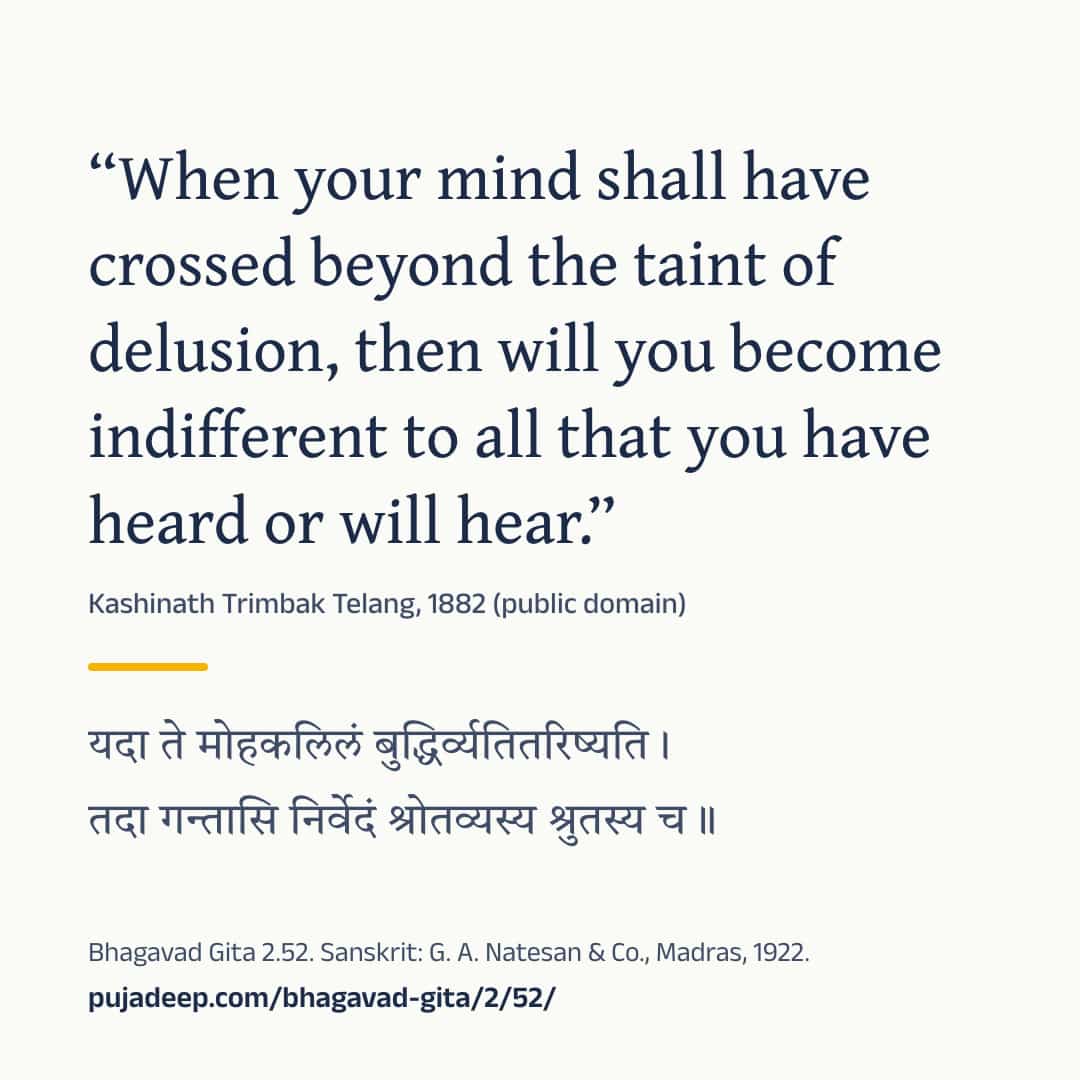
Send as text
The words and the link only. Many elders prefer this.
Bhagavad Gita 2.52

यदा ते मोहकलिलं बुद्धिर्व्यतितरिष्यति ।
तदा गन्तासि निर्वेदं श्रोतव्यस्य श्रुतस्य च ॥

“When your mind shall have crossed beyond the taint of delusion, then will you become indifferent to all that you have heard or will hear.”
(Kashinath Trimbak Telang, 1882, public domain)

“When thy Buddhi shall pass beyond this mass of delusion, then thou shalt rise to indifference as to what has been heard and shall be heard.”
(Annie Besant, 1895, public domain)

“When thy intellect crosses beyond the taint of illusion, then shalt thou attain to indifference, regarding things heard and yet to be heard.”
(Swami Swarupananda, 1909 (first printed 1907), public domain)

Sanskrit: G. A. Natesan & Co., Madras, 1922.
https://pujadeep.com/bhagavad-gita/2/52/?s=copy Nothing is sent from this site. Your own app sends it, to the chat you choose. The picture quotes Telang (1882). If you chose another translation above, the text quotes yours and no picture is offered.
Sanskrit text: The Bhagavad-Gita, or The Lord's Song, with the text in Devanagari and an English translation, 1922. Meanings: written for Pujadeep with AI help and reviewed. Source and changes
Questions families ask
Who speaks Bhagavad Gita 2.52?
Krishna speaks this verse, in chapter 2 (Sankhya Yoga).
Where does the Sanskrit text come from?
Sanskrit text: The Bhagavad-Gita, or The Lord's Song, with the text in Devanagari and an English translation, 1922. Meanings: written for Pujadeep with AI help and reviewed. See the source
Is the meaning on this page a translation?
Explanation written for this site with AI help from the sources listed here, and reviewed. It is not a translation and not the only way to read the text. Free to quote with credit.
Source and licence
- Sanskrit text
- The Bhagavad-Gita, or The Lord's Song, with the text in Devanagari and an English translation (Annie Besant, G. A. Natesan & Co., Madras, 1922). Public domain. The Sanskrit on these pages was read from this printing’s page images.
- Translation
- The Bhagavadgîtâ with the Sanatsugâtîya and the Anugîtâ, translated by Kâshinâth Trimbak Telang (The Sacred Books of the East, vol. VIII, ed. F. Max Müller) (Kashinath Trimbak Telang, F. Max Müller, Clarendon Press, Oxford, 1882). Public domain. Shown verbatim, as printed.
- Translation
- The Bhagavad Gîtâ, or The Lord's Song, translated by Annie Besant (Annie Besant, Theosophical Publishing Society, London, 1895). Public domain. Shown verbatim, as printed.
- Sanskrit text
- Srimad-Bhagavad-Gita, with Sanskrit Text; Paraphrase with Word-by-word Literal Translation; English Rendering and Comments, Index, &c., by the Swami Swarupananda (Himalayan Series, No. XX) (Swami Swarupananda, The Editors and Publishers, Advaita Ashrama, Mayavati, Prabuddha Bharata Press, Mayavati, Almora, Himalayas, 1909). Public domain. Used only to date the text. The Devanagari on this page is a reading text and is not copied from this printing.
- Common wording
- In this text, 32 words follow today's common wording, checked against sanskritdocuments.org; Sanskrit Wikisource; Gita Press, Gorakhpur; GRETIL, Göttingen and Bhaktivedanta Book Trust.
- Our explanation
- Explanation written for this site with AI help from the sources listed here, and reviewed. It is not a translation and not the only way to read the text. Free to quote with credit.
- Review
- AI review: 2 independent reviews against the cited edition, October 15, 2026.