Bhagavad Gita · Chapter 2: Sankhya Yoga · Speaker: Krishna
Bhagavad Gita 2.51: Karmajam buddhiyukta hi phalam
Krishna says that the wise who have this understanding give up the fruit that action produces.
Bhagavad Gita 2.51
कर्मजं बुद्धियुक्ता हि फलं त्यक्त्वा मनीषिणः ।जन्मबन्धविनिर्मुक्ताः पदं गच्छन्त्यनामयम् ॥
Karmajam buddhiyukta hi phalam tyaktva manishinah
Janmabandhavinirmuktah padam gachchhantyanamayam
karmajaṃ buddhiyuktā hi phalaṃ tyaktvā manīṣiṇaḥ |
janmabandhavinirmuktāḥ padaṃ gacchantyanāmayam ||
Our meaning Krishna says that the wise who have this understanding give up the fruit that action produces. Freed from the bond of rebirth, they reach the state where there is no suffering.
हिंदी अर्थ कृष्ण कहते हैं कि बुद्धि से युक्त ज्ञानी कर्म से पैदा होने वाले फल को छोड़ देते हैं। जन्म के बंधन से मुक्त होकर वे उस पद को पाते हैं जहाँ कोई दुःख नहीं है।
Word by word
Every word, with its dictionary page
Word by word
- कर्मजम् karmajam born of action (compound (neuter), accusative singular) Dictionary: karma-ja, Monier-Williams 1899, p. 258, col. 3
resulting or produced from any act (good or bad)
- बुद्धियुक्ताः buddhiyuktāḥ joined to understanding (compound (masculine), nominative plural) Dictionary: buddhi, Monier-Williams 1899, p. 733, col. 3
intelligence, reason, intellect, mind, discernment, judgment
; yukta, Monier-Williams 1899, p. 853, col. 2yoked or joined or fastened or attached or harnessed
- हि hi for (indeclinable) Dictionary: 2. hi, Monier-Williams 1899, p. 1297, col. 3
for, because, on account of
- फलम् phalam fruit (noun (neuter), accusative singular) Dictionary: phala, Monier-Williams 1899, p. 716, col. 2
fruit (esp. of trees)
- त्यक्त्वा tyaktvā having given up (absolutive (having done)) Dictionary: 1. tyaj, Monier-Williams 1899, p. 456, col. 3
to leave, abandon, quit
- मनीषिणः manīṣiṇaḥ the wise (noun (masculine), nominative plural) Dictionary: manīṣin, Monier-Williams 1899, p. 784, col. 2
thoughtful, intelligent, wise, sage, prudent
- जन्मबन्धविनिर्मुक्ताः janmabandhavinirmuktāḥ freed from the bond of birth (compound (masculine), nominative plural) Dictionary: janman, Monier-Williams 1899, p. 411, col. 3
birth, production
; bandha, Monier-Williams 1899, p. 720, col. 3binding, tying, a bond, tie, chain, fetter
; vi-nirmukta, Monier-Williams 1899, p. 971, col. 1liberated, escaped, free or exempt from
- पदम् padam state, place (noun (neuter), accusative singular) Dictionary: pada, Monier-Williams 1899, p. 583, col. 1
a step, pace, stride
- गच्छन्ति gacchanti go to, reach (present, 3rd person plural) Dictionary: 1. gam, Monier-Williams 1899, p. 347, col. 1
to go to any state or condition, undergo
- अनामयम् anāmayam free from ill, sorrowless (adjective (neuter), accusative singular) Dictionary: an-āmaya, Monier-Williams 1899, p. 28, col. 2
free from disease, healthy, salubrious
Public-domain translations
Kashinath Trimbak Telang, 1882. Public domain. Page 49.
The wise who have obtained devotion cast off the fruit of action; and released from the shackles of (repeated) births1, repair to that seat where there is no unhappiness2.
Footnotes (the translator’s own) Compare 3 translations
Kashinath Trimbak Telang, 1882. Public domain. Page 49.
The wise who have obtained devotion cast off the fruit of action; and released from the shackles of (repeated) births1, repair to that seat where there is no unhappiness2.
Footnotes (the translator’s own) You are reading this one
Annie Besant, 1895. Public domain. Page 34.
The Sages, united to Buddhi, renounce the fruit which action yieldeth, and liberated from the bonds of birth, they go to the blissful Seat.
You are reading this one
Swami Swarupananda, 1909 (first printed 1907). Public domain. Page 52.
The wise, possessed of this evenness of mind, abandoning the fruits of their actions, freed forever from the fetters of birth, go to that state which is beyond all evil.
You are reading this one
Share
Send one picture or the text to one chat. The picture names its source and the address of this page.
Send as text
The words and the link only. Many elders prefer this.
Bhagavad Gita 2.51

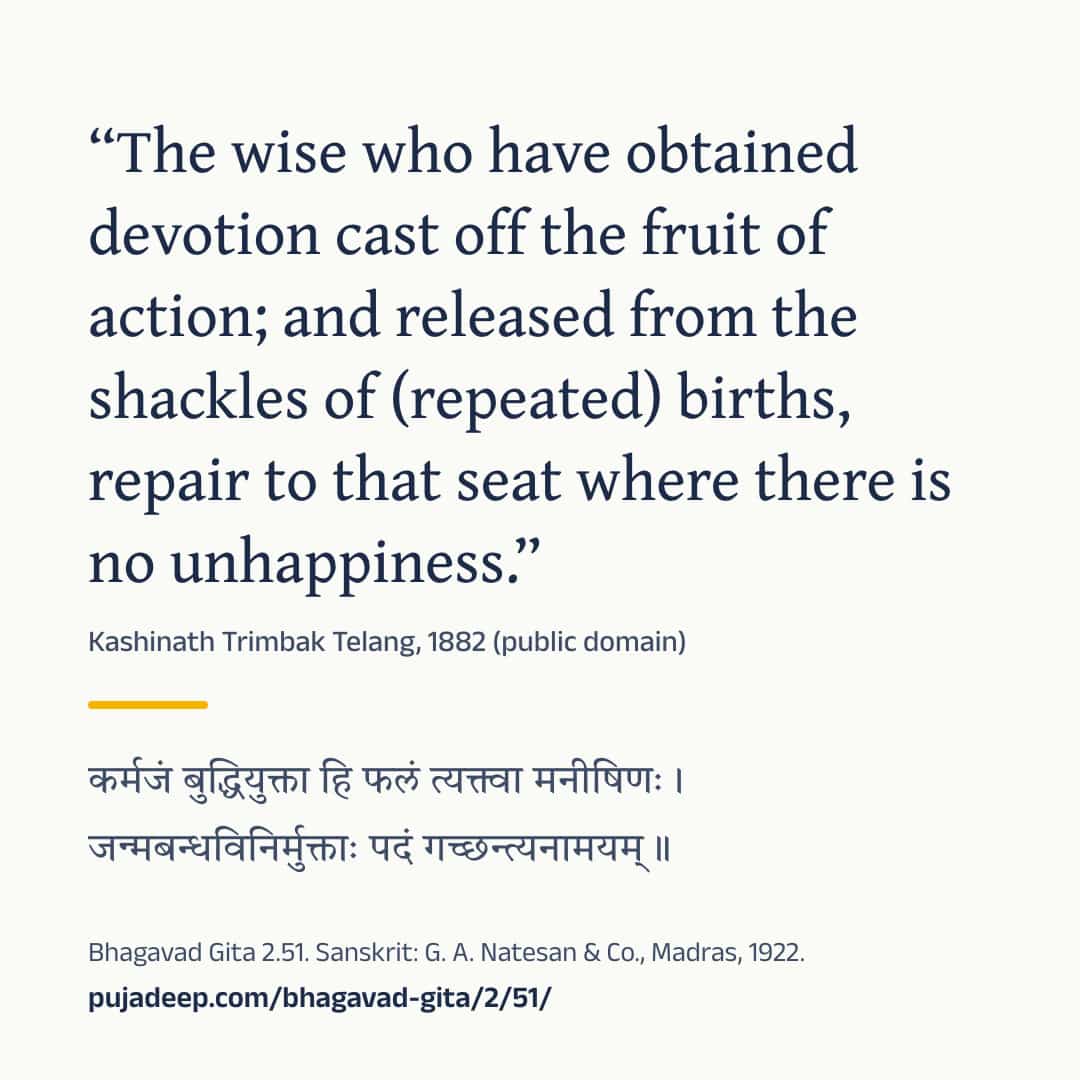
कर्मजं बुद्धियुक्ता हि फलं त्यक्त्वा मनीषिणः ।
जन्मबन्धविनिर्मुक्ताः पदं गच्छन्त्यनामयम् ॥

“The wise who have obtained devotion cast off the fruit of action; and released from the shackles of (repeated) births, repair to that seat where there is no unhappiness.”
(Kashinath Trimbak Telang, 1882, public domain)

“The Sages, united to Buddhi, renounce the fruit which action yieldeth, and liberated from the bonds of birth, they go to the blissful Seat.”
(Annie Besant, 1895, public domain)

“The wise, possessed of this evenness of mind, abandoning the fruits of their actions, freed forever from the fetters of birth, go to that state which is beyond all evil.”
(Swami Swarupananda, 1909 (first printed 1907), public domain)

Sanskrit: G. A. Natesan & Co., Madras, 1922.
https://pujadeep.com/bhagavad-gita/2/51/?s=copy Nothing is sent from this site. Your own app sends it, to the chat you choose. The picture quotes Telang (1882). If you chose another translation above, the text quotes yours and no picture is offered.
Sanskrit text: The Bhagavad-Gita, or The Lord's Song, with the text in Devanagari and an English translation, 1922. Meanings: written for Pujadeep with AI help and reviewed. Source and changes
Questions families ask
Who speaks Bhagavad Gita 2.51?
Krishna speaks this verse, in chapter 2 (Sankhya Yoga).
Where does the Sanskrit text come from?
Sanskrit text: The Bhagavad-Gita, or The Lord's Song, with the text in Devanagari and an English translation, 1922. Meanings: written for Pujadeep with AI help and reviewed. See the source
Is the meaning on this page a translation?
Explanation written for this site with AI help from the sources listed here, and reviewed. It is not a translation and not the only way to read the text. Free to quote with credit.
Source and licence
- Sanskrit text
- The Bhagavad-Gita, or The Lord's Song, with the text in Devanagari and an English translation (Annie Besant, G. A. Natesan & Co., Madras, 1922). Public domain. The Sanskrit on these pages was read from this printing’s page images.
- Translation
- The Bhagavadgîtâ with the Sanatsugâtîya and the Anugîtâ, translated by Kâshinâth Trimbak Telang (The Sacred Books of the East, vol. VIII, ed. F. Max Müller) (Kashinath Trimbak Telang, F. Max Müller, Clarendon Press, Oxford, 1882). Public domain. Shown verbatim, as printed.
- Translation
- The Bhagavad Gîtâ, or The Lord's Song, translated by Annie Besant (Annie Besant, Theosophical Publishing Society, London, 1895). Public domain. Shown verbatim, as printed.
- Sanskrit text
- Srimad-Bhagavad-Gita, with Sanskrit Text; Paraphrase with Word-by-word Literal Translation; English Rendering and Comments, Index, &c., by the Swami Swarupananda (Himalayan Series, No. XX) (Swami Swarupananda, The Editors and Publishers, Advaita Ashrama, Mayavati, Prabuddha Bharata Press, Mayavati, Almora, Himalayas, 1909). Public domain. Used only to date the text. The Devanagari on this page is a reading text and is not copied from this printing.
- Common wording
- In this text, 32 words follow today's common wording, checked against sanskritdocuments.org; Sanskrit Wikisource; Gita Press, Gorakhpur; GRETIL, Göttingen and Bhaktivedanta Book Trust.
- Our explanation
- Explanation written for this site with AI help from the sources listed here, and reviewed. It is not a translation and not the only way to read the text. Free to quote with credit.
- Review
- AI review: 2 independent reviews against the cited edition, October 15, 2026.