Bhagavad Gita · Chapter 2: Sankhya Yoga · Speaker: Krishna
Bhagavad Gita 2.50: Buddhiyukto jahatiha ubhe
Krishna says that a person joined to this understanding leaves behind both good deeds and bad deeds, here in this world.
Bhagavad Gita 2.50
बुद्धियुक्तो जहातीह उभे सुकृतदुष्कृते ।तस्माद्योगाय युज्यस्व योगः कर्मसु कौशलम् ॥
Buddhiyukto jahatiha ubhe sukritadushkrite
Tasmadyogaya yujyasva yogah karmasu kaushalam
buddhiyukto jahātīha ubhe sukṛtaduṣkṛte |
tasmādyogāya yujyasva yogaḥ karmasu kauśalam ||
Our meaning Krishna says that a person joined to this understanding leaves behind both good deeds and bad deeds, here in this world. So he urges Arjuna to devote himself to yoga, and says that yoga is skill in action.
हिंदी अर्थ कृष्ण कहते हैं कि इस बुद्धि से युक्त व्यक्ति यहीं, इसी संसार में, अच्छे और बुरे दोनों कर्मों को छोड़ देता है। इसलिए वे अर्जुन से योग में लगने को कहते हैं, और बताते हैं कि कर्मों में कुशलता ही योग है।
Word by word
Every word, with its dictionary page
Word by word
- बुद्धियुक्तः buddhiyuktaḥ joined to understanding (compound (masculine), nominative singular) Dictionary: buddhi, Monier-Williams 1899, p. 733, col. 3
intelligence, reason, intellect, mind, discernment, judgment
; yukta, Monier-Williams 1899, p. 853, col. 2yoked or joined or fastened or attached or harnessed
- जहाति jahāti leaves behind (present, 3rd person singular) Dictionary: 3. hā, Monier-Williams 1899, p. 1296, col. 2
to leave, abandon, desert, quit, forsake, relinquish
- इह iha here, in this life (indeclinable) Dictionary: iha, Monier-Williams 1899, p. 169, col. 3
in this place, here
- उभे ubhe both (pronoun (neuter), accusative dual) Dictionary: ubha, Monier-Williams 1899, p. 216, col. 2
both
- सुकृतदुष्कृते sukṛtaduṣkṛte good and bad deeds (compound (neuter), accusative dual) Dictionary: su-kṛta, Monier-Williams 1899, p. 1220, col. 2
a good or righteous deed, meritorious act, virtue, moral merit
; duṣ-kṛta, Monier-Williams 1899, p. 487, col. 3evil action, sin, guilt
- तस्मात् tasmāt therefore (indeclinable) Dictionary: tasmāt, Monier-Williams 1899, p. 441, col. 2
from that, on that account, therefore
- योगाय yogāya to yoga (noun (masculine), dative singular) Dictionary: yoga, Monier-Williams 1899, p. 856, col. 2
the act of yoking, joining, attaching
- युज्यस्व yujyasva apply yourself (imperative (middle), 2nd person singular) Dictionary: 1. yuj, Monier-Williams 1899, p. 853, col. 2
to yoke or join or fasten or harness
- योगः yogaḥ yoga (noun (masculine), nominative singular) Dictionary: yoga, Monier-Williams 1899, p. 856, col. 2
the act of yoking, joining, attaching
- कर्मसु karmasu in actions (noun (neuter), locative plural) Dictionary: karman, Monier-Williams 1899, p. 258, col. 2
act, action, performance, business
- कौशलम् kauśalam skill (noun (neuter), nominative singular) Dictionary: kauśala, Monier-Williams 1899, p. 317, col. 3
skilfulness, cleverness, experience
Public-domain translations
Kashinath Trimbak Telang, 1882. Public domain. Page 49.
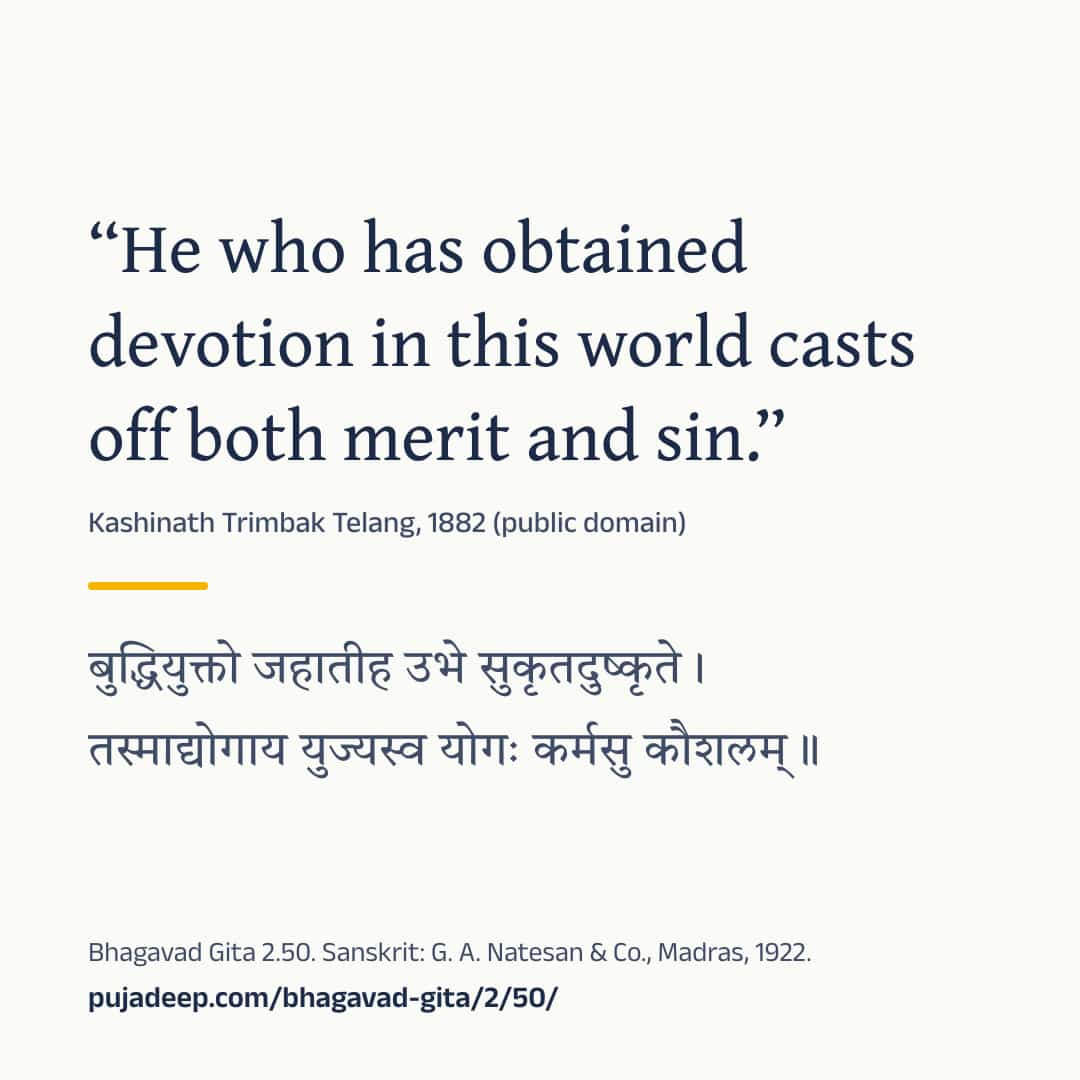
He who has obtained devotion in this world casts off both merit and sin1. Therefore apply yourself to devotion; devotion in (all) actions is wisdom.
Footnotes (the translator’s own) - Merit merely leads to heaven, as to which see note on last page. Cf. Sutta Nipâta, pp. 4, 136, 145 note. ↩
Compare 3 translations
Kashinath Trimbak Telang, 1882. Public domain. Page 49.
He who has obtained devotion in this world casts off both merit and sin1. Therefore apply yourself to devotion; devotion in (all) actions is wisdom.
Footnotes (the translator’s own) - Merit merely leads to heaven, as to which see note on last page. Cf. Sutta Nipâta, pp. 4, 136, 145 note. ↩
You are reading this one
Annie Besant, 1895. Public domain. Page 34.
United to Buddhi, one abandoneth here both good and evil deeds, therefore cleave thou to Yoga; Yoga is wisdom in action.
You are reading this one
Swami Swarupananda, 1909 (first printed 1907). Public domain. Page 51.
Endued with this evenness of mind, one frees oneself in this life, alike from vice and virtue. Devote thyself, therefore, to this Yoga. It is the very dexterity of work.
You are reading this one
Share
Send one picture or the text to one chat. The picture names its source and the address of this page.
Send as text
The words and the link only. Many elders prefer this.
Bhagavad Gita 2.50

बुद्धियुक्तो जहातीह उभे सुकृतदुष्कृते ।
तस्माद्योगाय युज्यस्व योगः कर्मसु कौशलम् ॥

“He who has obtained devotion in this world casts off both merit and sin. Therefore apply yourself to devotion; devotion in (all) actions is wisdom.”
(Kashinath Trimbak Telang, 1882, public domain)

“United to Buddhi, one abandoneth here both good and evil deeds, therefore cleave thou to Yoga; Yoga is wisdom in action.”
(Annie Besant, 1895, public domain)

“Endued with this evenness of mind, one frees oneself in this life, alike from vice and virtue. Devote thyself, therefore, to this Yoga. It is the very dexterity of work.”
(Swami Swarupananda, 1909 (first printed 1907), public domain)

Sanskrit: G. A. Natesan & Co., Madras, 1922.
https://pujadeep.com/bhagavad-gita/2/50/?s=copy Nothing is sent from this site. Your own app sends it, to the chat you choose. The picture quotes Telang (1882). If you chose another translation above, the text quotes yours and no picture is offered.
Sanskrit text: The Bhagavad-Gita, or The Lord's Song, with the text in Devanagari and an English translation, 1922. Meanings: written for Pujadeep with AI help and reviewed. Source and changes
Questions families ask
Who speaks Bhagavad Gita 2.50?
Krishna speaks this verse, in chapter 2 (Sankhya Yoga).
Where does the Sanskrit text come from?
Sanskrit text: The Bhagavad-Gita, or The Lord's Song, with the text in Devanagari and an English translation, 1922. Meanings: written for Pujadeep with AI help and reviewed. See the source
Is the meaning on this page a translation?
Explanation written for this site with AI help from the sources listed here, and reviewed. It is not a translation and not the only way to read the text. Free to quote with credit.
Source and licence
- Sanskrit text
- The Bhagavad-Gita, or The Lord's Song, with the text in Devanagari and an English translation (Annie Besant, G. A. Natesan & Co., Madras, 1922). Public domain. The Sanskrit on these pages was read from this printing’s page images.
- Translation
- The Bhagavadgîtâ with the Sanatsugâtîya and the Anugîtâ, translated by Kâshinâth Trimbak Telang (The Sacred Books of the East, vol. VIII, ed. F. Max Müller) (Kashinath Trimbak Telang, F. Max Müller, Clarendon Press, Oxford, 1882). Public domain. Shown verbatim, as printed.
- Translation
- The Bhagavad Gîtâ, or The Lord's Song, translated by Annie Besant (Annie Besant, Theosophical Publishing Society, London, 1895). Public domain. Shown verbatim, as printed.
- Sanskrit text
- Srimad-Bhagavad-Gita, with Sanskrit Text; Paraphrase with Word-by-word Literal Translation; English Rendering and Comments, Index, &c., by the Swami Swarupananda (Himalayan Series, No. XX) (Swami Swarupananda, The Editors and Publishers, Advaita Ashrama, Mayavati, Prabuddha Bharata Press, Mayavati, Almora, Himalayas, 1909). Public domain. Used only to date the text. The Devanagari on this page is a reading text and is not copied from this printing.
- Common wording
- In this text, 32 words follow today's common wording, checked against sanskritdocuments.org; Sanskrit Wikisource; Gita Press, Gorakhpur; GRETIL, Göttingen and Bhaktivedanta Book Trust.
- Our explanation
- Explanation written for this site with AI help from the sources listed here, and reviewed. It is not a translation and not the only way to read the text. Free to quote with credit.
- Review
- AI review: 2 independent reviews against the cited edition, October 15, 2026.