Bhagavad Gita · Chapter 2: Sankhya Yoga · Speaker: Krishna
Bhagavad Gita 2.49: Durena hyavaram karma
Krishna says that action done for its rewards is far lower than buddhi-yoga, the discipline of understanding.
Bhagavad Gita 2.49
दूरेण ह्यवरं कर्म बुद्धियोगाद्धनञ्जय ।बुद्धौ शरणमन्विच्छ कृपणाः फलहेतवः ॥
Durena hyavaram karma buddhiyogaddhananjaya
Buddhau sharanamanvichchha kripanah phalahetavah
dūreṇa hyavaraṃ karma buddhiyogāddhanañjaya |
buddhau śaraṇamanviccha kṛpaṇāḥ phalahetavaḥ ||
Our meaning Krishna says that action done for its rewards is far lower than buddhi-yoga, the discipline of understanding. He asks Arjuna to take refuge in that understanding. People who act only for results, he says, are to be pitied.
हिंदी अर्थ कृष्ण कहते हैं कि फल के लिए किया गया कर्म बुद्धियोग (समझ के अनुशासन) से बहुत नीचा है। वे अर्जुन से बुद्धि की शरण लेने को कहते हैं। वे कहते हैं कि जो केवल फल के लिए कर्म करते हैं, वे दया के पात्र हैं।
Word by word
Every word, with its dictionary page
Word by word
- दूरेण dūreṇa by far (adverb (instrumental)) Dictionary: dūra, Monier-Williams 1899, p. 489, col. 2
distant, far, remote
- हि hi for (indeclinable) Dictionary: 2. hi, Monier-Williams 1899, p. 1297, col. 3
for, because, on account of
- अवरम् avaram lower, inferior (adjective (neuter), nominative singular) Dictionary: avara, Monier-Williams 1899, p. 102, col. 2
low, mean, unimportant, of small value
- कर्म karma action (noun (neuter), nominative singular) Dictionary: karman, Monier-Williams 1899, p. 258, col. 2
act, action, performance, business
- बुद्धियोगात् buddhiyogāt than the yoga of understanding (compound (masculine), ablative singular) Dictionary: buddhi-yoga, Monier-Williams 1899, p. 734, col. 1
devotion of the intellect, intellectual union with the Supreme Spirit
- धनञ्जय dhanañjaya O Dhananjaya (Arjuna) (noun (masculine), vocative singular) Dictionary: dhanaṃ-jaya, Monier-Williams 1899, p. 508, col. 2
N. of Arjuna
- बुद्धौ buddhau in understanding (noun (feminine), locative singular) Dictionary: buddhi, Monier-Williams 1899, p. 733, col. 3
intelligence, reason, intellect, mind, discernment, judgment
- शरणम् śaraṇam refuge (noun (neuter), accusative singular) Dictionary: 2. śaraṇa, Monier-Williams 1899, p. 1057, col. 1
protecting, guarding, defending
- अन्विच्छ anviccha seek (imperative, 2nd person singular) Dictionary: anv-iṣ, Monier-Williams 1899, p. 47, col. 2
to desire, seek, seek after, search, aim at
- कृपणाः kṛpaṇāḥ pitiable, wretched (adjective (masculine), nominative plural) Dictionary: 1. kṛpaṇa, Monier-Williams 1899, p. 305, col. 1
inclined to grieve, pitiable, miserable, poor, wretched, feeble
- फलहेतवः phalahetavaḥ those who act for the fruit (compound (masculine), nominative plural) Dictionary: phala, Monier-Williams 1899, p. 716, col. 2
fruit (esp. of trees)
; hetu, Monier-Williams 1899, p. 1303, col. 3motive, cause, cause of, reason for
Public-domain translations
Kashinath Trimbak Telang, 1882. Public domain. Page 49.
Action, O Dhanañgaya! is far inferior to the devotion of the mind. In that devotion seek shelter. Wretched are those whose motive (to action) is the fruit (of action).
Compare 3 translations
Kashinath Trimbak Telang, 1882. Public domain. Page 49.
Action, O Dhanañgaya! is far inferior to the devotion of the mind. In that devotion seek shelter. Wretched are those whose motive (to action) is the fruit (of action).
You are reading this one
Annie Besant, 1895. Public domain. Page 34.
Far lower than Buddhi-Yoga1 is action, O Dhananjaya. Take thou refuge in Buddhi; pitiable are they who work for fruit.
Footnotes (the translator’s own) - Union with Buddhi; the innermost sheath (or vehicle) of Âtmâ. ↩
You are reading this one
Swami Swarupananda, 1909 (first printed 1907). Public domain. Page 51.
Work (with desire) is verily far inferior to that performed with the mind undisturbed by thoughts of results. O Dhananjaya, seek refuge in this evenness of mind. Wretched are they who act for results.
You are reading this one
Share
Send one picture or the text to one chat. The picture names its source and the address of this page.
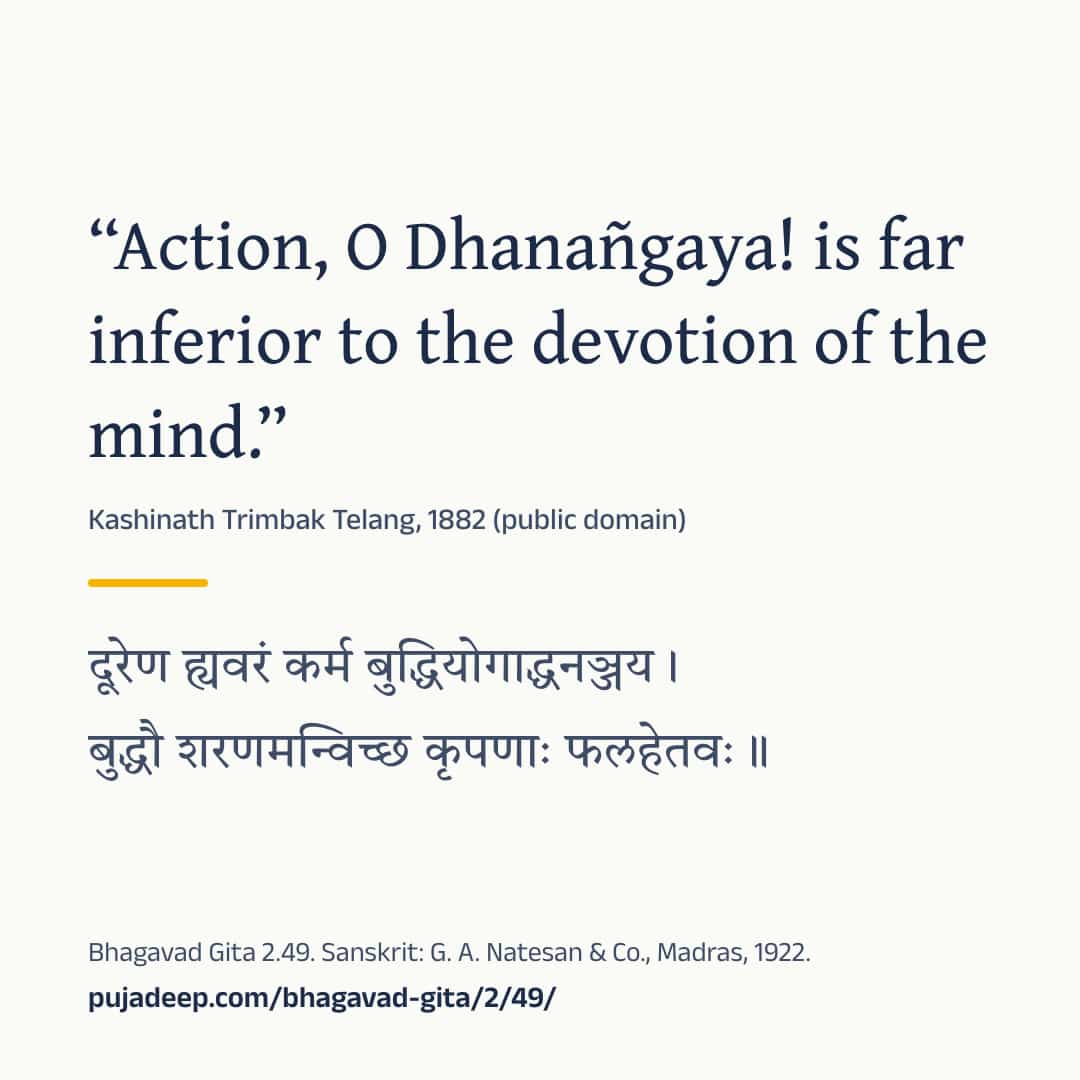
Send as text
The words and the link only. Many elders prefer this.
Bhagavad Gita 2.49

दूरेण ह्यवरं कर्म बुद्धियोगाद्धनञ्जय ।
बुद्धौ शरणमन्विच्छ कृपणाः फलहेतवः ॥

“Action, O Dhanañgaya! is far inferior to the devotion of the mind. In that devotion seek shelter. Wretched are those whose motive (to action) is the fruit (of action).”
(Kashinath Trimbak Telang, 1882, public domain)

“Far lower than Buddhi-Yoga is action, O Dhananjaya. Take thou refuge in Buddhi; pitiable are they who work for fruit.”
(Annie Besant, 1895, public domain)

“Work (with desire) is verily far inferior to that performed with the mind undisturbed by thoughts of results. O Dhananjaya, seek refuge in this evenness of mind. Wretched are they who act for results.”
(Swami Swarupananda, 1909 (first printed 1907), public domain)

Sanskrit: G. A. Natesan & Co., Madras, 1922.
https://pujadeep.com/bhagavad-gita/2/49/?s=copy Nothing is sent from this site. Your own app sends it, to the chat you choose. The picture quotes Telang (1882). If you chose another translation above, the text quotes yours and no picture is offered.
Sanskrit text: The Bhagavad-Gita, or The Lord's Song, with the text in Devanagari and an English translation, 1922. Meanings: written for Pujadeep with AI help and reviewed. Source and changes
Questions families ask
Who speaks Bhagavad Gita 2.49?
Krishna speaks this verse, in chapter 2 (Sankhya Yoga).
Where does the Sanskrit text come from?
Sanskrit text: The Bhagavad-Gita, or The Lord's Song, with the text in Devanagari and an English translation, 1922. Meanings: written for Pujadeep with AI help and reviewed. See the source
Is the meaning on this page a translation?
Explanation written for this site with AI help from the sources listed here, and reviewed. It is not a translation and not the only way to read the text. Free to quote with credit.
Source and licence
- Sanskrit text
- The Bhagavad-Gita, or The Lord's Song, with the text in Devanagari and an English translation (Annie Besant, G. A. Natesan & Co., Madras, 1922). Public domain. The Sanskrit on these pages was read from this printing’s page images.
- Translation
- The Bhagavadgîtâ with the Sanatsugâtîya and the Anugîtâ, translated by Kâshinâth Trimbak Telang (The Sacred Books of the East, vol. VIII, ed. F. Max Müller) (Kashinath Trimbak Telang, F. Max Müller, Clarendon Press, Oxford, 1882). Public domain. Shown verbatim, as printed.
- Translation
- The Bhagavad Gîtâ, or The Lord's Song, translated by Annie Besant (Annie Besant, Theosophical Publishing Society, London, 1895). Public domain. Shown verbatim, as printed.
- Sanskrit text
- Srimad-Bhagavad-Gita, with Sanskrit Text; Paraphrase with Word-by-word Literal Translation; English Rendering and Comments, Index, &c., by the Swami Swarupananda (Himalayan Series, No. XX) (Swami Swarupananda, The Editors and Publishers, Advaita Ashrama, Mayavati, Prabuddha Bharata Press, Mayavati, Almora, Himalayas, 1909). Public domain. Used only to date the text. The Devanagari on this page is a reading text and is not copied from this printing.
- Common wording
- In this text, 32 words follow today's common wording, checked against sanskritdocuments.org; Sanskrit Wikisource; Gita Press, Gorakhpur; GRETIL, Göttingen and Bhaktivedanta Book Trust.
- Our explanation
- Explanation written for this site with AI help from the sources listed here, and reviewed. It is not a translation and not the only way to read the text. Free to quote with credit.
- Review
- AI review: 2 independent reviews against the cited edition, October 15, 2026.