Bhagavad Gita · Chapter 2: Sankhya Yoga · Speaker: Krishna
Bhagavad Gita 2.48: Yogasthah kuru karmani sangam
Krishna tells Arjuna to act while established in yoga: to let go of attachment and to stay the same in success and failure.
Bhagavad Gita 2.48
योगस्थः कुरु कर्माणि सङ्गं त्यक्त्वा धनञ्जय ।सिद्ध्यसिद्ध्योः समो भूत्वा समत्वं योग उच्यते ॥
Yogasthah kuru karmani sangam tyaktva dhananjaya
Siddhyasiddhyoh samo bhutva samatvam yoga uchyate
yogasthaḥ kuru karmāṇi saṅgaṃ tyaktvā dhanañjaya |
siddhyasiddhyoḥ samo bhūtvā samatvaṃ yoga ucyate ||
Our meaning Krishna tells Arjuna to act while established in yoga: to let go of attachment and to stay the same in success and failure. This evenness of mind, he says, is what yoga means.
हिंदी अर्थ कृष्ण अर्जुन से कहते हैं कि वे योग में स्थित होकर, आसक्ति छोड़कर, सफलता और असफलता में समान रहकर कर्म करें। यह समता ही योग कहलाती है।
Word by word
Every word, with its dictionary page
Word by word
- योगस्थः yogasthaḥ steady in yoga (compound (masculine), nominative singular) Dictionary: yoga-stha, Monier-Williams 1899, p. 857, col. 2
absorbed in Y°
- कुरु kuru do (imperative, 2nd person singular) Dictionary: 1. kṛ, Monier-Williams 1899, p. 301, col. 1
to do, make, perform, accomplish, cause, effect, prepare
- कर्माणि karmāṇi actions (noun (neuter), accusative plural) Dictionary: karman, Monier-Williams 1899, p. 258, col. 2
act, action, performance, business
- सङ्गम् saṅgam attachment (noun (masculine), accusative singular) Dictionary: saṅga, Monier-Williams 1899, p. 1132, col. 3
addiction or devotion to, propensity for
- त्यक्त्वा tyaktvā having given up (absolutive (having done)) Dictionary: 1. tyaj, Monier-Williams 1899, p. 456, col. 3
to leave, abandon, quit
- धनञ्जय dhanañjaya O Dhananjaya (Arjuna) (noun (masculine), vocative singular) Dictionary: dhanaṃ-jaya, Monier-Williams 1899, p. 508, col. 2
N. of Arjuna
- सिद्ध्यसिद्ध्योः siddhyasiddhyoḥ in success and failure (compound (feminine), locative dual) Dictionary: 2. siddhi, Monier-Williams 1899, p. 1216, col. 2
accomplishment, performance, fulfilment, complete attainment
; a-siddhi, Monier-Williams 1899, p. 120, col. 3imperfect accomplishment, failure
- समः samaḥ the same, even (adjective (masculine), nominative singular) Dictionary: 2. sama, Monier-Williams 1899, p. 1152, col. 1
same, equal, similar, like, equivalent
- भूत्वा bhūtvā having become (absolutive (having done)) Dictionary: 1. bhū, Monier-Williams 1899, p. 760, col. 2
arise, come into being, exist
- समत्वम् samatvam evenness (noun (neuter), nominative singular) Dictionary: sama-tva, Monier-Williams 1899, p. 1152, col. 2
equanimity
- योगः yogaḥ yoga (noun (masculine), nominative singular) Dictionary: yoga, Monier-Williams 1899, p. 856, col. 2
the act of yoking, joining, attaching
- उच्यते ucyate is called (present passive, 3rd person singular) Dictionary: vac, Monier-Williams 1899, p. 912, col. 1
to speak, say, tell, utter, announce
Public-domain translations
Kashinath Trimbak Telang, 1882. Public domain. Page 48–49.
Having recourse to devotion, O Dhanañgaya! perform actions, casting off (all) attachment, and being equable in success or ill-success; (such) equability is called devotion.
Compare 3 translations
Kashinath Trimbak Telang, 1882. Public domain. Page 48–49.
Having recourse to devotion, O Dhanañgaya! perform actions, casting off (all) attachment, and being equable in success or ill-success; (such) equability is called devotion.
You are reading this one
Annie Besant, 1895. Public domain. Page 33–34.
Perform action, O Dhananjaya, dwelling in union with the Divine1, renouncing attachments, and balanced evenly in success and failure; equilibrium is called Yoga.
Footnotes (the translator’s own) - Dwelling in Yoga. ↩
You are reading this one
Swami Swarupananda, 1909 (first printed 1907). Public domain. Page 50.
Being steadfast in Yoga, O Dhananjaya, perform actions, abandoning attachment, remaining unconcerned as regards success and failure. This evenness of mind (in regard to success and failure) is known as Yoga.
You are reading this one
Share
Send one picture or the text to one chat. The picture names its source and the address of this page.
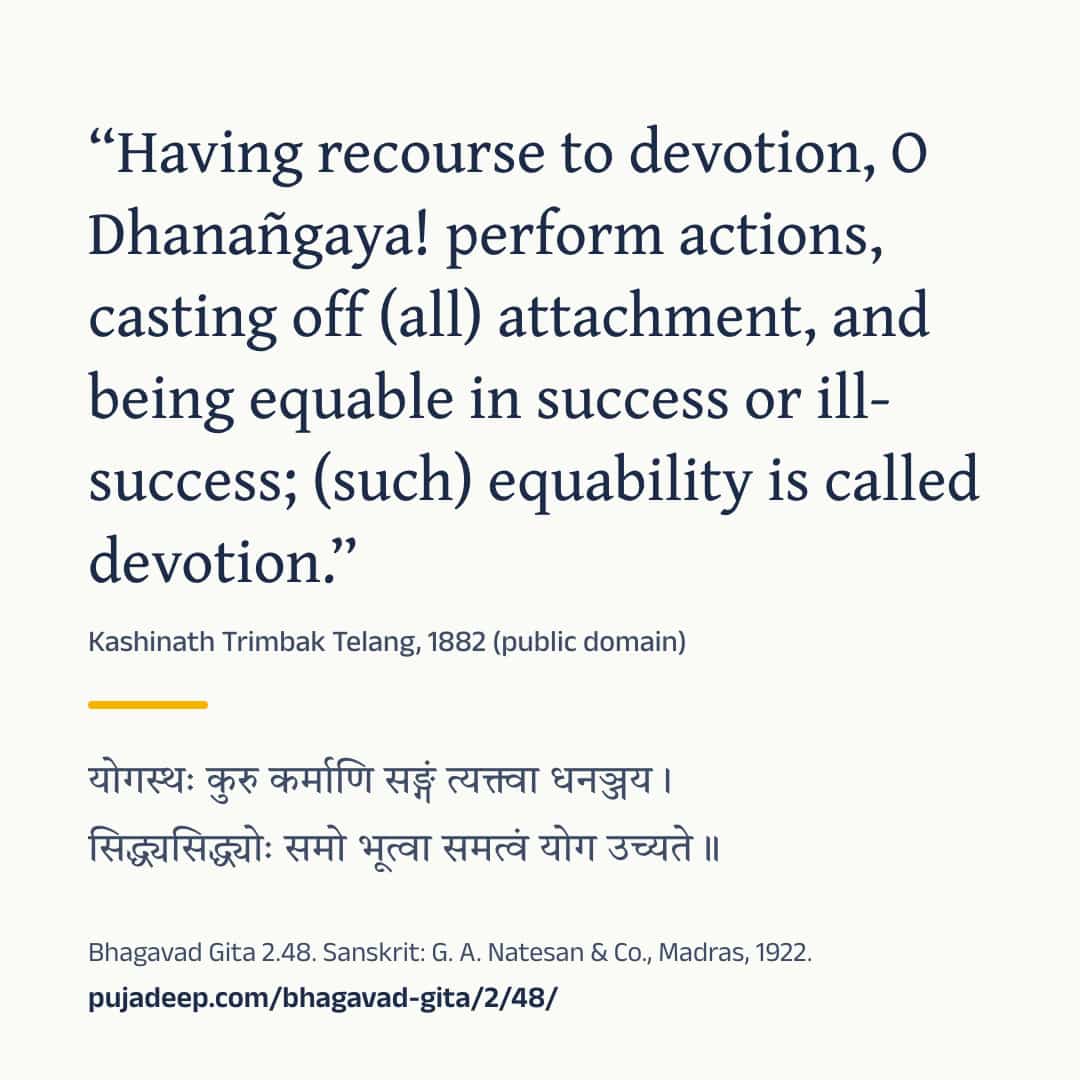
Send as text
The words and the link only. Many elders prefer this.
Bhagavad Gita 2.48

योगस्थः कुरु कर्माणि सङ्गं त्यक्त्वा धनञ्जय ।
सिद्ध्यसिद्ध्योः समो भूत्वा समत्वं योग उच्यते ॥

“Having recourse to devotion, O Dhanañgaya! perform actions, casting off (all) attachment, and being equable in success or ill-success; (such) equability is called devotion.”
(Kashinath Trimbak Telang, 1882, public domain)

“Perform action, O Dhananjaya, dwelling in union with the Divine, renouncing attachments, and balanced evenly in success and failure; equilibrium is called Yoga.”
(Annie Besant, 1895, public domain)

“Being steadfast in Yoga, O Dhananjaya, perform actions, abandoning attachment, remaining unconcerned as regards success and failure. This evenness of mind (in regard to success and failure) is known as Yoga.”
(Swami Swarupananda, 1909 (first printed 1907), public domain)

Sanskrit: G. A. Natesan & Co., Madras, 1922.
https://pujadeep.com/bhagavad-gita/2/48/?s=copy Nothing is sent from this site. Your own app sends it, to the chat you choose. The picture quotes Telang (1882). If you chose another translation above, the text quotes yours and no picture is offered.
Sanskrit text: The Bhagavad-Gita, or The Lord's Song, with the text in Devanagari and an English translation, 1922. Meanings: written for Pujadeep with AI help and reviewed. Source and changes
Questions families ask
Who speaks Bhagavad Gita 2.48?
Krishna speaks this verse, in chapter 2 (Sankhya Yoga).
Where does the Sanskrit text come from?
Sanskrit text: The Bhagavad-Gita, or The Lord's Song, with the text in Devanagari and an English translation, 1922. Meanings: written for Pujadeep with AI help and reviewed. See the source
Is the meaning on this page a translation?
Explanation written for this site with AI help from the sources listed here, and reviewed. It is not a translation and not the only way to read the text. Free to quote with credit.
Source and licence
- Sanskrit text
- The Bhagavad-Gita, or The Lord's Song, with the text in Devanagari and an English translation (Annie Besant, G. A. Natesan & Co., Madras, 1922). Public domain. The Sanskrit on these pages was read from this printing’s page images.
- Translation
- The Bhagavadgîtâ with the Sanatsugâtîya and the Anugîtâ, translated by Kâshinâth Trimbak Telang (The Sacred Books of the East, vol. VIII, ed. F. Max Müller) (Kashinath Trimbak Telang, F. Max Müller, Clarendon Press, Oxford, 1882). Public domain. Shown verbatim, as printed.
- Translation
- The Bhagavad Gîtâ, or The Lord's Song, translated by Annie Besant (Annie Besant, Theosophical Publishing Society, London, 1895). Public domain. Shown verbatim, as printed.
- Sanskrit text
- Srimad-Bhagavad-Gita, with Sanskrit Text; Paraphrase with Word-by-word Literal Translation; English Rendering and Comments, Index, &c., by the Swami Swarupananda (Himalayan Series, No. XX) (Swami Swarupananda, The Editors and Publishers, Advaita Ashrama, Mayavati, Prabuddha Bharata Press, Mayavati, Almora, Himalayas, 1909). Public domain. Used only to date the text. The Devanagari on this page is a reading text and is not copied from this printing.
- Common wording
- In this text, 32 words follow today's common wording, checked against sanskritdocuments.org; Sanskrit Wikisource; Gita Press, Gorakhpur; GRETIL, Göttingen and Bhaktivedanta Book Trust.
- Our explanation
- Explanation written for this site with AI help from the sources listed here, and reviewed. It is not a translation and not the only way to read the text. Free to quote with credit.
- Review
- AI review: 2 independent reviews against the cited edition, October 15, 2026.