Bhagavad Gita · Chapter 2: Sankhya Yoga · Speaker: Krishna
Bhagavad Gita 2.47: Karmanyevadhikaraste
Krishna tells Arjuna that his right is to the action alone, never to its results.
Bhagavad Gita 2.47
कर्मण्येवाधिकारस्ते मा फलेषु कदाचन ।मा कर्मफलहेतुर्भूर्मा ते सङ्गोऽस्त्वकर्मणि ॥
Karmanyevadhikaraste ma phaleshu kadachana
Ma karmaphalaheturbhurma te sangostvakarmani
karmaṇyevādhikāraste mā phaleṣu kadācana |
mā karmaphalaheturbhūrmā te saṅgo’stvakarmaṇi ||
Our meaning Krishna tells Arjuna that his right is to the action alone, never to its results. He should not make the result his reason to act, and he should not cling to doing nothing either.
हिंदी अर्थ कृष्ण अर्जुन से कहते हैं कि उनका अधिकार केवल कर्म करने में है, उसके फल में कभी नहीं। वे फल को कर्म का कारण न बनाएँ, और कर्म न करने में भी आसक्ति न रखें।
Word by word
Every word, with its dictionary page
Word by word
- कर्मणि karmaṇi in action (noun (neuter), locative singular) Dictionary: karman, Monier-Williams 1899, p. 258, col. 2
act, action, performance, business
- एव eva only (indeclinable) Dictionary: 1. eva, Monier-Williams 1899, p. 232, col. 2
just, exactly, very, same, only, even, alone, merely
- अधिकारः adhikāraḥ right, claim (noun (masculine), nominative singular) Dictionary: adhi-kāra, Monier-Williams 1899, p. 20, col. 3
authority
- ते te your (pronoun, genitive singular) Dictionary: 2. tva, Monier-Williams 1899, p. 463, col. 2
base of the 2nd personal pron.
- मा mā not (indeclinable) Dictionary: 1. mā, Monier-Williams 1899, p. 804, col. 1
a particle of prohibition or negation
- फलेषु phaleṣu in the fruits (noun (neuter), locative plural) Dictionary: phala, Monier-Williams 1899, p. 716, col. 2
fruit (esp. of trees)
- कदाचन kadācana ever (indeclinable) Dictionary: kadā, Monier-Williams 1899, p. 248, col. 1
at some time, one day
- मा mā do not (indeclinable) Dictionary: 1. mā, Monier-Williams 1899, p. 804, col. 1
a particle of prohibition or negation
- कर्मफलहेतुः karmaphalahetuḥ acting for the fruits (compound (masculine), nominative singular) Dictionary: karma-phala, Monier-Williams 1899, p. 259, col. 1
the fruit or recompense of actions
; hetu, Monier-Williams 1899, p. 1303, col. 3motive, cause, cause of, reason for
- भूः bhūḥ be (aorist (with mā: do not), 2nd person singular) Dictionary: 1. bhū, Monier-Williams 1899, p. 760, col. 2
arise, come into being, exist
- मा mā let not (indeclinable) Dictionary: 1. mā, Monier-Williams 1899, p. 804, col. 1
a particle of prohibition or negation
- ते te your (pronoun, genitive singular) Dictionary: 2. tva, Monier-Williams 1899, p. 463, col. 2
base of the 2nd personal pron.
- सङ्गः saṅgaḥ attachment (noun (masculine), nominative singular) Dictionary: saṅga, Monier-Williams 1899, p. 1132, col. 3
addiction or devotion to, propensity for
- अस्तु astu be (imperative, 3rd person singular) Dictionary: 1. as, Monier-Williams 1899, p. 117, col. 2
to be, live, exist, be present
- अकर्मणि akarmaṇi to inaction (noun (neuter), locative singular) Dictionary: a-karman, Monier-Williams 1899, p. 2, col. 1
absence of work
Public-domain translations
Kashinath Trimbak Telang, 1882. Public domain. Page 48.
Your business is with action alone; not by any means with fruit. Let not the fruit of action be your motive (to action). Let not your attachment be (fixed) on inaction1.
Footnotes (the translator’s own) - Doing nothing at all. ↩
Compare 3 translations
Kashinath Trimbak Telang, 1882. Public domain. Page 48.
Your business is with action alone; not by any means with fruit. Let not the fruit of action be your motive (to action). Let not your attachment be (fixed) on inaction1.
Footnotes (the translator’s own) - Doing nothing at all. ↩
You are reading this one
Annie Besant, 1895. Public domain. Page 33.
Thy business is with the action only, never with its fruits; so let not the fruit of action be thy motive, nor be thou to inaction attached.
You are reading this one
Swami Swarupananda, 1909 (first printed 1907). Public domain. Page 49.
Thy right is to work only; but never to the fruits thereof. Be thou not the producer of the fruits of (thy) actions; neither let thy attachment be towards inaction.
You are reading this one
Share
Send one picture or the text to one chat. The picture names its source and the address of this page.
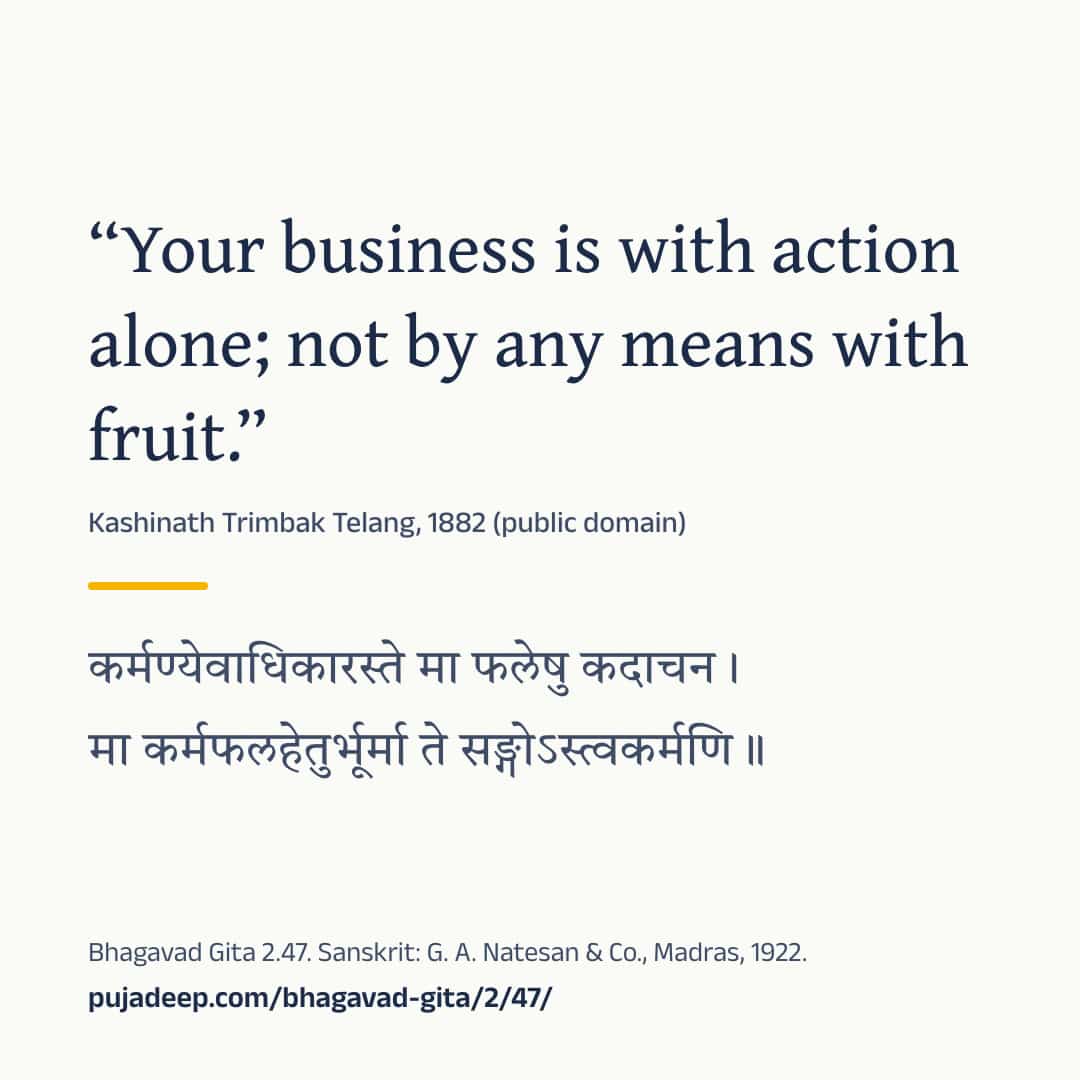
Send as text
The words and the link only. Many elders prefer this.
Bhagavad Gita 2.47

कर्मण्येवाधिकारस्ते मा फलेषु कदाचन ।
मा कर्मफलहेतुर्भूर्मा ते सङ्गोऽस्त्वकर्मणि ॥

“Your business is with action alone; not by any means with fruit. Let not the fruit of action be your motive (to action). Let not your attachment be (fixed) on inaction.”
(Kashinath Trimbak Telang, 1882, public domain)

“Thy business is with the action only, never with its fruits; so let not the fruit of action be thy motive, nor be thou to inaction attached.”
(Annie Besant, 1895, public domain)

“Thy right is to work only; but never to the fruits thereof. Be thou not the producer of the fruits of (thy) actions; neither let thy attachment be towards inaction.”
(Swami Swarupananda, 1909 (first printed 1907), public domain)

Sanskrit: G. A. Natesan & Co., Madras, 1922.
https://pujadeep.com/bhagavad-gita/2/47/?s=copy Nothing is sent from this site. Your own app sends it, to the chat you choose. The picture quotes Telang (1882). If you chose another translation above, the text quotes yours and no picture is offered.
Sanskrit text: The Bhagavad-Gita, or The Lord's Song, with the text in Devanagari and an English translation, 1922. Meanings: written for Pujadeep with AI help and reviewed. Source and changes
Questions families ask
Who speaks Bhagavad Gita 2.47?
Krishna speaks this verse, in chapter 2 (Sankhya Yoga).
Where does the Sanskrit text come from?
Sanskrit text: The Bhagavad-Gita, or The Lord's Song, with the text in Devanagari and an English translation, 1922. Meanings: written for Pujadeep with AI help and reviewed. See the source
Is the meaning on this page a translation?
Explanation written for this site with AI help from the sources listed here, and reviewed. It is not a translation and not the only way to read the text. Free to quote with credit.
Source and licence
- Sanskrit text
- The Bhagavad-Gita, or The Lord's Song, with the text in Devanagari and an English translation (Annie Besant, G. A. Natesan & Co., Madras, 1922). Public domain. The Sanskrit on these pages was read from this printing’s page images.
- Translation
- The Bhagavadgîtâ with the Sanatsugâtîya and the Anugîtâ, translated by Kâshinâth Trimbak Telang (The Sacred Books of the East, vol. VIII, ed. F. Max Müller) (Kashinath Trimbak Telang, F. Max Müller, Clarendon Press, Oxford, 1882). Public domain. Shown verbatim, as printed.
- Translation
- The Bhagavad Gîtâ, or The Lord's Song, translated by Annie Besant (Annie Besant, Theosophical Publishing Society, London, 1895). Public domain. Shown verbatim, as printed.
- Sanskrit text
- Srimad-Bhagavad-Gita, with Sanskrit Text; Paraphrase with Word-by-word Literal Translation; English Rendering and Comments, Index, &c., by the Swami Swarupananda (Himalayan Series, No. XX) (Swami Swarupananda, The Editors and Publishers, Advaita Ashrama, Mayavati, Prabuddha Bharata Press, Mayavati, Almora, Himalayas, 1909). Public domain. Used only to date the text. The Devanagari on this page is a reading text and is not copied from this printing.
- Common wording
- In this text, 32 words follow today's common wording, checked against sanskritdocuments.org; Sanskrit Wikisource; Gita Press, Gorakhpur; GRETIL, Göttingen and Bhaktivedanta Book Trust.
- Our explanation
- Explanation written for this site with AI help from the sources listed here, and reviewed. It is not a translation and not the only way to read the text. Free to quote with credit.
- Review
- AI review: 2 independent reviews against the cited edition, October 15, 2026.