Bhagavad Gita · Chapter 2: Sankhya Yoga · Speaker: Krishna
Bhagavad Gita 2.46: Yavanartha udapane sarvatah
Krishna: Whatever use a small well has is already found where water floods everywhere.
Bhagavad Gita 2.46
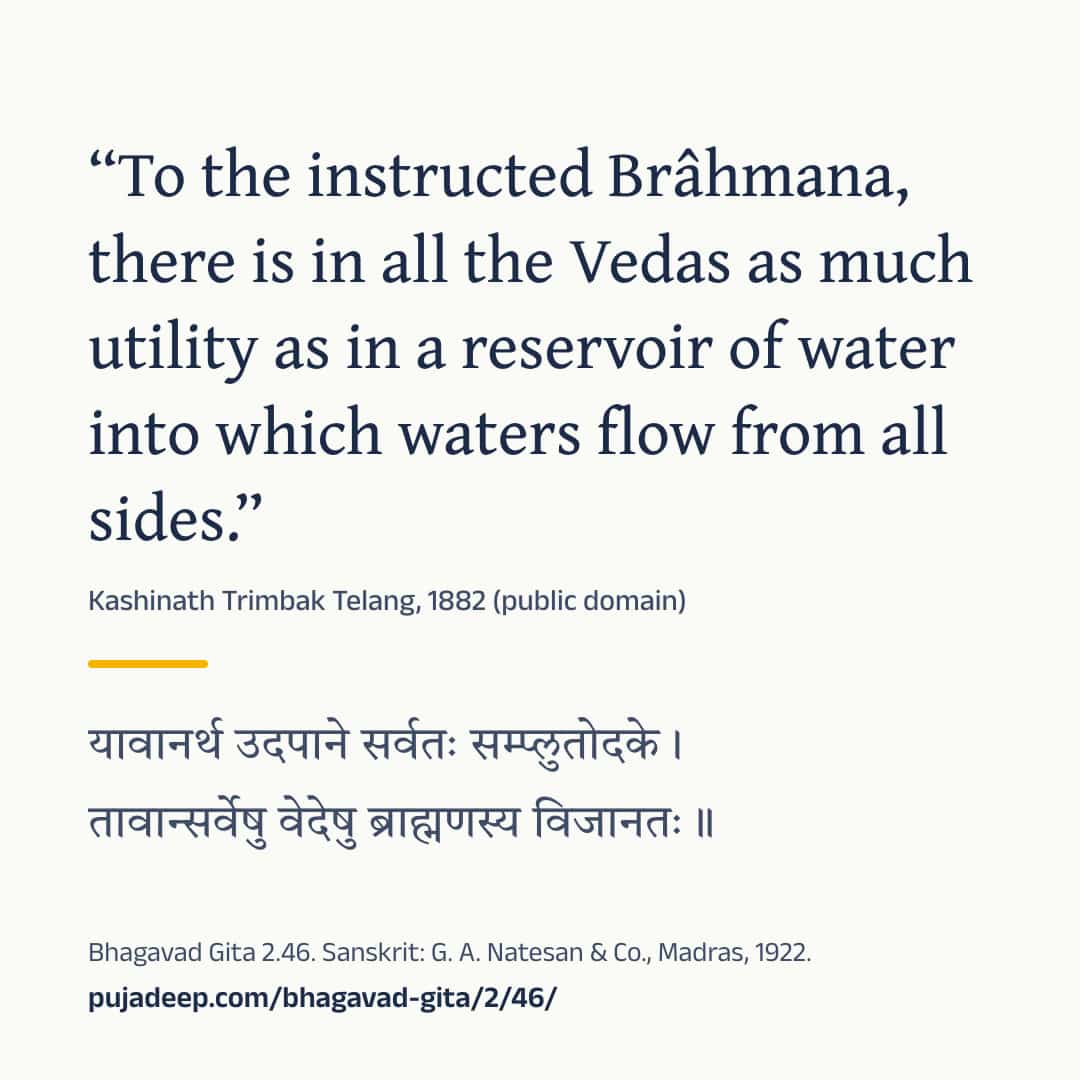
यावानर्थ उदपाने सर्वतः सम्प्लुतोदके ।तावान्सर्वेषु वेदेषु ब्राह्मणस्य विजानतः ॥
Yavanartha udapane sarvatah samplutodake
Tavansarveshu vedeshu brahmanasya vijanatah
yāvānartha udapāne sarvataḥ samplutodake |
tāvānsarveṣu vedeṣu brāhmaṇasya vijānataḥ ||
Our meaning Whatever use a small well has is already found where water floods everywhere. In the same way, Krishna says, whatever the Vedas offer is already present for a brahmana who has true knowledge. The commentators explain this comparison in more than one way.
हिंदी अर्थ जहाँ चारों ओर जल ही जल हो, वहाँ छोटे कुएँ से जितना काम निकलता है, उतना उस बड़े जलाशय में पहले से मिल जाता है। इसी तरह, कृष्ण कहते हैं, ज्ञानी ब्राह्मण के लिए वेदों में जो कुछ है, वह उसके ज्ञान में पहले से है। टीकाकार इस उपमा को एक से अधिक ढंग से समझाते हैं।
Word by word
Every word, with its dictionary page
Word by word
- यावान् yāvān as much (adjective (masculine), nominative singular) Dictionary: yāvat, Monier-Williams 1899, p. 852, col. 1
as great, as large, as much, as many
- अर्थः arthaḥ use, purpose (noun (masculine), nominative singular) Dictionary: artha, Monier-Williams 1899, p. 90, col. 3
aim, purpose
- उदपाने udapāne in a well or tank (noun (masculine), locative singular) Dictionary: uda-pāna, Monier-Williams 1899, p. 183, col. 2
a well
- सर्वतः sarvataḥ on every side (indeclinable) Dictionary: sarvatas, Monier-Williams 1899, p. 1189, col. 1
from all sides, in every direction, everywhere
- सम्प्लुतोदके samplutodake when water floods (compound (neuter), locative singular) Dictionary: sam-plu, Monier-Williams 1899, p. 1177, col. 2
to flow or stream together, meet (as waters)
; udaka, Monier-Williams 1899, p. 183, col. 2water
- तावान् tāvān so much (adjective (masculine), nominative singular) Dictionary: tāvat, Monier-Williams 1899, p. 445, col. 3
so great, so large, so much, so far, so long, so many
- सर्वेषु sarveṣu in all (pronoun (masculine), locative plural) Dictionary: sarva, Monier-Williams 1899, p. 1184, col. 3
whole, entire, all, every
- वेदेषु vedeṣu in the Vedas (noun (masculine), locative plural) Dictionary: 1. veda, Monier-Williams 1899, p. 1015, col. 1
knowledge, true or sacred knowledge or lore
- ब्राह्मणस्य brāhmaṇasya for a brahmana, a knower of Brahman (noun (masculine), genitive singular) Dictionary: brāhmaṇa, Monier-Williams 1899, p. 741, col. 2
one who has divine knowledge
- विजानतः vijānataḥ who knows (present participle (masculine), genitive singular) Dictionary: vi-jñā, Monier-Williams 1899, p. 961, col. 1
to distinguish, discern, observe, investigate, recognize, ascertain, know, understand
Public-domain translations
Kashinath Trimbak Telang, 1882. Public domain. Page 48.
To the instructed Brâhmana, there is in all the Vedas as much utility as in a reservoir of water into which waters flow from all sides1.
Footnotes (the translator’s own) - The meaning here is not easily apprehended. I suggest the following explanation:—Having said that the Vedas are concerned with actions for special benefits, Krishna compares them to a reservoir which provides water for various special purposes, drinking, bathing, &c. The Vedas similarly prescribe particular rites and ceremonies for going to heaven, or destroying an enemy, &c. But, says Krishna, man's duty is merely to perform the actions prescribed for him among these, and not entertain desires for the special benefits named. The stanza occurs in the Sanatsugâtîya, too. ↩
Compare 3 translations
Kashinath Trimbak Telang, 1882. Public domain. Page 48.
To the instructed Brâhmana, there is in all the Vedas as much utility as in a reservoir of water into which waters flow from all sides1.
Footnotes (the translator’s own) - The meaning here is not easily apprehended. I suggest the following explanation:—Having said that the Vedas are concerned with actions for special benefits, Krishna compares them to a reservoir which provides water for various special purposes, drinking, bathing, &c. The Vedas similarly prescribe particular rites and ceremonies for going to heaven, or destroying an enemy, &c. But, says Krishna, man's duty is merely to perform the actions prescribed for him among these, and not entertain desires for the special benefits named. The stanza occurs in the Sanatsugâtîya, too. ↩
You are reading this one
Annie Besant, 1895. Public domain. Page 33.
All the Vedas are as useful to an enlightened Brâhman, as is a tank in a place covered all over with water.
You are reading this one
Swami Swarupananda, 1909 (first printed 1907). Public domain. Page 49.
To the Bràhmana who has known the Self, all the Vedas are of so much use as a reservoir is, when there is a flood everywhere.
You are reading this one
Share
Send one picture or the text to one chat. The picture names its source and the address of this page.
Send as text
The words and the link only. Many elders prefer this.
Bhagavad Gita 2.46

यावानर्थ उदपाने सर्वतः सम्प्लुतोदके ।
तावान्सर्वेषु वेदेषु ब्राह्मणस्य विजानतः ॥

“To the instructed Brâhmana, there is in all the Vedas as much utility as in a reservoir of water into which waters flow from all sides.”
(Kashinath Trimbak Telang, 1882, public domain)

“All the Vedas are as useful to an enlightened Brâhman, as is a tank in a place covered all over with water.”
(Annie Besant, 1895, public domain)

“To the Bràhmana who has known the Self, all the Vedas are of so much use as a reservoir is, when there is a flood everywhere.”
(Swami Swarupananda, 1909 (first printed 1907), public domain)

Sanskrit: G. A. Natesan & Co., Madras, 1922.
https://pujadeep.com/bhagavad-gita/2/46/?s=copy Nothing is sent from this site. Your own app sends it, to the chat you choose. The picture quotes Telang (1882). If you chose another translation above, the text quotes yours and no picture is offered.
Sanskrit text: The Bhagavad-Gita, or The Lord's Song, with the text in Devanagari and an English translation, 1922. Meanings: written for Pujadeep with AI help and reviewed. Source and changes
Questions families ask
Who speaks Bhagavad Gita 2.46?
Krishna speaks this verse, in chapter 2 (Sankhya Yoga).
Where does the Sanskrit text come from?
Sanskrit text: The Bhagavad-Gita, or The Lord's Song, with the text in Devanagari and an English translation, 1922. Meanings: written for Pujadeep with AI help and reviewed. See the source
Is the meaning on this page a translation?
Explanation written for this site with AI help from the sources listed here, and reviewed. It is not a translation and not the only way to read the text. Free to quote with credit.
Source and licence
- Sanskrit text
- The Bhagavad-Gita, or The Lord's Song, with the text in Devanagari and an English translation (Annie Besant, G. A. Natesan & Co., Madras, 1922). Public domain. The Sanskrit on these pages was read from this printing’s page images.
- Translation
- The Bhagavadgîtâ with the Sanatsugâtîya and the Anugîtâ, translated by Kâshinâth Trimbak Telang (The Sacred Books of the East, vol. VIII, ed. F. Max Müller) (Kashinath Trimbak Telang, F. Max Müller, Clarendon Press, Oxford, 1882). Public domain. Shown verbatim, as printed.
- Translation
- The Bhagavad Gîtâ, or The Lord's Song, translated by Annie Besant (Annie Besant, Theosophical Publishing Society, London, 1895). Public domain. Shown verbatim, as printed.
- Sanskrit text
- Srimad-Bhagavad-Gita, with Sanskrit Text; Paraphrase with Word-by-word Literal Translation; English Rendering and Comments, Index, &c., by the Swami Swarupananda (Himalayan Series, No. XX) (Swami Swarupananda, The Editors and Publishers, Advaita Ashrama, Mayavati, Prabuddha Bharata Press, Mayavati, Almora, Himalayas, 1909). Public domain. Used only to date the text. The Devanagari on this page is a reading text and is not copied from this printing.
- Common wording
- In this text, 32 words follow today's common wording, checked against sanskritdocuments.org; Sanskrit Wikisource; Gita Press, Gorakhpur; GRETIL, Göttingen and Bhaktivedanta Book Trust.
- Our explanation
- Explanation written for this site with AI help from the sources listed here, and reviewed. It is not a translation and not the only way to read the text. Free to quote with credit.
- Review
- AI review: 2 independent reviews against the cited edition, October 15, 2026.