Bhagavad Gita · Chapter 2: Sankhya Yoga · Speaker: Krishna
Bhagavad Gita 2.70: Apuryamanamachalapratishtham
Krishna: Rivers keep flowing into the ocean, yet the ocean stays full and does not move from its place.
Bhagavad Gita 2.70
आपूर्यमाणमचलप्रतिष्ठं समुद्रमापः प्रविशन्ति यद्वत् ।तद्वत्कामा यं प्रविशन्ति सर्वे स शान्तिमाप्नोति न कामकामी ॥
Apuryamanamachalapratishtham samudramapah pravishanti yadvat
Tadvatkama yam pravishanti sarve sa shantimapnoti na kamakami
āpūryamāṇamacalapratiṣṭhaṃ samudramāpaḥ praviśanti yadvat |
tadvatkāmā yaṃ praviśanti sarve sa śāntimāpnoti na kāmakāmī ||
Our meaning Rivers keep flowing into the ocean, yet the ocean stays full and does not move from its place. In the same way, Krishna says, the person into whom all desires flow, without being stirred, finds peace. The one who chases desires does not.
हिंदी अर्थ कृष्ण कहते हैं कि जैसे नदियों का जल सदा भरते रहने वाले और अपनी मर्यादा में अचल रहने वाले समुद्र में समा जाता है, वैसे ही जिस व्यक्ति में सब कामनाएँ समा जाती हैं, वह शांति पाता है; कामनाओं के पीछे भागने वाला नहीं।
Word by word
Every word, with its dictionary page
Word by word
- आपूर्यमाणम् āpūryamāṇam ever being filled (present passive participle, accusative singular (masculine)) Dictionary: ā-pṝ, Monier-Williams 1899, p. 143, col. 3
to be filled, become full, increase
- अचलप्रतिष्ठम् acalapratiṣṭham unmoving in its place (compound (masculine), accusative singular) Dictionary: a-cala, Monier-Williams 1899, p. 8, col. 3
not moving, immovable
; 2. prati-ṣṭhā, Monier-Williams 1899, p. 671, col. 2standing still, resting, remaining, steadfastness, stability
- समुद्रम् samudram the ocean (noun (masculine), accusative singular) Dictionary: sam-udra, Monier-Williams 1899, p. 1166, col. 3
- आपः āpaḥ waters (noun (feminine), nominative plural) Dictionary: 2. ap, Monier-Williams 1899, p. 47, col. 3
water
- प्रविशन्ति praviśanti enter (present, 3rd person plural) Dictionary: pra-viś, Monier-Williams 1899, p. 692, col. 3
to enter, go into
- यद्वत् yadvat just as (indeclinable) Dictionary: yad-vat, Monier-Williams 1899, p. 844, col. 3
in which way, as
- तद्वत् tadvat so (indeclinable) Dictionary: tad-vat, Monier-Williams 1899, p. 434, col. 2
like that, thus, so
- कामाः kāmāḥ desires (noun (masculine), nominative plural) Dictionary: kāma, Monier-Williams 1899, p. 271, col. 3
wish, desire, longing
- यम् yam whom (pronoun (masculine), accusative singular) Dictionary: yad, Monier-Williams 1899, p. 844, col. 2
who, which, what, whichever, whatever, that
- प्रविशन्ति praviśanti enter (present, 3rd person plural) Dictionary: pra-viś, Monier-Williams 1899, p. 692, col. 3
to enter, go into
- सर्वे sarve all (pronoun (masculine), nominative plural) Dictionary: sarva, Monier-Williams 1899, p. 1184, col. 3
whole, entire, all, every
- सः saḥ he (pronoun (masculine), nominative singular) Dictionary: tad, Monier-Williams 1899, p. 434, col. 1
m. he, f. she, n. it, that, this
- शान्तिम् śāntim peace (noun (feminine), accusative singular) Dictionary: śānti, Monier-Williams 1899, p. 1064, col. 3
tranquillity, peace, quiet, peace or calmness of mind
- आप्नोति āpnoti attains (present, 3rd person singular) Dictionary: 1. āp, Monier-Williams 1899, p. 142, col. 1
to reach, overtake, meet
- न na not (indeclinable) Dictionary: 2. na, Monier-Williams 1899, p. 523, col. 1
ind. not, no, nor, neither
- कामकामी kāmakāmī one who longs for desires (compound (masculine), nominative singular) Dictionary: kāma-kāmin, Monier-Williams 1899, p. 272, col. 1
having various desires or wishes, following the dictates of passion
Public-domain translations
Kashinath Trimbak Telang, 1882. Public domain. Page 51.
He into whom all objects of desire enter, as waters enter the ocean, which, (though) replenished, (still) keeps its position unmoved,—he only obtains tranquillity; not he who desires (those) objects of desire.
Compare 3 translations
Kashinath Trimbak Telang, 1882. Public domain. Page 51.
He into whom all objects of desire enter, as waters enter the ocean, which, (though) replenished, (still) keeps its position unmoved,—he only obtains tranquillity; not he who desires (those) objects of desire.
You are reading this one
Annie Besant, 1895. Public domain. Page 38.
He attaineth Peace, into whom all desires flow as rivers flow into the ocean, which is filled with water but remaineth unmoved—not he who desireth desire.
You are reading this one
Swami Swarupananda, 1909 (first printed 1907). Public domain. Page 61.
As into the ocean,—brimful, and still,—flow the waters, even so the Muni into whom enter all desires, he, and not the desirer of desires, attains to peace.
You are reading this one
Share
Send one picture or the text to one chat. The picture names its source and the address of this page.
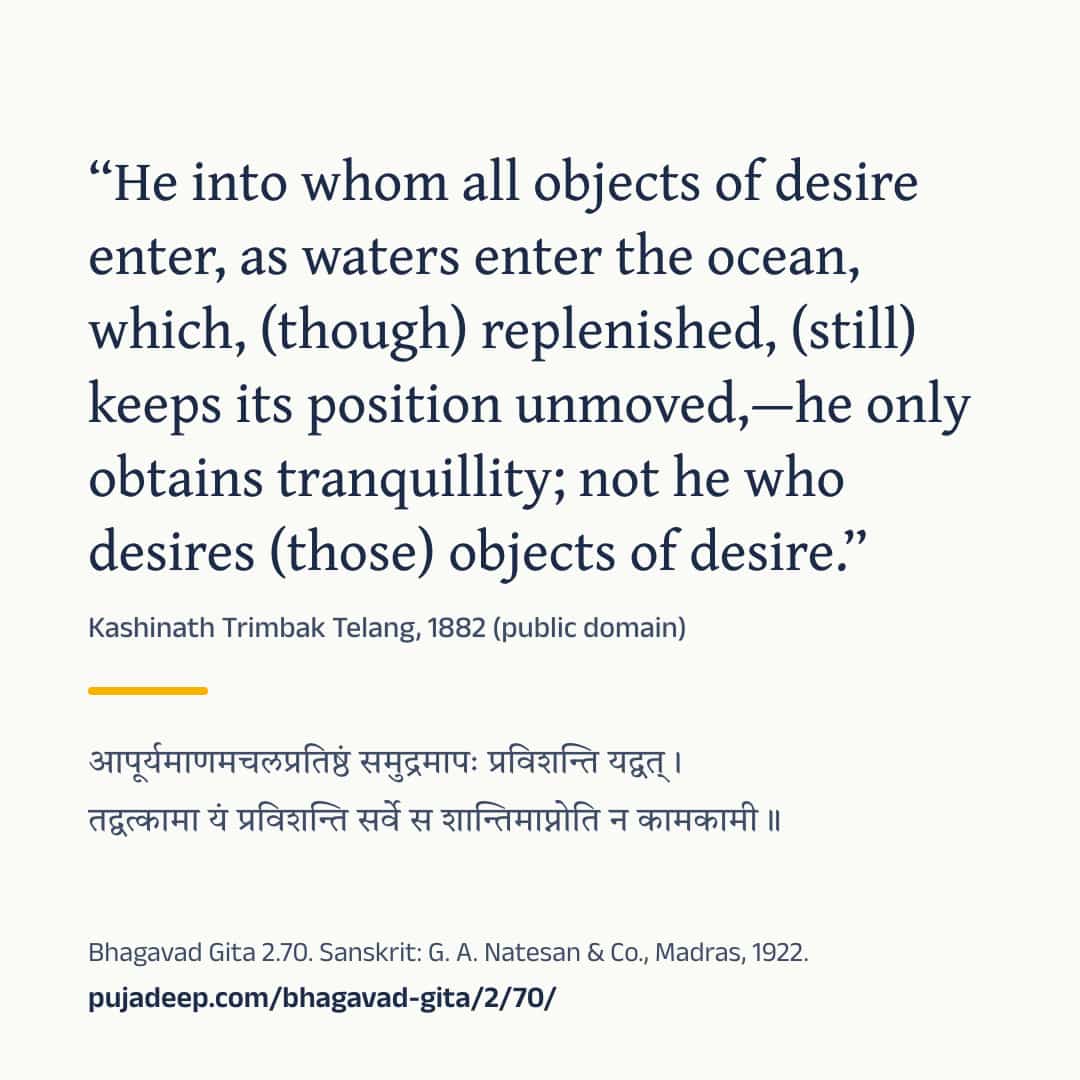
Send as text
The words and the link only. Many elders prefer this.
Bhagavad Gita 2.70

आपूर्यमाणमचलप्रतिष्ठं समुद्रमापः प्रविशन्ति यद्वत् ।
तद्वत्कामा यं प्रविशन्ति सर्वे स शान्तिमाप्नोति न कामकामी ॥

“He into whom all objects of desire enter, as waters enter the ocean, which, (though) replenished, (still) keeps its position unmoved,—he only obtains tranquillity; not he who desires (those) objects of desire.”
(Kashinath Trimbak Telang, 1882, public domain)

“He attaineth Peace, into whom all desires flow as rivers flow into the ocean, which is filled with water but remaineth unmoved—not he who desireth desire.”
(Annie Besant, 1895, public domain)

“As into the ocean,—brimful, and still,—flow the waters, even so the Muni into whom enter all desires, he, and not the desirer of desires, attains to peace.”
(Swami Swarupananda, 1909 (first printed 1907), public domain)

Sanskrit: G. A. Natesan & Co., Madras, 1922.
https://pujadeep.com/bhagavad-gita/2/70/?s=copy Nothing is sent from this site. Your own app sends it, to the chat you choose. The picture quotes Telang (1882). If you chose another translation above, the text quotes yours and no picture is offered.
Sanskrit text: The Bhagavad-Gita, or The Lord's Song, with the text in Devanagari and an English translation, 1922. Meanings: written for Pujadeep with AI help and reviewed. Source and changes
Questions families ask
Who speaks Bhagavad Gita 2.70?
Krishna speaks this verse, in chapter 2 (Sankhya Yoga).
Where does the Sanskrit text come from?
Sanskrit text: The Bhagavad-Gita, or The Lord's Song, with the text in Devanagari and an English translation, 1922. Meanings: written for Pujadeep with AI help and reviewed. See the source
Is the meaning on this page a translation?
Explanation written for this site with AI help from the sources listed here, and reviewed. It is not a translation and not the only way to read the text. Free to quote with credit.
Source and licence
- Sanskrit text
- The Bhagavad-Gita, or The Lord's Song, with the text in Devanagari and an English translation (Annie Besant, G. A. Natesan & Co., Madras, 1922). Public domain. The Sanskrit on these pages was read from this printing’s page images.
- Translation
- The Bhagavadgîtâ with the Sanatsugâtîya and the Anugîtâ, translated by Kâshinâth Trimbak Telang (The Sacred Books of the East, vol. VIII, ed. F. Max Müller) (Kashinath Trimbak Telang, F. Max Müller, Clarendon Press, Oxford, 1882). Public domain. Shown verbatim, as printed.
- Translation
- The Bhagavad Gîtâ, or The Lord's Song, translated by Annie Besant (Annie Besant, Theosophical Publishing Society, London, 1895). Public domain. Shown verbatim, as printed.
- Sanskrit text
- Srimad-Bhagavad-Gita, with Sanskrit Text; Paraphrase with Word-by-word Literal Translation; English Rendering and Comments, Index, &c., by the Swami Swarupananda (Himalayan Series, No. XX) (Swami Swarupananda, The Editors and Publishers, Advaita Ashrama, Mayavati, Prabuddha Bharata Press, Mayavati, Almora, Himalayas, 1909). Public domain. Used only to date the text. The Devanagari on this page is a reading text and is not copied from this printing.
- Common wording
- In this text, 32 words follow today's common wording, checked against sanskritdocuments.org; Sanskrit Wikisource; Gita Press, Gorakhpur; GRETIL, Göttingen and Bhaktivedanta Book Trust.
- Our explanation
- Explanation written for this site with AI help from the sources listed here, and reviewed. It is not a translation and not the only way to read the text. Free to quote with credit.
- Review
- AI review: 2 independent reviews against the cited edition, October 15, 2026.