Bhagavad Gita · Chapter 2: Sankhya Yoga · Speaker: Krishna
Bhagavad Gita 2.71: Vihaya kamanyah
Krishna says that the person who gives up all desires and lives free of craving, without the sense of “mine” and without ego, attains peace.
Bhagavad Gita 2.71
विहाय कामान्यः सर्वान्पुमांश्चरति निःस्पृहः ।निर्ममो निरहङ्कारः स शान्तिमधिगच्छति ॥
Vihaya kamanyah sarvanpumanshcharati nihsprihah
Nirmamo nirahankarah sa shantimadhigachchhati
vihāya kāmānyaḥ sarvānpumāṃścarati niḥspṛhaḥ |
nirmamo nirahaṅkāraḥ sa śāntimadhigacchati ||
Our meaning Krishna says that the person who gives up all desires and lives free of craving, without the sense of “mine” and without ego, attains peace.
हिंदी अर्थ कृष्ण कहते हैं कि जो व्यक्ति सब कामनाओं को छोड़कर, लालसा से रहित होकर विचरता है, जिसमें “मेरा” का भाव और अहंकार नहीं है, वह शांति पाता है।
Word by word
Every word, with its dictionary page
Word by word
- विहाय vihāya having given up (absolutive (having done)) Dictionary: vi-hā, Monier-Williams 1899, p. 1003, col. 1
to leave behind, relinquish, quit, abandon
- कामान् kāmān desires (noun (masculine), accusative plural) Dictionary: kāma, Monier-Williams 1899, p. 271, col. 3
wish, desire, longing
- यः yaḥ who (pronoun (masculine), nominative singular) Dictionary: yad, Monier-Williams 1899, p. 844, col. 2
who, which, what, whichever, whatever, that
- सर्वान् sarvān all (pronoun (masculine), accusative plural) Dictionary: sarva, Monier-Williams 1899, p. 1184, col. 3
whole, entire, all, every
- पुमान् pumān a man (noun (masculine), nominative singular) Dictionary: 2. puṃs, Monier-Williams 1899, p. 630, col. 3
- चरति carati moves about, lives (present, 3rd person singular) Dictionary: car, Monier-Williams 1899, p. 389, col. 1
to move one's self, go, walk, move, stir, roam about, wander
- निःस्पृहः niḥspṛhaḥ free from longing (adjective (masculine), nominative singular) Dictionary: niḥ-spṛha, Monier-Williams 1899, p. 539, col. 2
free from desire, not longing for
- निर्ममः nirmamaḥ without "mine" (adjective (masculine), nominative singular) Dictionary: nir-mama, Monier-Williams 1899, p. 541, col. 3
unselfish, disinterested, (esp.) free from all worldly connections
- निरहङ्कारः nirahaṅkāraḥ without ego (adjective (masculine), nominative singular) Dictionary: nir-ahaṃkāra, Monier-Williams 1899, p. 540, col. 1
free from egotism, unselfish, humble
- सः saḥ he (pronoun (masculine), nominative singular) Dictionary: tad, Monier-Williams 1899, p. 434, col. 1
m. he, f. she, n. it, that, this
- शान्तिम् śāntim peace (noun (feminine), accusative singular) Dictionary: śānti, Monier-Williams 1899, p. 1064, col. 3
tranquillity, peace, quiet, peace or calmness of mind
- अधिगच्छति adhigacchati attains (present, 3rd person singular) Dictionary: adhi-gam, Monier-Williams 1899, p. 20, col. 3
to meet, find, discover, obtain
Public-domain translations
Kashinath Trimbak Telang, 1882. Public domain. Page 51–52.
The man who, casting off all desires, lives free from attachments, who is free from egoism1, and from (the feeling that this or that is) mine2, obtains tranquillity.
Footnotes (the translator’s own) Compare 3 translations
Kashinath Trimbak Telang, 1882. Public domain. Page 51–52.
The man who, casting off all desires, lives free from attachments, who is free from egoism1, and from (the feeling that this or that is) mine2, obtains tranquillity.
Footnotes (the translator’s own) You are reading this one
Annie Besant, 1895. Public domain. Page 38.
Who so forsaketh all desires and goeth onwards free from yearnings, humble and unselfish—he goeth to Peace.
You are reading this one
Swami Swarupananda, 1909 (first printed 1907). Public domain. Page 61.
That man who lives devoid of longing, abandoning all desires, without the sense of 'I' and 'mine,' he attains to peace.
You are reading this one
Share
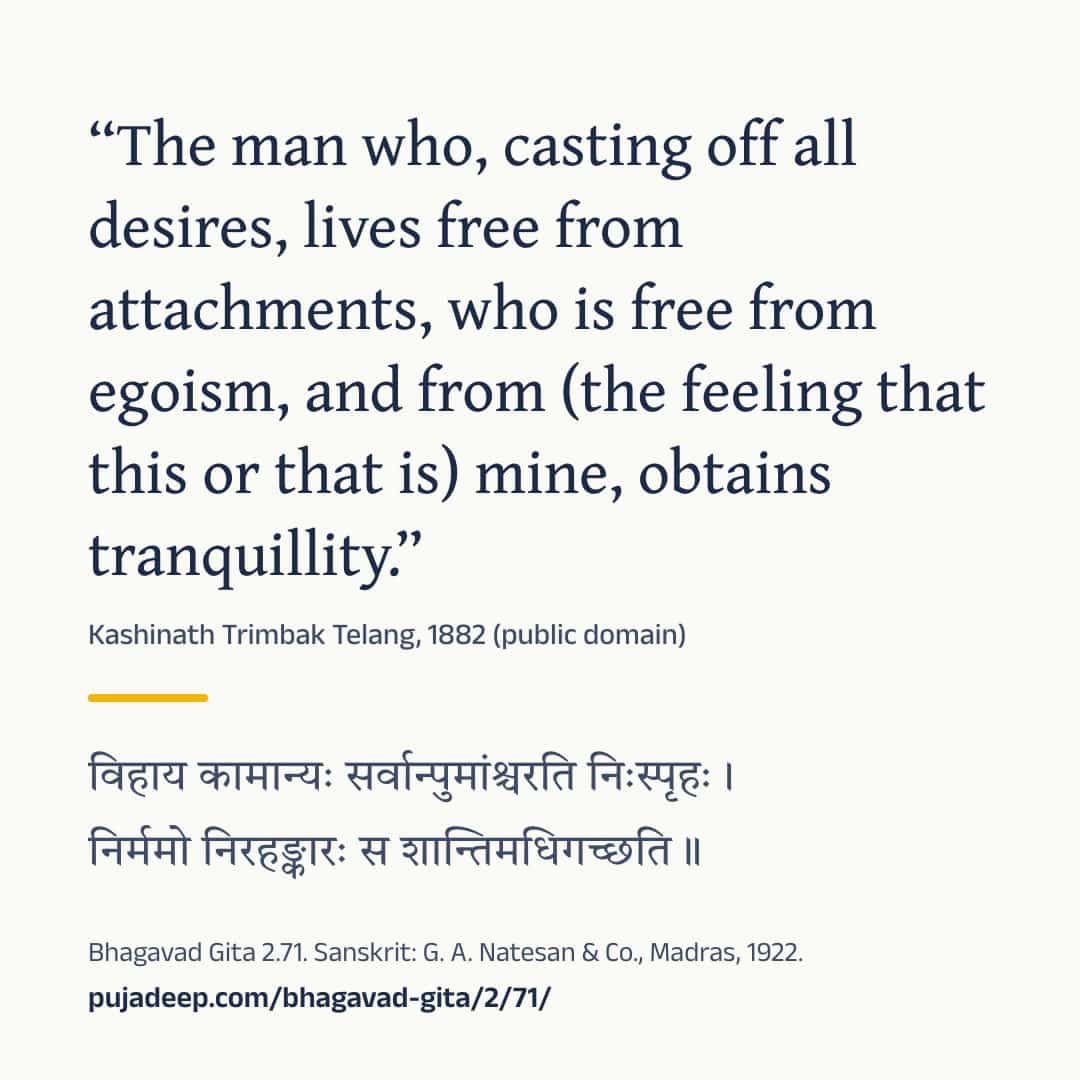
Send one picture or the text to one chat. The picture names its source and the address of this page.
Send as text
The words and the link only. Many elders prefer this.
Bhagavad Gita 2.71

विहाय कामान्यः सर्वान्पुमांश्चरति निःस्पृहः ।
निर्ममो निरहङ्कारः स शान्तिमधिगच्छति ॥

“The man who, casting off all desires, lives free from attachments, who is free from egoism, and from (the feeling that this or that is) mine, obtains tranquillity.”
(Kashinath Trimbak Telang, 1882, public domain)

“Who so forsaketh all desires and goeth onwards free from yearnings, humble and unselfish—he goeth to Peace.”
(Annie Besant, 1895, public domain)

“That man who lives devoid of longing, abandoning all desires, without the sense of 'I' and 'mine,' he attains to peace.”
(Swami Swarupananda, 1909 (first printed 1907), public domain)

Sanskrit: G. A. Natesan & Co., Madras, 1922.
https://pujadeep.com/bhagavad-gita/2/71/?s=copy Nothing is sent from this site. Your own app sends it, to the chat you choose. The picture quotes Telang (1882). If you chose another translation above, the text quotes yours and no picture is offered.
Sanskrit text: The Bhagavad-Gita, or The Lord's Song, with the text in Devanagari and an English translation, 1922. Meanings: written for Pujadeep with AI help and reviewed. Source and changes
Questions families ask
Who speaks Bhagavad Gita 2.71?
Krishna speaks this verse, in chapter 2 (Sankhya Yoga).
Where does the Sanskrit text come from?
Sanskrit text: The Bhagavad-Gita, or The Lord's Song, with the text in Devanagari and an English translation, 1922. Meanings: written for Pujadeep with AI help and reviewed. See the source
Is the meaning on this page a translation?
Explanation written for this site with AI help from the sources listed here, and reviewed. It is not a translation and not the only way to read the text. Free to quote with credit.
Source and licence
- Sanskrit text
- The Bhagavad-Gita, or The Lord's Song, with the text in Devanagari and an English translation (Annie Besant, G. A. Natesan & Co., Madras, 1922). Public domain. The Sanskrit on these pages was read from this printing’s page images.
- Translation
- The Bhagavadgîtâ with the Sanatsugâtîya and the Anugîtâ, translated by Kâshinâth Trimbak Telang (The Sacred Books of the East, vol. VIII, ed. F. Max Müller) (Kashinath Trimbak Telang, F. Max Müller, Clarendon Press, Oxford, 1882). Public domain. Shown verbatim, as printed.
- Translation
- The Bhagavad Gîtâ, or The Lord's Song, translated by Annie Besant (Annie Besant, Theosophical Publishing Society, London, 1895). Public domain. Shown verbatim, as printed.
- Sanskrit text
- Srimad-Bhagavad-Gita, with Sanskrit Text; Paraphrase with Word-by-word Literal Translation; English Rendering and Comments, Index, &c., by the Swami Swarupananda (Himalayan Series, No. XX) (Swami Swarupananda, The Editors and Publishers, Advaita Ashrama, Mayavati, Prabuddha Bharata Press, Mayavati, Almora, Himalayas, 1909). Public domain. Used only to date the text. The Devanagari on this page is a reading text and is not copied from this printing.
- Common wording
- In this text, 32 words follow today's common wording, checked against sanskritdocuments.org; Sanskrit Wikisource; Gita Press, Gorakhpur; GRETIL, Göttingen and Bhaktivedanta Book Trust.
- Our explanation
- Explanation written for this site with AI help from the sources listed here, and reviewed. It is not a translation and not the only way to read the text. Free to quote with credit.
- Review
- AI review: 2 independent reviews against the cited edition, October 15, 2026.