श्रीमद्भगवद्गीता · अध्याय 2: सांख्ययोग · वक्ता: कृष्ण
श्रीमद्भगवद्गीता 2.45 का अर्थ
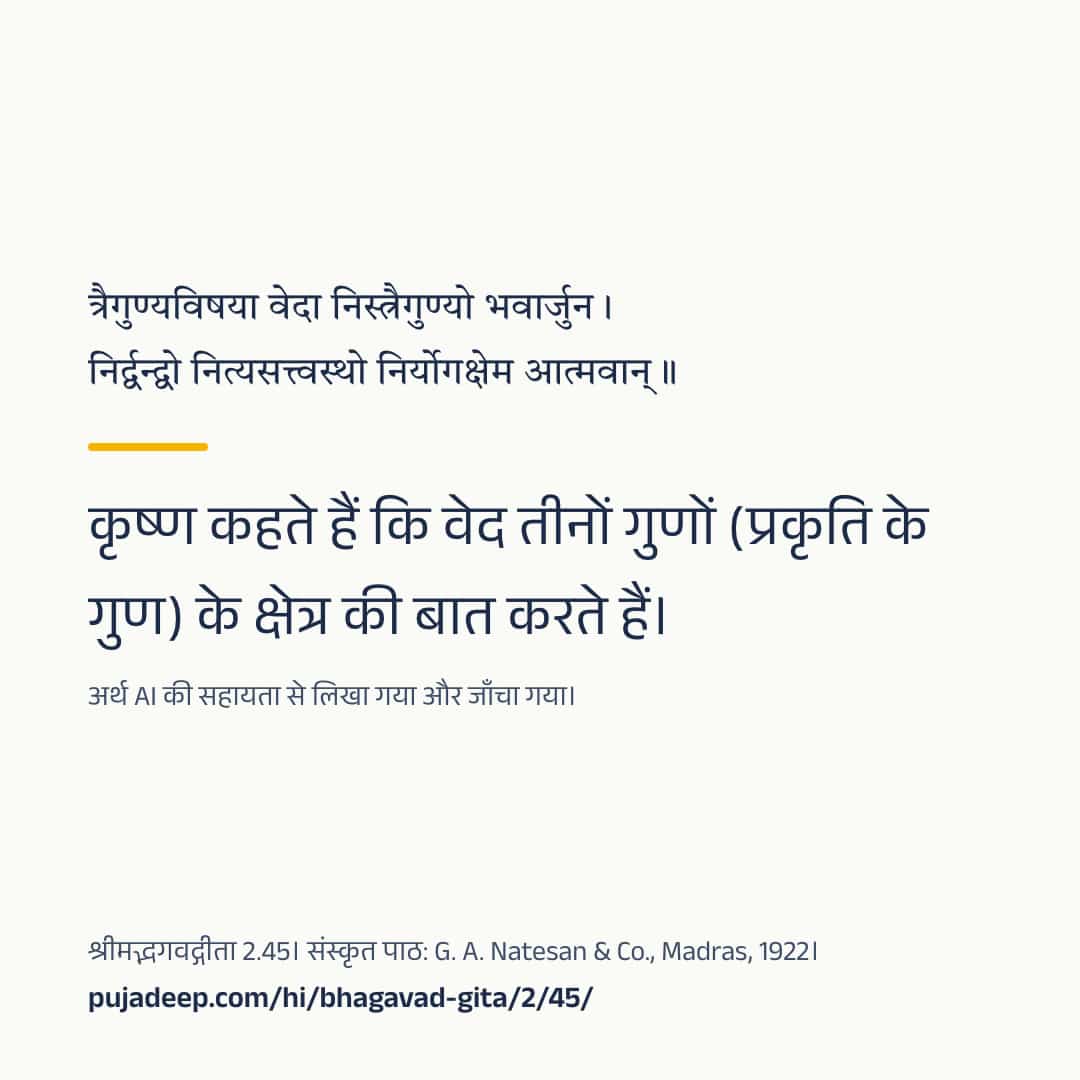
श्रीमद्भगवद्गीता (Bhagavad Gita) 2.45: कृष्ण कहते हैं कि वेद तीनों गुणों (प्रकृति के गुण) के क्षेत्र की बात करते हैं।
श्रीमद्भगवद्गीता 2.45
त्रैगुण्यविषया वेदा निस्त्रैगुण्यो भवार्जुन ।निर्द्वन्द्वो नित्यसत्त्वस्थो निर्योगक्षेम आत्मवान् ॥
Traigunyavishaya veda nistraigunyo bhavarjuna
Nirdvandvo nityasattvastho niryogakshema atmavan
traiguṇyaviṣayā vedā nistraiguṇyo bhavārjuna |
nirdvandvo nityasattvastho niryogakṣema ātmavān ||
हमारा अर्थ कृष्ण कहते हैं कि वेद तीनों गुणों (प्रकृति के गुण) के क्षेत्र की बात करते हैं। वे अर्जुन से कहते हैं कि वे तीनों गुणों और द्वंद्वों से ऊपर उठें, सदा सत्त्व में स्थित रहें, पाने और बचाने की चिंता छोड़ें, और आत्मा में स्थित रहें।
English meaning Krishna says the Vedas deal with the world of the three gunas (the qualities of nature). He asks Arjuna to rise above the three gunas and above the pairs of opposites, to stay always in sattva (purity), to be free of worry about getting and keeping, and to be centred in the self.
शब्दार्थ
हर शब्द, शब्दकोश के पृष्ठ के साथ
शब्दार्थ
- त्रैगुण्यविषयाः traiguṇyaviṣayāḥ तीन गुणों के विषय वाले (समास (पुंलिंग), प्रथमा बहुवचन) शब्दकोश: traiguṇya, मोनियर-विलियम्स 1899, पृ. 462, स्तंभ 1
the 3 Guṇas
; viṣaya, मोनियर-विलियम्स 1899, पृ. 997, स्तंभ 1sphere (of influence or activity)
- वेदाः vedāḥ वेद (संज्ञा (पुंलिंग), प्रथमा बहुवचन) शब्दकोश: 1. veda, मोनियर-विलियम्स 1899, पृ. 1015, स्तंभ 1
knowledge, true or sacred knowledge or lore
- निस्त्रैगुण्यः nistraiguṇyaḥ तीनों गुणों से परे (समास (पुंलिंग), प्रथमा एकवचन) शब्दकोश: nis-traiguṇya, मोनियर-विलियम्स 1899, पृ. 543, स्तंभ 3
destitute of the three Guṇas
- भव bhava हो जाओ (आज्ञार्थ (लोट्), मध्यम पुरुष एकवचन) शब्दकोश: 1. bhū, मोनियर-विलियम्स 1899, पृ. 760, स्तंभ 2
arise, come into being, exist
- अर्जुन arjuna हे अर्जुन (संज्ञा (पुंलिंग), संबोधन एकवचन) शब्दकोश: arjuna, मोनियर-विलियम्स 1899, पृ. 90, स्तंभ 1
- निर्द्वन्द्वः nirdvandvaḥ द्वंद्वों से रहित (समास (पुंलिंग), प्रथमा एकवचन) शब्दकोश: nir-dvaṃdva, मोनियर-विलियम्स 1899, पृ. 541, स्तंभ 2
indifferent to the alternatives or opposite pairs
- नित्यसत्त्वस्थः nityasattvasthaḥ सदा सत्त्व में स्थित (समास (पुंलिंग), प्रथमा एकवचन) शब्दकोश: nitya, मोनियर-विलियम्स 1899, पृ. 547, स्तंभ 2
continual, perpetual, eternal
; sat-tva, मोनियर-विलियम्स 1899, पृ. 1135, स्तंभ 2the quality of purity or goodness
; stha, मोनियर-विलियम्स 1899, पृ. 1262, स्तंभ 3standing, staying, abiding, being situated in
- निर्योगक्षेमः niryogakṣemaḥ योग-क्षेम की चिंता से रहित (समास (पुंलिंग), प्रथमा एकवचन) शब्दकोश: nis, मोनियर-विलियम्स 1899, पृ. 543, स्तंभ 2
out, forth, away
; yoga-kṣema, मोनियर-विलियम्स 1899, पृ. 856, स्तंभ 3the security or secure possession of what has been acquired
- आत्मवान् ātmavān संयमी, आत्मवान (विशेषण (पुंलिंग), प्रथमा एकवचन) शब्दकोश: ātma-vat, मोनियर-विलियम्स 1899, पृ. 135, स्तंभ 3
self-possessed, composed, prudent
सार्वजनिक डोमेन (कॉपीराइट-मुक्त) के अनुवाद
Kashinath Trimbak Telang, 1882। सार्वजनिक डोमेन (कॉपीराइट-मुक्त)। पृष्ठ 48।
The Vedas (merely) relate to the effects of the three qualities1; do you, O Arguna! rise above those effects of the three qualities, and be free from the pairs of opposites2, always preserve courage3, be free from anxiety for new acquisitions or protection of old acquisitions, and be self-controlled4.
पाद-टिप्पणियाँ (अनुवादक की अपनी) 3 अनुवादों की तुलना करें
Kashinath Trimbak Telang, 1882। सार्वजनिक डोमेन (कॉपीराइट-मुक्त)। पृष्ठ 48।
The Vedas (merely) relate to the effects of the three qualities1; do you, O Arguna! rise above those effects of the three qualities, and be free from the pairs of opposites2, always preserve courage3, be free from anxiety for new acquisitions or protection of old acquisitions, and be self-controlled4.
पाद-टिप्पणियाँ (अनुवादक की अपनी) आप यही पढ़ रहे हैं
Annie Besant, 1895। सार्वजनिक डोमेन (कॉपीराइट-मुक्त)। पृष्ठ 33।
The Vedas deal with the three attributes;1 be thou without these three attributes, O Arjuna; without the pairs of opposites, ever steadfast in Sattva, careless of possessions, full of the SELF.
पाद-टिप्पणियाँ (अनुवादक की अपनी) - Gunas=attributes, or forms of energy. They are Sattva, purity, Rajas, activity or passion, Tama, inertness or darkness. ↩
आप यही पढ़ रहे हैं
Swami Swarupananda, 1909 (पहली बार 1907 में छपा)। सार्वजनिक डोमेन (कॉपीराइट-मुक्त)। पृष्ठ 48।
The Vedas deal with the three Gunas. Be thou free, O Arjuna, from the triad of the Gunas, free from the pairs of opposites, ever-balanced, free from (the thought of) getting and keeping, and established in the Self.
आप यही पढ़ रहे हैं
भेजें
एक तस्वीर या पाठ एक चैट में भेजें। तस्वीर पर उसका स्रोत और इस पृष्ठ का पता लिखा है।
पाठ के रूप में भेजें
केवल शब्द और लिंक। कई बड़े-बुज़ुर्ग यही पसंद करते हैं।
श्रीमद्भगवद्गीता 2.45

त्रैगुण्यविषया वेदा निस्त्रैगुण्यो भवार्जुन ।
निर्द्वन्द्वो नित्यसत्त्वस्थो निर्योगक्षेम आत्मवान् ॥

“The Vedas (merely) relate to the effects of the three qualities; do you, O Arguna! rise above those effects of the three qualities, and be free from the pairs of opposites, always preserve courage, be free from anxiety for new acquisitions or protection of old acquisitions, and be self-controlled.”
(Kashinath Trimbak Telang, 1882, public domain)

“The Vedas deal with the three attributes; be thou without these three attributes, O Arjuna; without the pairs of opposites, ever steadfast in Sattva, careless of possessions, full of the SELF.”
(Annie Besant, 1895, public domain)

“The Vedas deal with the three Gunas. Be thou free, O Arjuna, from the triad of the Gunas, free from the pairs of opposites, ever-balanced, free from (the thought of) getting and keeping, and established in the Self.”
(Swami Swarupananda, 1909 (first printed 1907), public domain)

संस्कृत पाठ: G. A. Natesan & Co., Madras, 1922।
https://pujadeep.com/hi/bhagavad-gita/2/45/?s=copy
इस साइट से कुछ नहीं भेजा जाता। आपका अपना ऐप उसे आपकी चुनी हुई चैट में भेजता है। तस्वीर में तेलंग (1882) का अनुवाद है। अगर आपने ऊपर कोई और अनुवाद चुना है, तो पाठ में वही आता है और तस्वीर नहीं दी जाती।
संस्कृत पाठ: The Bhagavad-Gita, or The Lord's Song, with the text in Devanagari and an English translation, 1922। अर्थ: पूजादीप के लिए AI की सहायता से लिखे और जाँचे गए। स्रोत और बदलाव
परिवार जो प्रश्न पूछते हैं
गीता 2.45 कौन कहता है?
यह श्लोक कृष्ण कहते हैं, अध्याय 2 (सांख्ययोग) में।
संस्कृत पाठ कहाँ से लिया गया है?
संस्कृत पाठ: The Bhagavad-Gita, or The Lord's Song, with the text in Devanagari and an English translation, 1922। अर्थ: पूजादीप के लिए AI की सहायता से लिखे और जाँचे गए। स्रोत देखें
क्या इस पृष्ठ का अर्थ अनुवाद है?
इस साइट के लिए यहाँ दिए स्रोतों के आधार पर AI की सहायता से लिखी और जाँची गई व्याख्या। यह अनुवाद नहीं है, और पाठ को पढ़ने का एकमात्र तरीका भी नहीं है। श्रेय देकर उद्धृत करने के लिए स्वतंत्र।
स्रोत और लाइसेंस
- संस्कृत पाठ
- The Bhagavad-Gita, or The Lord's Song, with the text in Devanagari and an English translation (Annie Besant, G. A. Natesan & Co., Madras, 1922). सार्वजनिक डोमेन (कॉपीराइट-मुक्त)। इन पृष्ठों का संस्कृत पाठ इसी मुद्रण के पृष्ठ-चित्रों से पढ़ा गया है।
- अनुवाद
- The Bhagavadgîtâ with the Sanatsugâtîya and the Anugîtâ, translated by Kâshinâth Trimbak Telang (The Sacred Books of the East, vol. VIII, ed. F. Max Müller) (Kashinath Trimbak Telang, F. Max Müller, Clarendon Press, Oxford, 1882). सार्वजनिक डोमेन (कॉपीराइट-मुक्त)। जैसा छपा है, वैसा ही दिखाया गया।
- अनुवाद
- The Bhagavad Gîtâ, or The Lord's Song, translated by Annie Besant (Annie Besant, Theosophical Publishing Society, London, 1895). सार्वजनिक डोमेन (कॉपीराइट-मुक्त)। जैसा छपा है, वैसा ही दिखाया गया।
- संस्कृत पाठ
- Srimad-Bhagavad-Gita, with Sanskrit Text; Paraphrase with Word-by-word Literal Translation; English Rendering and Comments, Index, &c., by the Swami Swarupananda (Himalayan Series, No. XX) (Swami Swarupananda, The Editors and Publishers, Advaita Ashrama, Mayavati, Prabuddha Bharata Press, Mayavati, Almora, Himalayas, 1909). सार्वजनिक डोमेन (कॉपीराइट-मुक्त)। केवल यह दिखाने के लिए कि पाठ कितना पुराना है। इस पृष्ठ का देवनागरी पाठ एक पठन-पाठ है, इस मुद्रण से नहीं लिया गया।
- प्रचलित पाठ
- इस पाठ में 32 शब्द आज के प्रचलित रूप में हैं; इन्हें sanskritdocuments.org; संस्कृत विकिस्रोत; गीता प्रेस, गोरखपुर; ग्रेटिल, गॉटिंगेन और भक्तिवेदांत बुक ट्रस्ट के पाठ से मिलाकर जाँचा गया।
- हमारी व्याख्या
- इस साइट के लिए यहाँ दिए स्रोतों के आधार पर AI की सहायता से लिखी और जाँची गई व्याख्या। यह अनुवाद नहीं है, और पाठ को पढ़ने का एकमात्र तरीका भी नहीं है। श्रेय देकर उद्धृत करने के लिए स्वतंत्र।
- समीक्षा
- AI समीक्षा: उद्धृत संस्करण के विरुद्ध 2 स्वतंत्र समीक्षाएँ, 15 अक्टूबर 2026।