Bhagavad Gita · Chapter 2: Sankhya Yoga · Speaker: Krishna
Bhagavad Gita 2.43: Kamatmanah svargapara
Such people, Krishna says, are full of desire and aim at heaven.
Bhagavad Gita 2.43
कामात्मानः स्वर्गपरा जन्मकर्मफलप्रदाम् ।क्रियाविशेषबहुलां भोगैश्वर्यगतिं प्रति ॥
Kamatmanah svargapara janmakarmaphalapradam
Kriyavisheshabahulam bhogaishvaryagatim prati
kāmātmānaḥ svargaparā janmakarmaphalapradām |
kriyāviśeṣabahulāṃ bhogaiśvaryagatiṃ prati ||
Our meaning Such people, Krishna says, are full of desire and aim at heaven. Their words offer rebirth as the reward of action, and list many special rites for gaining pleasure and power.
हिंदी अर्थ कृष्ण कहते हैं कि ऐसे लोग कामनाओं से भरे हैं और स्वर्ग को ही लक्ष्य मानते हैं। उनकी बातें कर्म के फल के रूप में नए जन्म का वादा करती हैं, और भोग तथा ऐश्वर्य पाने के लिए अनेक विशेष क्रियाएँ बताती हैं।
Word by word
Every word, with its dictionary page
Word by word
- कामात्मानः kāmātmānaḥ full of desire (compound (masculine), nominative plural) Dictionary: kāmātman, Monier-Williams 1899, p. 272, col. 3
whose very essence is desire
- स्वर्गपराः svargaparāḥ holding heaven highest (compound (masculine), nominative plural) Dictionary: svarga-para, Monier-Williams 1899, p. 1281, col. 3
desirous of heaven
- जन्मकर्मफलप्रदाम् janmakarmaphalapradām telling of rebirth as action's fruit (compound (feminine), accusative singular) Dictionary: janman, Monier-Williams 1899, p. 411, col. 3
birth, production
; karma-phala, Monier-Williams 1899, p. 259, col. 1the fruit or recompense of actions
; pra-da, Monier-Williams 1899, p. 679, col. 3giving, yielding, offering, granting, bestowing
- क्रियाविशेषबहुलाम् kriyāviśeṣabahulām full of special rites (compound (feminine), accusative singular) Dictionary: kriyā, Monier-Williams 1899, p. 320, col. 3
doing, performing, performance
; vi-śeṣa, Monier-Williams 1899, p. 990, col. 2a kind, species
; bahula, Monier-Williams 1899, p. 726, col. 2abundant, numerous, many, much
- भोगैश्वर्यगतिम् bhogaiśvaryagatim gaining pleasure and power (compound (feminine), accusative singular) Dictionary: 2. bhoga, Monier-Williams 1899, p. 767, col. 2
enjoyment, eating, feeding on
; aiśvarya, Monier-Williams 1899, p. 234, col. 3the state of being a mighty lord, sovereignty, supremacy, power, sway
; gati, Monier-Williams 1899, p. 347, col. 3going, moving
- प्रति prati towards (indeclinable) Dictionary: 1. prati, Monier-Williams 1899, p. 661, col. 2
towards, near to
Public-domain translations
Kashinath Trimbak Telang, 1882. Public domain.
Telang translates verses 42–44 as one sentence; see 2.42. Read it at 2.42
Compare 3 translations
Kashinath Trimbak Telang, 1882. Public domain.
Telang translates verses 42–44 as one sentence; see 2.42. Read it at 2.42
You are reading this one
Annie Besant, 1895. Public domain. Page 32.
With Kâma for Self,1 with Svarga for goal, they offer birth as the fruit of action, and prescribe many and various ceremonies for the attainment of pleasure and lordship.
Footnotes (the translator’s own) - Those whose very self is Kâma, i.e., desire, and who therefore act with a view to win Svarga, and also rebirth to wealth and rank. ↩
You are reading this one
Swami Swarupananda, 1909 (first printed 1907). Public domain.
Swarupananda renders verses 42–44 together; see 2.42. Read it at 2.42
You are reading this one
Share
Send one picture or the text to one chat. The picture names its source and the address of this page.
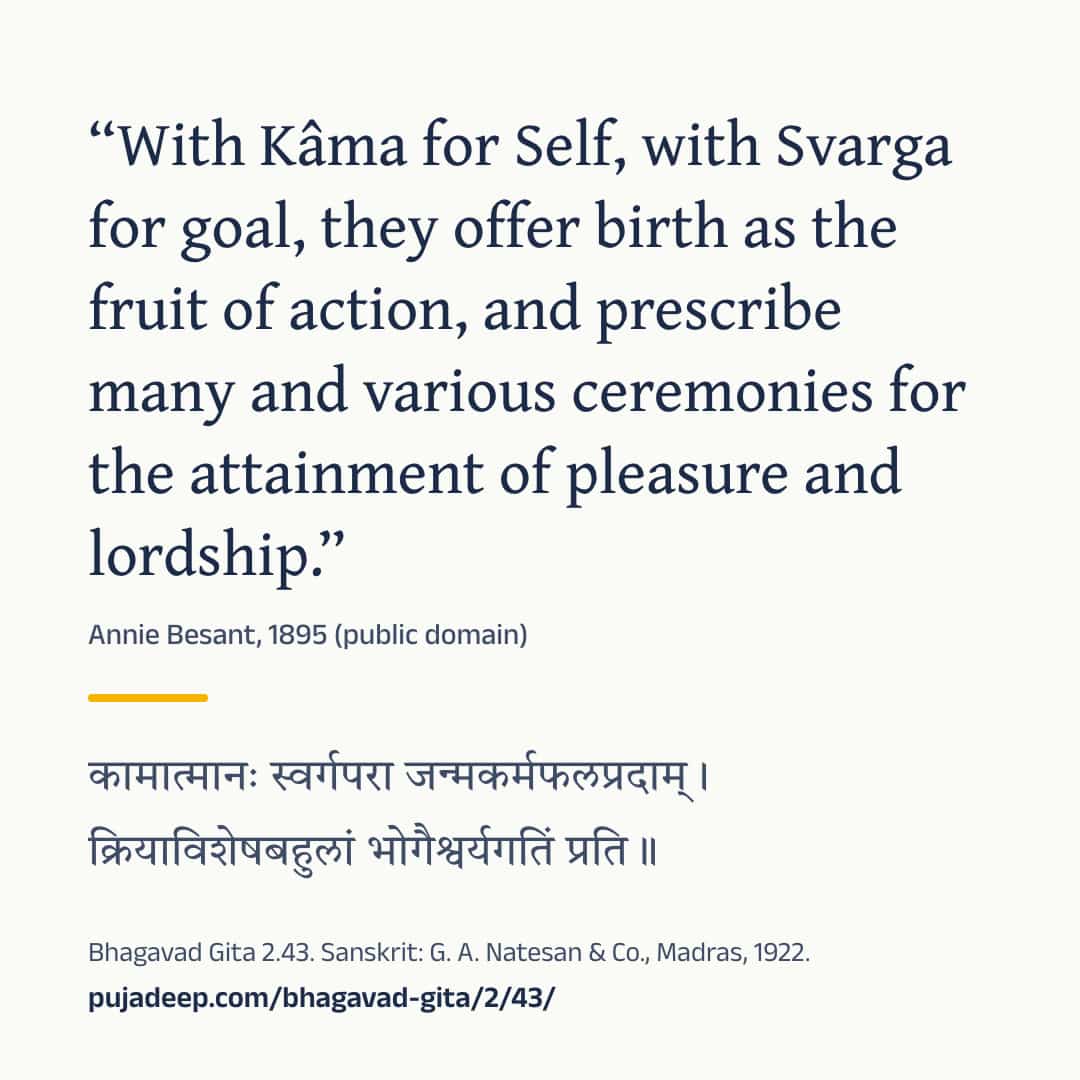
Send as text
The words and the link only. Many elders prefer this.
Bhagavad Gita 2.43

कामात्मानः स्वर्गपरा जन्मकर्मफलप्रदाम् ।
क्रियाविशेषबहुलां भोगैश्वर्यगतिं प्रति ॥

“With Kâma for Self, with Svarga for goal, they offer birth as the fruit of action, and prescribe many and various ceremonies for the attainment of pleasure and lordship.”
(Annie Besant, 1895, public domain)

Sanskrit: G. A. Natesan & Co., Madras, 1922.
https://pujadeep.com/bhagavad-gita/2/43/?s=copy Nothing is sent from this site. Your own app sends it, to the chat you choose. The picture quotes Telang (1882). If you chose another translation above, the text quotes yours and no picture is offered.
Sanskrit text: The Bhagavad-Gita, or The Lord's Song, with the text in Devanagari and an English translation, 1922. Meanings: written for Pujadeep with AI help and reviewed. Source and changes
Questions families ask
Who speaks Bhagavad Gita 2.43?
Krishna speaks this verse, in chapter 2 (Sankhya Yoga).
Where does the Sanskrit text come from?
Sanskrit text: The Bhagavad-Gita, or The Lord's Song, with the text in Devanagari and an English translation, 1922. Meanings: written for Pujadeep with AI help and reviewed. See the source
Is the meaning on this page a translation?
Explanation written for this site with AI help from the sources listed here, and reviewed. It is not a translation and not the only way to read the text. Free to quote with credit.
Source and licence
- Sanskrit text
- The Bhagavad-Gita, or The Lord's Song, with the text in Devanagari and an English translation (Annie Besant, G. A. Natesan & Co., Madras, 1922). Public domain. The Sanskrit on these pages was read from this printing’s page images.
- Translation
- The Bhagavadgîtâ with the Sanatsugâtîya and the Anugîtâ, translated by Kâshinâth Trimbak Telang (The Sacred Books of the East, vol. VIII, ed. F. Max Müller) (Kashinath Trimbak Telang, F. Max Müller, Clarendon Press, Oxford, 1882). Public domain. Shown verbatim, as printed.
- Translation
- The Bhagavad Gîtâ, or The Lord's Song, translated by Annie Besant (Annie Besant, Theosophical Publishing Society, London, 1895). Public domain. Shown verbatim, as printed.
- Sanskrit text
- Srimad-Bhagavad-Gita, with Sanskrit Text; Paraphrase with Word-by-word Literal Translation; English Rendering and Comments, Index, &c., by the Swami Swarupananda (Himalayan Series, No. XX) (Swami Swarupananda, The Editors and Publishers, Advaita Ashrama, Mayavati, Prabuddha Bharata Press, Mayavati, Almora, Himalayas, 1909). Public domain. Used only to date the text. The Devanagari on this page is a reading text and is not copied from this printing.
- Common wording
- In this text, 32 words follow today's common wording, checked against sanskritdocuments.org; Sanskrit Wikisource; Gita Press, Gorakhpur; GRETIL, Göttingen and Bhaktivedanta Book Trust.
- Our explanation
- Explanation written for this site with AI help from the sources listed here, and reviewed. It is not a translation and not the only way to read the text. Free to quote with credit.
- Review
- AI review: 2 independent reviews against the cited edition, October 15, 2026.