Bhagavad Gita · Chapter 2: Sankhya Yoga · Speaker: Krishna
Bhagavad Gita 2.42: Yamimam pushpitam vacham
Krishna begins a long sentence that runs through verse 44.
Bhagavad Gita 2.42
यामिमां पुष्पितां वाचं प्रवदन्त्यविपश्चितः ।वेदवादरताः पार्थ नान्यदस्तीति वादिनः ॥
Yamimam pushpitam vacham pravadantyavipashchitah
Vedavadaratah partha nanyadastiti vadinah
yāmimāṃ puṣpitāṃ vācaṃ pravadantyavipaścitaḥ |
vedavādaratāḥ pārtha nānyadastīti vādinaḥ ||
Our meaning Krishna begins a long sentence that runs through verse 44. He describes people without discernment who speak flowery words. They delight in the parts of the Vedas that praise rituals and their rewards, and they say there is nothing beyond these.
हिंदी अर्थ कृष्ण एक लंबा वाक्य शुरू करते हैं जो श्लोक 44 तक चलता है। वे उन अविवेकी लोगों का वर्णन करते हैं जो फूलों जैसी लुभावनी बातें करते हैं, वेदों के कर्मकांड और उनके फल बताने वाले वचनों में ही रमे रहते हैं, और कहते हैं कि इसके आगे कुछ नहीं है।
Word by word
Every word, with its dictionary page
Word by word
- याम् yām which (pronoun (feminine), accusative singular) Dictionary: yad, Monier-Williams 1899, p. 844, col. 2
who, which, what, whichever, whatever, that
- इमाम् imām this (pronoun (feminine), accusative singular) Dictionary: 1. idam, Monier-Williams 1899, p. 165, col. 2
- पुष्पिताम् puṣpitām flowery (past participle (feminine), accusative singular) Dictionary: puṣpita, Monier-Williams 1899, p. 640, col. 2
flowered, bearing flowers, blooming, in bloom
- वाचम् vācam speech (noun (feminine), accusative singular) Dictionary: vāc, Monier-Williams 1899, p. 936, col. 1
speech, voice, talk, language
- प्रवदन्ति pravadanti speak, proclaim (present, 3rd person plural) Dictionary: pra-vad, Monier-Williams 1899, p. 690, col. 3
to assert, affirm, state
- अविपश्चितः avipaścitaḥ the unwise (adjective (masculine), nominative plural) Dictionary: a-vipaścit, Monier-Williams 1899, p. 109, col. 1
unwise, ignorant
- वेदवादरताः vedavādaratāḥ delighting in Vedic words (compound (masculine), nominative plural) Dictionary: veda-vāda, Monier-Williams 1899, p. 1016, col. 1
speaking about the V°, Vedic discussion
; rata, Monier-Williams 1899, p. 867, col. 2delighting in, intent upon, fond or enamoured of, devoted or attached
- पार्थ pārtha O Partha (noun (masculine), vocative singular) Dictionary: 2. pārtha, Monier-Williams 1899, p. 621, col. 3
- न na not (indeclinable) Dictionary: 2. na, Monier-Williams 1899, p. 523, col. 1
ind. not, no, nor, neither
- अन्यत् anyat anything else (pronoun (neuter), nominative singular) Dictionary: 2. anya, Monier-Williams 1899, p. 45, col. 2
other, different
- अस्ति asti is (present, 3rd person singular) Dictionary: 1. as, Monier-Williams 1899, p. 117, col. 2
to be, live, exist, be present
- इति iti thus (ends their words) (indeclinable) Dictionary: 2. iti, Monier-Williams 1899, p. 165, col. 1
in this manner, thus
- वादिनः vādinaḥ saying (noun (masculine), nominative plural) Dictionary: vādin, Monier-Williams 1899, p. 940, col. 1
saying, discoursing, speaking, talking
Public-domain translations
Kashinath Trimbak Telang, 1882. Public domain. Page 47–48.
The state of mind consisting in firm understanding regarding steady contemplation1 does not belong to those, O son of Prithâ! who are strongly attached to (worldly) pleasures and power, and whose minds are drawn away by that flowery talk which is full of (ordinances of) specific acts for the attainment of (those) pleasures and (that) power, and which promises birth as the fruit of acts2—(that flowery talk) which those unwise ones utter, who are enamoured of Vedic words, who say there is nothing else, who are full of desires, and whose goal is heaven3.
This sentence covers verses 2.42 to 2.44.
Footnotes (the translator’s own) Compare 3 translations
Kashinath Trimbak Telang, 1882. Public domain. Page 47–48.
The state of mind consisting in firm understanding regarding steady contemplation1 does not belong to those, O son of Prithâ! who are strongly attached to (worldly) pleasures and power, and whose minds are drawn away by that flowery talk which is full of (ordinances of) specific acts for the attainment of (those) pleasures and (that) power, and which promises birth as the fruit of acts2—(that flowery talk) which those unwise ones utter, who are enamoured of Vedic words, who say there is nothing else, who are full of desires, and whose goal is heaven3.
This sentence covers verses 2.42 to 2.44.
Footnotes (the translator’s own) You are reading this one
Annie Besant, 1895. Public domain. Page 32.
Flowery speech is uttered by the foolish, rejoicing in the words of the Vedas, O Pârtha; "There is naught but this," say they.
You are reading this one
Swami Swarupananda, 1909 (first printed 1907). Public domain. Page 47.
O Pârtha, no set determination is formed in the minds of those that are deeply attached to pleasure and power, and whose discrimination is stolen away by the flowery words of the unwise, who are full of desires and look upon heaven as their highest goal and who, being perfectly satisfied with the panegyric words of the Vedas, declare that there is nothing else. Their (flowery) words are exuberant with various specific rites as the means to pleasure and power and are the causes of (new) births as the result of their works (performed with desire).
This sentence covers verses 2.42 to 2.44.
You are reading this one
Share
Send one picture or the text to one chat. The picture names its source and the address of this page.
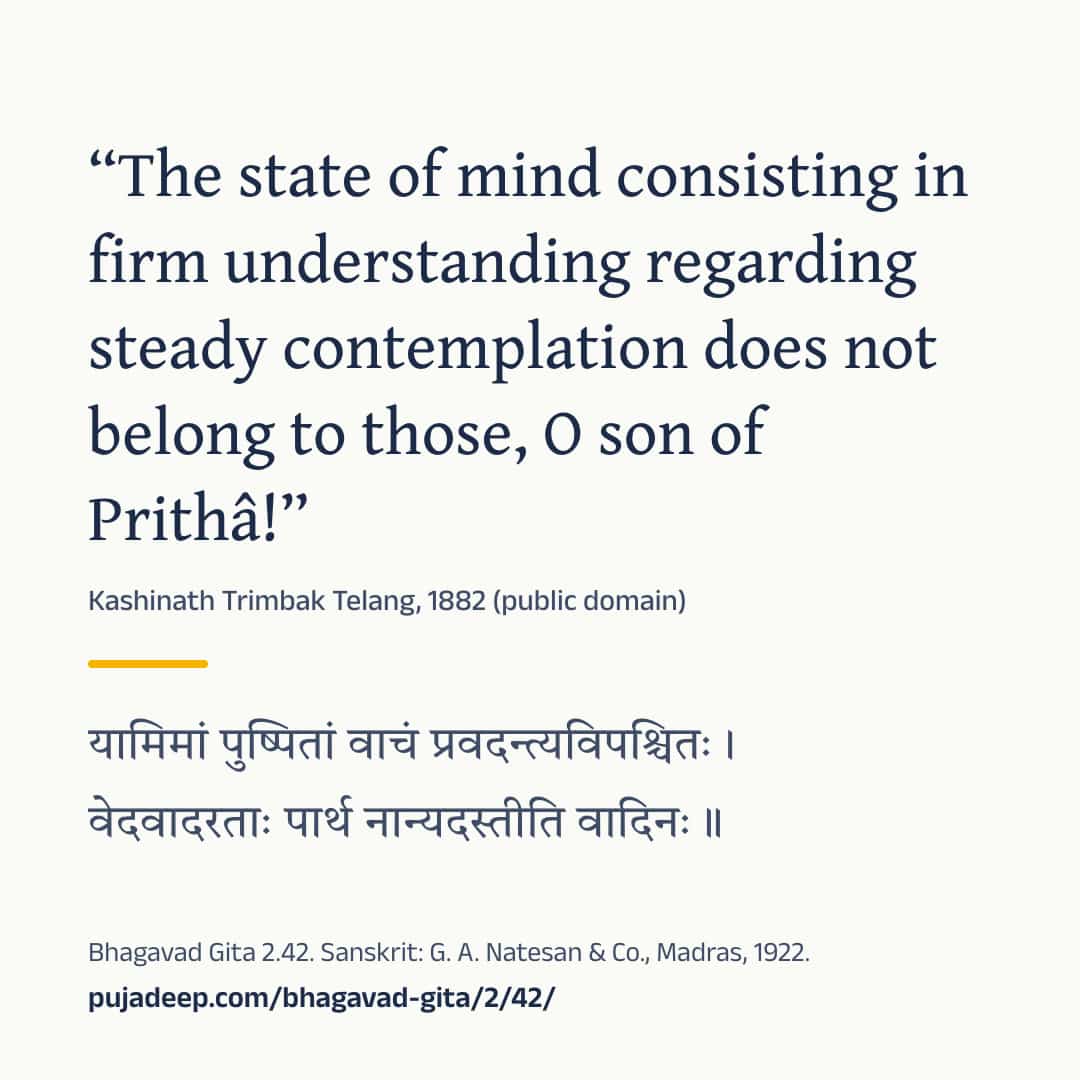
Send as text
The words and the link only. Many elders prefer this.
Bhagavad Gita 2.42

यामिमां पुष्पितां वाचं प्रवदन्त्यविपश्चितः ।
वेदवादरताः पार्थ नान्यदस्तीति वादिनः ॥

“The state of mind consisting in firm understanding regarding steady contemplation does not belong to those, O son of Prithâ! who are strongly attached to (worldly) pleasures and power, and whose minds are drawn away by that flowery talk which is full of (ordinances of) specific acts for the attainment of (those) pleasures and (that) power, and which promises birth as the fruit of acts—(that flowery talk) which those unwise ones utter, who are enamoured of Vedic words, who say there is nothing else, who are full of desires, and whose goal is heaven.”
(Kashinath Trimbak Telang, 1882, public domain)

“Flowery speech is uttered by the foolish, rejoicing in the words of the Vedas, O Pârtha; "There is naught but this," say they.”
(Annie Besant, 1895, public domain)

“O Pârtha, no set determination is formed in the minds of those that are deeply attached to pleasure and power, and whose discrimination is stolen away by the flowery words of the unwise, who are full of desires and look upon heaven as their highest goal and who, being perfectly satisfied with the panegyric words of the Vedas, declare that there is nothing else. Their (flowery) words are exuberant with various specific rites as the means to pleasure and power and are the causes of (new) births as the result of their works (performed with desire).”
(Swami Swarupananda, 1909 (first printed 1907), public domain)

Sanskrit: G. A. Natesan & Co., Madras, 1922.
https://pujadeep.com/bhagavad-gita/2/42/?s=copy Nothing is sent from this site. Your own app sends it, to the chat you choose. The picture quotes Telang (1882). If you chose another translation above, the text quotes yours and no picture is offered.
Sanskrit text: The Bhagavad-Gita, or The Lord's Song, with the text in Devanagari and an English translation, 1922. Meanings: written for Pujadeep with AI help and reviewed. Source and changes
Questions families ask
Who speaks Bhagavad Gita 2.42?
Krishna speaks this verse, in chapter 2 (Sankhya Yoga).
Where does the Sanskrit text come from?
Sanskrit text: The Bhagavad-Gita, or The Lord's Song, with the text in Devanagari and an English translation, 1922. Meanings: written for Pujadeep with AI help and reviewed. See the source
Is the meaning on this page a translation?
Explanation written for this site with AI help from the sources listed here, and reviewed. It is not a translation and not the only way to read the text. Free to quote with credit.
Source and licence
- Sanskrit text
- The Bhagavad-Gita, or The Lord's Song, with the text in Devanagari and an English translation (Annie Besant, G. A. Natesan & Co., Madras, 1922). Public domain. The Sanskrit on these pages was read from this printing’s page images.
- Translation
- The Bhagavadgîtâ with the Sanatsugâtîya and the Anugîtâ, translated by Kâshinâth Trimbak Telang (The Sacred Books of the East, vol. VIII, ed. F. Max Müller) (Kashinath Trimbak Telang, F. Max Müller, Clarendon Press, Oxford, 1882). Public domain. Shown verbatim, as printed.
- Translation
- The Bhagavad Gîtâ, or The Lord's Song, translated by Annie Besant (Annie Besant, Theosophical Publishing Society, London, 1895). Public domain. Shown verbatim, as printed.
- Sanskrit text
- Srimad-Bhagavad-Gita, with Sanskrit Text; Paraphrase with Word-by-word Literal Translation; English Rendering and Comments, Index, &c., by the Swami Swarupananda (Himalayan Series, No. XX) (Swami Swarupananda, The Editors and Publishers, Advaita Ashrama, Mayavati, Prabuddha Bharata Press, Mayavati, Almora, Himalayas, 1909). Public domain. Used only to date the text. The Devanagari on this page is a reading text and is not copied from this printing.
- Common wording
- In this text, 32 words follow today's common wording, checked against sanskritdocuments.org; Sanskrit Wikisource; Gita Press, Gorakhpur; GRETIL, Göttingen and Bhaktivedanta Book Trust.
- Our explanation
- Explanation written for this site with AI help from the sources listed here, and reviewed. It is not a translation and not the only way to read the text. Free to quote with credit.
- Review
- AI review: 2 independent reviews against the cited edition, October 15, 2026.