श्रीमद्भगवद्गीता · अध्याय 2: सांख्ययोग · वक्ता: कृष्ण
श्रीमद्भगवद्गीता 2.42 का अर्थ
श्रीमद्भगवद्गीता (Bhagavad Gita) 2.42: कृष्ण एक लंबा वाक्य शुरू करते हैं जो श्लोक 44 तक चलता है।
श्रीमद्भगवद्गीता 2.42
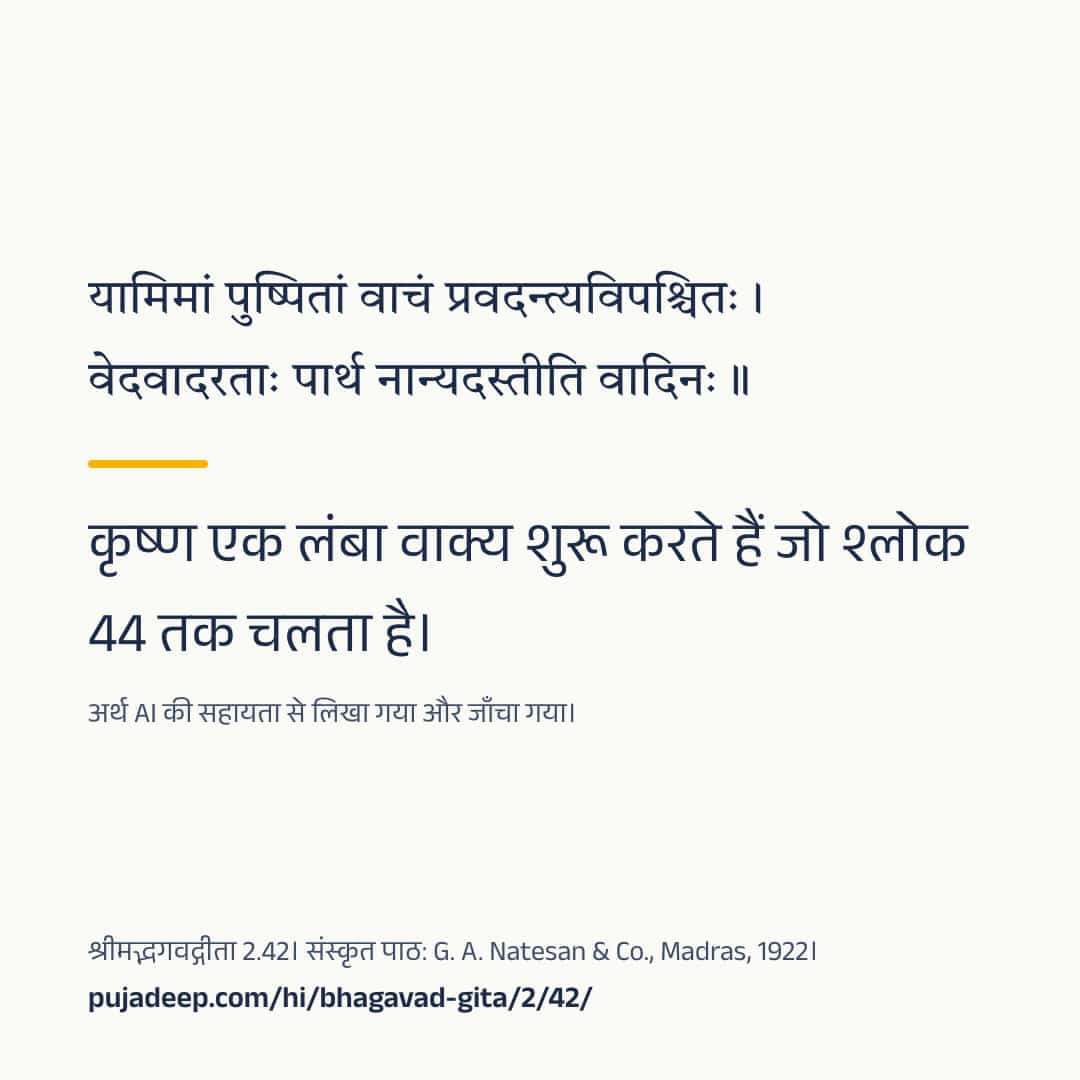
यामिमां पुष्पितां वाचं प्रवदन्त्यविपश्चितः ।वेदवादरताः पार्थ नान्यदस्तीति वादिनः ॥
Yamimam pushpitam vacham pravadantyavipashchitah
Vedavadaratah partha nanyadastiti vadinah
yāmimāṃ puṣpitāṃ vācaṃ pravadantyavipaścitaḥ |
vedavādaratāḥ pārtha nānyadastīti vādinaḥ ||
हमारा अर्थ कृष्ण एक लंबा वाक्य शुरू करते हैं जो श्लोक 44 तक चलता है। वे उन अविवेकी लोगों का वर्णन करते हैं जो फूलों जैसी लुभावनी बातें करते हैं, वेदों के कर्मकांड और उनके फल बताने वाले वचनों में ही रमे रहते हैं, और कहते हैं कि इसके आगे कुछ नहीं है।
English meaning Krishna begins a long sentence that runs through verse 44. He describes people without discernment who speak flowery words. They delight in the parts of the Vedas that praise rituals and their rewards, and they say there is nothing beyond these.
शब्दार्थ
हर शब्द, शब्दकोश के पृष्ठ के साथ
शब्दार्थ
- याम् yām जिस (सर्वनाम (स्त्रीलिंग), द्वितीया एकवचन) शब्दकोश: yad, मोनियर-विलियम्स 1899, पृ. 844, स्तंभ 2
who, which, what, whichever, whatever, that
- इमाम् imām इस (सर्वनाम (स्त्रीलिंग), द्वितीया एकवचन) शब्दकोश: 1. idam, मोनियर-विलियम्स 1899, पृ. 165, स्तंभ 2
- पुष्पिताम् puṣpitām फूलों जैसी सजी (भूतकालिक कृदन्त (स्त्रीलिंग), द्वितीया एकवचन) शब्दकोश: puṣpita, मोनियर-विलियम्स 1899, पृ. 640, स्तंभ 2
flowered, bearing flowers, blooming, in bloom
- वाचम् vācam वाणी (संज्ञा (स्त्रीलिंग), द्वितीया एकवचन) शब्दकोश: vāc, मोनियर-विलियम्स 1899, पृ. 936, स्तंभ 1
speech, voice, talk, language
- प्रवदन्ति pravadanti कहते हैं (वर्तमान काल (लट्), प्रथम पुरुष बहुवचन) शब्दकोश: pra-vad, मोनियर-विलियम्स 1899, पृ. 690, स्तंभ 3
to assert, affirm, state
- अविपश्चितः avipaścitaḥ अविवेकी लोग (विशेषण (पुंलिंग), प्रथमा बहुवचन) शब्दकोश: a-vipaścit, मोनियर-विलियम्स 1899, पृ. 109, स्तंभ 1
unwise, ignorant
- वेदवादरताः vedavādaratāḥ वेद के वचनों में रमे हुए (समास (पुंलिंग), प्रथमा बहुवचन) शब्दकोश: veda-vāda, मोनियर-विलियम्स 1899, पृ. 1016, स्तंभ 1
speaking about the V°, Vedic discussion
; rata, मोनियर-विलियम्स 1899, पृ. 867, स्तंभ 2delighting in, intent upon, fond or enamoured of, devoted or attached
- पार्थ pārtha हे पार्थ (संज्ञा (पुंलिंग), संबोधन एकवचन) शब्दकोश: 2. pārtha, मोनियर-विलियम्स 1899, पृ. 621, स्तंभ 3
- न na नहीं (अव्यय) शब्दकोश: 2. na, मोनियर-विलियम्स 1899, पृ. 523, स्तंभ 1
ind. not, no, nor, neither
- अन्यत् anyat और कुछ (सर्वनाम (नपुंसकलिंग), प्रथमा एकवचन) शब्दकोश: 2. anya, मोनियर-विलियम्स 1899, पृ. 45, स्तंभ 2
other, different
- अस्ति asti है (वर्तमान काल (लट्), प्रथम पुरुष एकवचन) शब्दकोश: 1. as, मोनियर-विलियम्स 1899, पृ. 117, स्तंभ 2
to be, live, exist, be present
- इति iti ऐसा (कथन का अंत) (अव्यय) शब्दकोश: 2. iti, मोनियर-विलियम्स 1899, पृ. 165, स्तंभ 1
in this manner, thus
- वादिनः vādinaḥ कहने वाले (संज्ञा (पुंलिंग), प्रथमा बहुवचन) शब्दकोश: vādin, मोनियर-विलियम्स 1899, पृ. 940, स्तंभ 1
saying, discoursing, speaking, talking
सार्वजनिक डोमेन (कॉपीराइट-मुक्त) के अनुवाद
Kashinath Trimbak Telang, 1882। सार्वजनिक डोमेन (कॉपीराइट-मुक्त)। पृष्ठ 47–48।
The state of mind consisting in firm understanding regarding steady contemplation1 does not belong to those, O son of Prithâ! who are strongly attached to (worldly) pleasures and power, and whose minds are drawn away by that flowery talk which is full of (ordinances of) specific acts for the attainment of (those) pleasures and (that) power, and which promises birth as the fruit of acts2—(that flowery talk) which those unwise ones utter, who are enamoured of Vedic words, who say there is nothing else, who are full of desires, and whose goal is heaven3.
यह वाक्य श्लोक 2.42 से 2.44 तक का है।
पाद-टिप्पणियाँ (अनुवादक की अपनी) 3 अनुवादों की तुलना करें
Kashinath Trimbak Telang, 1882। सार्वजनिक डोमेन (कॉपीराइट-मुक्त)। पृष्ठ 47–48।
The state of mind consisting in firm understanding regarding steady contemplation1 does not belong to those, O son of Prithâ! who are strongly attached to (worldly) pleasures and power, and whose minds are drawn away by that flowery talk which is full of (ordinances of) specific acts for the attainment of (those) pleasures and (that) power, and which promises birth as the fruit of acts2—(that flowery talk) which those unwise ones utter, who are enamoured of Vedic words, who say there is nothing else, who are full of desires, and whose goal is heaven3.
यह वाक्य श्लोक 2.42 से 2.44 तक का है।
पाद-टिप्पणियाँ (अनुवादक की अपनी) आप यही पढ़ रहे हैं
Annie Besant, 1895। सार्वजनिक डोमेन (कॉपीराइट-मुक्त)। पृष्ठ 32।
Flowery speech is uttered by the foolish, rejoicing in the words of the Vedas, O Pârtha; "There is naught but this," say they.
आप यही पढ़ रहे हैं
Swami Swarupananda, 1909 (पहली बार 1907 में छपा)। सार्वजनिक डोमेन (कॉपीराइट-मुक्त)। पृष्ठ 47।
O Pârtha, no set determination is formed in the minds of those that are deeply attached to pleasure and power, and whose discrimination is stolen away by the flowery words of the unwise, who are full of desires and look upon heaven as their highest goal and who, being perfectly satisfied with the panegyric words of the Vedas, declare that there is nothing else. Their (flowery) words are exuberant with various specific rites as the means to pleasure and power and are the causes of (new) births as the result of their works (performed with desire).
यह वाक्य श्लोक 2.42 से 2.44 तक का है।
आप यही पढ़ रहे हैं
भेजें
एक तस्वीर या पाठ एक चैट में भेजें। तस्वीर पर उसका स्रोत और इस पृष्ठ का पता लिखा है।
पाठ के रूप में भेजें
केवल शब्द और लिंक। कई बड़े-बुज़ुर्ग यही पसंद करते हैं।
श्रीमद्भगवद्गीता 2.42

यामिमां पुष्पितां वाचं प्रवदन्त्यविपश्चितः ।
वेदवादरताः पार्थ नान्यदस्तीति वादिनः ॥

“The state of mind consisting in firm understanding regarding steady contemplation does not belong to those, O son of Prithâ! who are strongly attached to (worldly) pleasures and power, and whose minds are drawn away by that flowery talk which is full of (ordinances of) specific acts for the attainment of (those) pleasures and (that) power, and which promises birth as the fruit of acts—(that flowery talk) which those unwise ones utter, who are enamoured of Vedic words, who say there is nothing else, who are full of desires, and whose goal is heaven.”
(Kashinath Trimbak Telang, 1882, public domain)

“Flowery speech is uttered by the foolish, rejoicing in the words of the Vedas, O Pârtha; "There is naught but this," say they.”
(Annie Besant, 1895, public domain)

“O Pârtha, no set determination is formed in the minds of those that are deeply attached to pleasure and power, and whose discrimination is stolen away by the flowery words of the unwise, who are full of desires and look upon heaven as their highest goal and who, being perfectly satisfied with the panegyric words of the Vedas, declare that there is nothing else. Their (flowery) words are exuberant with various specific rites as the means to pleasure and power and are the causes of (new) births as the result of their works (performed with desire).”
(Swami Swarupananda, 1909 (first printed 1907), public domain)

संस्कृत पाठ: G. A. Natesan & Co., Madras, 1922।
https://pujadeep.com/hi/bhagavad-gita/2/42/?s=copy
इस साइट से कुछ नहीं भेजा जाता। आपका अपना ऐप उसे आपकी चुनी हुई चैट में भेजता है। तस्वीर में तेलंग (1882) का अनुवाद है। अगर आपने ऊपर कोई और अनुवाद चुना है, तो पाठ में वही आता है और तस्वीर नहीं दी जाती।
संस्कृत पाठ: The Bhagavad-Gita, or The Lord's Song, with the text in Devanagari and an English translation, 1922। अर्थ: पूजादीप के लिए AI की सहायता से लिखे और जाँचे गए। स्रोत और बदलाव
परिवार जो प्रश्न पूछते हैं
गीता 2.42 कौन कहता है?
यह श्लोक कृष्ण कहते हैं, अध्याय 2 (सांख्ययोग) में।
संस्कृत पाठ कहाँ से लिया गया है?
संस्कृत पाठ: The Bhagavad-Gita, or The Lord's Song, with the text in Devanagari and an English translation, 1922। अर्थ: पूजादीप के लिए AI की सहायता से लिखे और जाँचे गए। स्रोत देखें
क्या इस पृष्ठ का अर्थ अनुवाद है?
इस साइट के लिए यहाँ दिए स्रोतों के आधार पर AI की सहायता से लिखी और जाँची गई व्याख्या। यह अनुवाद नहीं है, और पाठ को पढ़ने का एकमात्र तरीका भी नहीं है। श्रेय देकर उद्धृत करने के लिए स्वतंत्र।
स्रोत और लाइसेंस
- संस्कृत पाठ
- The Bhagavad-Gita, or The Lord's Song, with the text in Devanagari and an English translation (Annie Besant, G. A. Natesan & Co., Madras, 1922). सार्वजनिक डोमेन (कॉपीराइट-मुक्त)। इन पृष्ठों का संस्कृत पाठ इसी मुद्रण के पृष्ठ-चित्रों से पढ़ा गया है।
- अनुवाद
- The Bhagavadgîtâ with the Sanatsugâtîya and the Anugîtâ, translated by Kâshinâth Trimbak Telang (The Sacred Books of the East, vol. VIII, ed. F. Max Müller) (Kashinath Trimbak Telang, F. Max Müller, Clarendon Press, Oxford, 1882). सार्वजनिक डोमेन (कॉपीराइट-मुक्त)। जैसा छपा है, वैसा ही दिखाया गया।
- अनुवाद
- The Bhagavad Gîtâ, or The Lord's Song, translated by Annie Besant (Annie Besant, Theosophical Publishing Society, London, 1895). सार्वजनिक डोमेन (कॉपीराइट-मुक्त)। जैसा छपा है, वैसा ही दिखाया गया।
- संस्कृत पाठ
- Srimad-Bhagavad-Gita, with Sanskrit Text; Paraphrase with Word-by-word Literal Translation; English Rendering and Comments, Index, &c., by the Swami Swarupananda (Himalayan Series, No. XX) (Swami Swarupananda, The Editors and Publishers, Advaita Ashrama, Mayavati, Prabuddha Bharata Press, Mayavati, Almora, Himalayas, 1909). सार्वजनिक डोमेन (कॉपीराइट-मुक्त)। केवल यह दिखाने के लिए कि पाठ कितना पुराना है। इस पृष्ठ का देवनागरी पाठ एक पठन-पाठ है, इस मुद्रण से नहीं लिया गया।
- प्रचलित पाठ
- इस पाठ में 32 शब्द आज के प्रचलित रूप में हैं; इन्हें sanskritdocuments.org; संस्कृत विकिस्रोत; गीता प्रेस, गोरखपुर; ग्रेटिल, गॉटिंगेन और भक्तिवेदांत बुक ट्रस्ट के पाठ से मिलाकर जाँचा गया।
- हमारी व्याख्या
- इस साइट के लिए यहाँ दिए स्रोतों के आधार पर AI की सहायता से लिखी और जाँची गई व्याख्या। यह अनुवाद नहीं है, और पाठ को पढ़ने का एकमात्र तरीका भी नहीं है। श्रेय देकर उद्धृत करने के लिए स्वतंत्र।
- समीक्षा
- AI समीक्षा: उद्धृत संस्करण के विरुद्ध 2 स्वतंत्र समीक्षाएँ, 15 अक्टूबर 2026।