Bhagavad Gita · Chapter 2: Sankhya Yoga · Speaker: Krishna
Bhagavad Gita 2.41: Vyavasayatmika buddhirekeha
On this path, Krishna says, a mind that has truly decided is single and focused.
Bhagavad Gita 2.41
व्यवसायात्मिका बुद्धिरेकेह कुरुनन्दन ।बहुशाखा ह्यनन्ताश्च बुद्धयोऽव्यवसायिनाम् ॥
Vyavasayatmika buddhirekeha kurunandana
Bahushakha hyanantashcha buddhayovyavasayinam
vyavasāyātmikā buddhirekeha kurunandana |
bahuśākhā hyanantāśca buddhayo’vyavasāyinām ||
Our meaning On this path, Krishna says, a mind that has truly decided is single and focused. The minds of the undecided branch out in endless directions.
हिंदी अर्थ कृष्ण कहते हैं कि इस मार्ग पर निश्चय वाली बुद्धि एक ही होती है, जबकि अनिश्चित लोगों की बुद्धियाँ अनगिनत शाखाओं में बँटी रहती हैं।
Word by word
Every word, with its dictionary page
Word by word
- व्यवसायात्मिका vyavasāyātmikā resolute, of firm resolve (compound (feminine), nominative singular) Dictionary: vy-avasāyātmaka, Monier-Williams 1899, p. 1033, col. 3
full of resolve or energy, energetic
- बुद्धिः buddhiḥ understanding (noun (feminine), nominative singular) Dictionary: buddhi, Monier-Williams 1899, p. 733, col. 3
intelligence, reason, intellect, mind, discernment, judgment
- एका ekā one, single (adjective (feminine), nominative singular) Dictionary: eka, Monier-Williams 1899, p. 227, col. 3
one
- इह iha here (indeclinable) Dictionary: iha, Monier-Williams 1899, p. 169, col. 3
in this place, here
- कुरुनन्दन kurunandana O joy of the Kurus (compound (masculine), vocative singular) Dictionary: kuru-nandana, Monier-Williams 1899, p. 294, col. 1
a descendant of Kuru
- बहुशाखाः bahuśākhāḥ many-branched (compound (feminine), nominative plural) Dictionary: bahu-śākha, Monier-Williams 1899, p. 726, col. 1
having many branches or ramifications, multifarious, manifold
- हि hi for (indeclinable) Dictionary: 2. hi, Monier-Williams 1899, p. 1297, col. 3
for, because, on account of
- अनन्ताः anantāḥ endless (adjective (feminine), nominative plural) Dictionary: an-anta, Monier-Williams 1899, p. 25, col. 1
endless, boundless, eternal, infinite
- च ca and (indeclinable) Dictionary: 2. ca, Monier-Williams 1899, p. 380, col. 1
ind. and, both, also, moreover, as well as
- बुद्धयः buddhayaḥ thoughts, minds (noun (feminine), nominative plural) Dictionary: buddhi, Monier-Williams 1899, p. 733, col. 3
intelligence, reason, intellect, mind, discernment, judgment
- अव्यवसायिनाम् avyavasāyinām of the irresolute (adjective (masculine), genitive plural) Dictionary: a-vyavasāyin, Monier-Williams 1899, p. 112, col. 1
inactive, negligent, remiss
Public-domain translations
Kashinath Trimbak Telang, 1882. Public domain. Page 47.
There is here1, O descendant of Kuru! but one state of mind consisting in firm understanding. But the states of mind of those who have no firm understanding are many-branched and endless.
Footnotes (the translator’s own) - I. e. for those who enter on this 'path.' ↩
Compare 3 translations
Kashinath Trimbak Telang, 1882. Public domain. Page 47.
There is here1, O descendant of Kuru! but one state of mind consisting in firm understanding. But the states of mind of those who have no firm understanding are many-branched and endless.
Footnotes (the translator’s own) - I. e. for those who enter on this 'path.' ↩
You are reading this one
Annie Besant, 1895. Public domain. Page 32.
The determinate Reason is but one in this mortal life, O joy of the Kurus; many branched and endless are the thoughts of the irresolute.
You are reading this one
Swami Swarupananda, 1909 (first printed 1907). Public domain. Page 46.
In this, O son of Kuru, there is set determination towards one goal. The purposes of the undecided are innumerable and many-branching.
You are reading this one
Share
Send one picture or the text to one chat. The picture names its source and the address of this page.
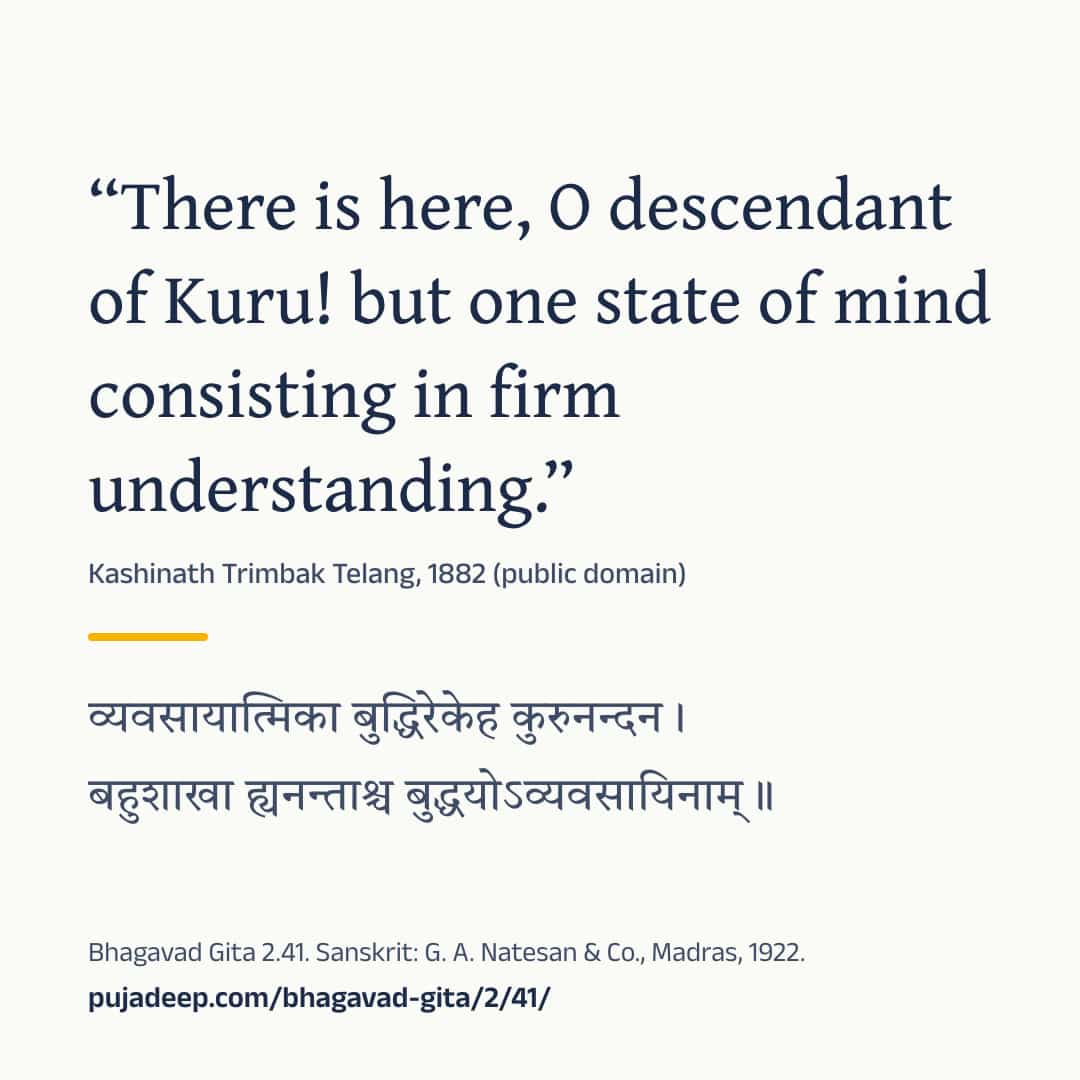
Send as text
The words and the link only. Many elders prefer this.
Bhagavad Gita 2.41

व्यवसायात्मिका बुद्धिरेकेह कुरुनन्दन ।
बहुशाखा ह्यनन्ताश्च बुद्धयोऽव्यवसायिनाम् ॥

“There is here, O descendant of Kuru! but one state of mind consisting in firm understanding. But the states of mind of those who have no firm understanding are many-branched and endless.”
(Kashinath Trimbak Telang, 1882, public domain)

“The determinate Reason is but one in this mortal life, O joy of the Kurus; many branched and endless are the thoughts of the irresolute.”
(Annie Besant, 1895, public domain)

“In this, O son of Kuru, there is set determination towards one goal. The purposes of the undecided are innumerable and many-branching.”
(Swami Swarupananda, 1909 (first printed 1907), public domain)

Sanskrit: G. A. Natesan & Co., Madras, 1922.
https://pujadeep.com/bhagavad-gita/2/41/?s=copy Nothing is sent from this site. Your own app sends it, to the chat you choose. The picture quotes Telang (1882). If you chose another translation above, the text quotes yours and no picture is offered.
Sanskrit text: The Bhagavad-Gita, or The Lord's Song, with the text in Devanagari and an English translation, 1922. Meanings: written for Pujadeep with AI help and reviewed. Source and changes
Questions families ask
Who speaks Bhagavad Gita 2.41?
Krishna speaks this verse, in chapter 2 (Sankhya Yoga).
Where does the Sanskrit text come from?
Sanskrit text: The Bhagavad-Gita, or The Lord's Song, with the text in Devanagari and an English translation, 1922. Meanings: written for Pujadeep with AI help and reviewed. See the source
Is the meaning on this page a translation?
Explanation written for this site with AI help from the sources listed here, and reviewed. It is not a translation and not the only way to read the text. Free to quote with credit.
Source and licence
- Sanskrit text
- The Bhagavad-Gita, or The Lord's Song, with the text in Devanagari and an English translation (Annie Besant, G. A. Natesan & Co., Madras, 1922). Public domain. The Sanskrit on these pages was read from this printing’s page images.
- Translation
- The Bhagavadgîtâ with the Sanatsugâtîya and the Anugîtâ, translated by Kâshinâth Trimbak Telang (The Sacred Books of the East, vol. VIII, ed. F. Max Müller) (Kashinath Trimbak Telang, F. Max Müller, Clarendon Press, Oxford, 1882). Public domain. Shown verbatim, as printed.
- Translation
- The Bhagavad Gîtâ, or The Lord's Song, translated by Annie Besant (Annie Besant, Theosophical Publishing Society, London, 1895). Public domain. Shown verbatim, as printed.
- Sanskrit text
- Srimad-Bhagavad-Gita, with Sanskrit Text; Paraphrase with Word-by-word Literal Translation; English Rendering and Comments, Index, &c., by the Swami Swarupananda (Himalayan Series, No. XX) (Swami Swarupananda, The Editors and Publishers, Advaita Ashrama, Mayavati, Prabuddha Bharata Press, Mayavati, Almora, Himalayas, 1909). Public domain. Used only to date the text. The Devanagari on this page is a reading text and is not copied from this printing.
- Common wording
- In this text, 32 words follow today's common wording, checked against sanskritdocuments.org; Sanskrit Wikisource; Gita Press, Gorakhpur; GRETIL, Göttingen and Bhaktivedanta Book Trust.
- Our explanation
- Explanation written for this site with AI help from the sources listed here, and reviewed. It is not a translation and not the only way to read the text. Free to quote with credit.
- Review
- AI review: 2 independent reviews against the cited edition, October 15, 2026.