Bhagavad Gita · Chapter 2: Sankhya Yoga · Speaker: Krishna
Bhagavad Gita 2.57
Krishna says that a person who is not attached to anything, and who neither celebrates good things nor hates bad ones when they come, has wisdom that is firmly set.
Bhagavad Gita 2.57
यः सर्वत्रानभिस्नेहस्तत्तत्प्राप्य शुभाशुभम् ।नाभिनन्दति न द्वेष्टि तस्य प्रज्ञा प्रतिष्ठिता ॥
Yah sarvatranabhisnehastattatprapya shubhashubham
Nabhinandati na dveshti tasya prajna pratishthita
yaḥ sarvatrānabhisnehastattatprāpya śubhāśubham |
nābhinandati na dveṣṭi tasya prajñā pratiṣṭhitā ||
Our meaning Krishna says that a person who is not attached to anything, and who neither celebrates good things nor hates bad ones when they come, has wisdom that is firmly set.
हिंदी अर्थ कृष्ण कहते हैं कि जो सब जगह आसक्ति से रहित है, और अच्छा या बुरा पाकर न प्रसन्न होता है न द्वेष करता है, उसकी बुद्धि स्थिर है।
Word by word
Every word, with its dictionary page
Word by word
- यः yaḥ who (pronoun (masculine), nominative singular) Dictionary: yad, Monier-Williams 1899, p. 844, col. 2
who, which, what, whichever, whatever, that
- सर्वत्र sarvatra everywhere (indeclinable) Dictionary: sarvatra, Monier-Williams 1899, p. 1189, col. 2
everywhere, in every case, always, at all times
- अनभिस्नेहः anabhisnehaḥ without attachment (adjective (masculine), nominative singular) Dictionary: an-abhisneha, Monier-Williams 1899, p. 26, col. 1
without affection, cold, unimpassioned
- तत् tat this (pronoun (neuter), accusative singular) Dictionary: tad, Monier-Williams 1899, p. 434, col. 1
m. he, f. she, n. it, that, this
- तत् tat or that (whatever comes) (pronoun (neuter), accusative singular) Dictionary: tad, Monier-Williams 1899, p. 434, col. 1
m. he, f. she, n. it, that, this
- प्राप्य prāpya having met with (absolutive (having done)) Dictionary: prāp, Monier-Williams 1899, p. 707, col. 2
to attain to, reach, arrive at, meet with, find
- शुभाशुभम् śubhāśubham good or bad (compound (neuter), accusative singular) Dictionary: śubhāśubha, Monier-Williams 1899, p. 1083, col. 3
pleasant and unpleasant, agreeable and disagreeable
- न na not (indeclinable) Dictionary: 2. na, Monier-Williams 1899, p. 523, col. 1
ind. not, no, nor, neither
- अभिनन्दति abhinandati rejoices (present, 3rd person singular) Dictionary: abhi-nand, Monier-Williams 1899, p. 63, col. 3
to rejoice at, salute, welcome, greet, hail
- न na not (indeclinable) Dictionary: 2. na, Monier-Williams 1899, p. 523, col. 1
ind. not, no, nor, neither
- द्वेष्टि dveṣṭi hates (present, 3rd person singular) Dictionary: 2. dviṣ, Monier-Williams 1899, p. 506, col. 3
to hate, show hatred against
- तस्य tasya his (pronoun (masculine), genitive singular) Dictionary: tad, Monier-Williams 1899, p. 434, col. 1
m. he, f. she, n. it, that, this
- प्रज्ञा prajñā wisdom (noun (feminine), nominative singular) Dictionary: pra-jñā, Monier-Williams 1899, p. 659, col. 2
wisdom, intelligence, knowledge, discrimination, judgment
- प्रतिष्ठिता pratiṣṭhitā is firmly set (past participle (feminine), nominative singular) Dictionary: prati-ṣṭhita, Monier-Williams 1899, p. 671, col. 3
standing, stationed, placed, situated in or on
2 printings differ
Public-domain translations
Kashinath Trimbak Telang, 1882. Public domain. Page 50.
His mind is steady, who, being without attachments anywhere, feels no exultation and no aversion on encountering the various agreeable and disagreeable1 (things of this world).
Footnotes (the translator’s own) - The word subhâsubha in this sense also occurs in the Dhammapada, stanza 78, and in the Maitrî-upanishad, p. 34. ↩
Compare 3 translations
Kashinath Trimbak Telang, 1882. Public domain. Page 50.
His mind is steady, who, being without attachments anywhere, feels no exultation and no aversion on encountering the various agreeable and disagreeable1 (things of this world).
Footnotes (the translator’s own) - The word subhâsubha in this sense also occurs in the Dhammapada, stanza 78, and in the Maitrî-upanishad, p. 34. ↩
You are reading this one
Annie Besant, 1895. Public domain. Page 35–36.
He who on every side is without attachments, whatever hap of fair and foul, who neither likes nor dislikes, of such a one the understanding is well-poised.
You are reading this one
Swami Swarupananda, 1909 (first printed 1907). Public domain. Page 55.
He who is everywhere unattached, not pleased at receiving good, nor vexed at evil, his wisdom is fixed.
You are reading this one
Share
Send one picture or the text to one chat. The picture names its source and the address of this page.
Send as text
The words and the link only. Many elders prefer this.
Bhagavad Gita 2.57

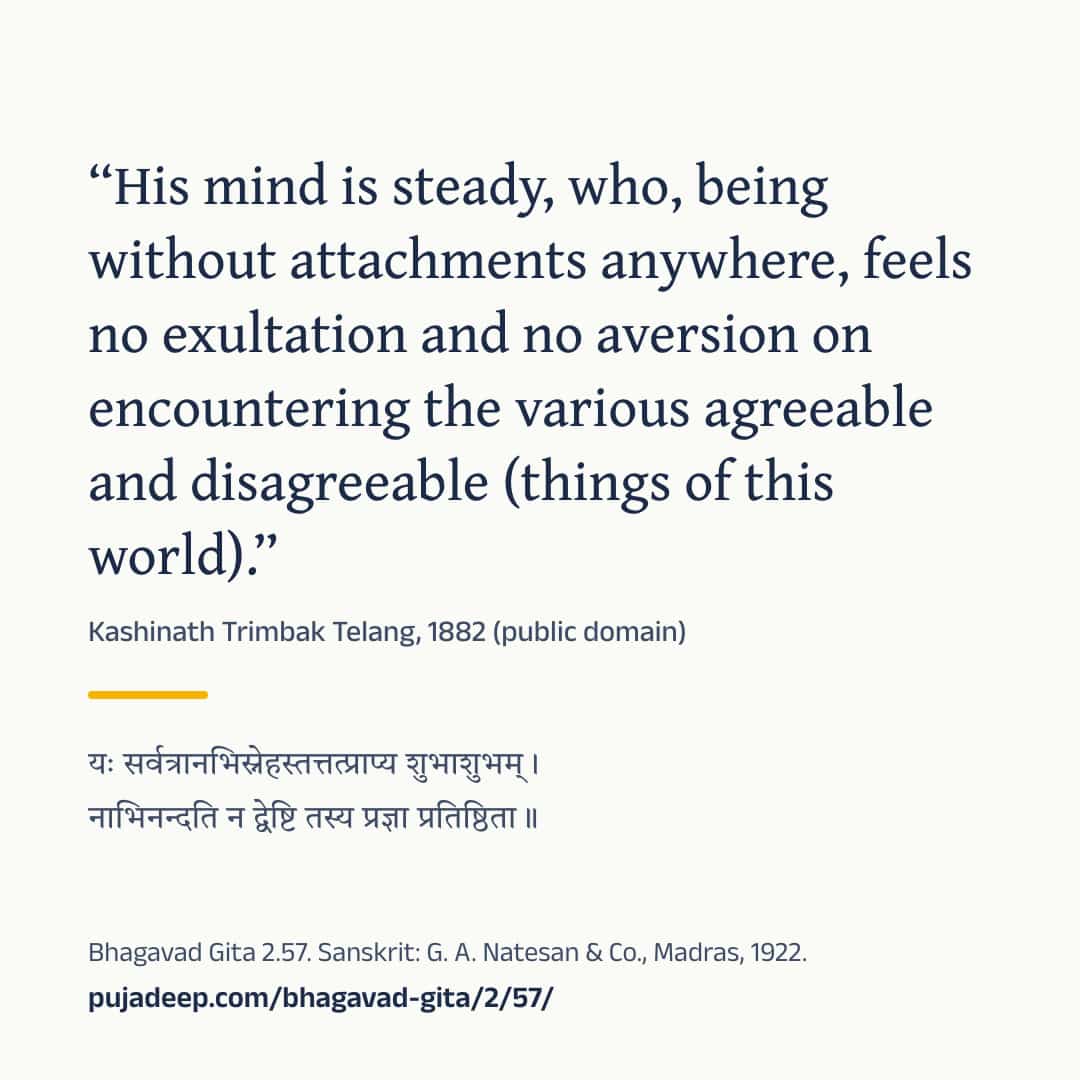
यः सर्वत्रानभिस्नेहस्तत्तत्प्राप्य शुभाशुभम् ।
नाभिनन्दति न द्वेष्टि तस्य प्रज्ञा प्रतिष्ठिता ॥

“His mind is steady, who, being without attachments anywhere, feels no exultation and no aversion on encountering the various agreeable and disagreeable (things of this world).”
(Kashinath Trimbak Telang, 1882, public domain)

“He who on every side is without attachments, whatever hap of fair and foul, who neither likes nor dislikes, of such a one the understanding is well-poised.”
(Annie Besant, 1895, public domain)

“He who is everywhere unattached, not pleased at receiving good, nor vexed at evil, his wisdom is fixed.”
(Swami Swarupananda, 1909 (first printed 1907), public domain)

Sanskrit: G. A. Natesan & Co., Madras, 1922.
https://pujadeep.com/bhagavad-gita/2/57/?s=copy Nothing is sent from this site. Your own app sends it, to the chat you choose. The picture quotes Telang (1882). If you chose another translation above, the text quotes yours and no picture is offered.
Sanskrit text: The Bhagavad-Gita, or The Lord's Song, with the text in Devanagari and an English translation, 1922. Meanings: written for Pujadeep with AI help and reviewed. Source and changes
Questions families ask
Who speaks Bhagavad Gita 2.57?
Krishna speaks this verse, in chapter 2 (Sankhya Yoga).
Where does the Sanskrit text come from?
Sanskrit text: The Bhagavad-Gita, or The Lord's Song, with the text in Devanagari and an English translation, 1922. Meanings: written for Pujadeep with AI help and reviewed. See the source
Is the meaning on this page a translation?
Explanation written for this site with AI help from the sources listed here, and reviewed. It is not a translation and not the only way to read the text. Free to quote with credit.
Source and licence
- Sanskrit text
- The Bhagavad-Gita, or The Lord's Song, with the text in Devanagari and an English translation (Annie Besant, G. A. Natesan & Co., Madras, 1922). Public domain. The Sanskrit on these pages was read from this printing’s page images.
- Translation
- The Bhagavadgîtâ with the Sanatsugâtîya and the Anugîtâ, translated by Kâshinâth Trimbak Telang (The Sacred Books of the East, vol. VIII, ed. F. Max Müller) (Kashinath Trimbak Telang, F. Max Müller, Clarendon Press, Oxford, 1882). Public domain. Shown verbatim, as printed.
- Translation
- The Bhagavad Gîtâ, or The Lord's Song, translated by Annie Besant (Annie Besant, Theosophical Publishing Society, London, 1895). Public domain. Shown verbatim, as printed.
- Sanskrit text
- Srimad-Bhagavad-Gita, with Sanskrit Text; Paraphrase with Word-by-word Literal Translation; English Rendering and Comments, Index, &c., by the Swami Swarupananda (Himalayan Series, No. XX) (Swami Swarupananda, The Editors and Publishers, Advaita Ashrama, Mayavati, Prabuddha Bharata Press, Mayavati, Almora, Himalayas, 1909). Public domain. Used only to date the text. The Devanagari on this page is a reading text and is not copied from this printing.
- Common wording
- In this text, 32 words follow today's common wording, checked against sanskritdocuments.org; Sanskrit Wikisource; Gita Press, Gorakhpur; GRETIL, Göttingen and Bhaktivedanta Book Trust.
- Our explanation
- Explanation written for this site with AI help from the sources listed here, and reviewed. It is not a translation and not the only way to read the text. Free to quote with credit.
- Review
- AI review: 2 independent reviews against the cited edition, October 15, 2026.