Bhagavad Gita · Chapter 2: Sankhya Yoga · Speaker: Krishna
Bhagavad Gita 2.64: Ragadveshaviyuktaistu
But, Krishna says, a self-controlled person can move among sense objects with senses that are free from liking and disliking and under control.
Bhagavad Gita 2.64
रागद्वेषवियुक्तैस्तु विषयानिन्द्रियैश्चरन् ।आत्मवश्यैर्विधेयात्मा प्रसादमधिगच्छति ॥
Ragadveshaviyuktaistu vishayanindriyaishcharan
Atmavashyairvidheyatma prasadamadhigachchhati
rāgadveṣaviyuktaistu viṣayānindriyaiścaran |
ātmavaśyairvidheyātmā prasādamadhigacchati ||
Our meaning But, Krishna says, a self-controlled person can move among sense objects with senses that are free from liking and disliking and under control. Such a person, he says, reaches inner calm (prasāda).
हिंदी अर्थ इसके विपरीत, कृष्ण कहते हैं कि जो संयमी व्यक्ति राग और द्वेष से रहित, अपने वश में रहने वाली इंद्रियों के साथ विषयों के बीच विचरता है, वह प्रसाद (मन की निर्मल शांति) पाता है।
Word by word
Every word, with its dictionary page
Word by word
- रागद्वेषवियुक्तैः rāgadveṣaviyuktaiḥ free from liking and dislike (compound (neuter), instrumental plural) Dictionary: rāga, Monier-Williams 1899, p. 872, col. 1
any feeling or passion, (esp.) love, affection or sympathy for
; dveṣa, Monier-Williams 1899, p. 507, col. 1hatred, dislike, repugnance, enmity
; vi-yukta, Monier-Williams 1899, p. 981, col. 3disjoined, detached, separated or delivered from
- तु tu but (indeclinable) Dictionary: 2. tu, Monier-Williams 1899, p. 449, col. 3
but
- विषयान् viṣayān sense objects (noun (masculine), accusative plural) Dictionary: viṣaya, Monier-Williams 1899, p. 997, col. 1
sphere (of influence or activity)
- इन्द्रियैः indriyaiḥ with the senses (noun (neuter), instrumental plural) Dictionary: indriya, Monier-Williams 1899, p. 167, col. 2
faculty of sense, sense, organ of sense
- चरन् caran moving among (present participle (masculine), nominative singular) Dictionary: car, Monier-Williams 1899, p. 389, col. 1
to move one's self, go, walk, move, stir, roam about, wander
- आत्मवश्यैः ātmavaśyaiḥ under one's own control (compound (neuter), instrumental plural) Dictionary: ātman, Monier-Williams 1899, p. 135, col. 1
the individual soul, self
; vaśya, Monier-Williams 1899, p. 929, col. 3subdued, tamed, humbled; being under control
- विधेयात्मा vidheyātmā self-controlled (compound (masculine), nominative singular) Dictionary: vidheyātman, Monier-Williams 1899, p. 968, col. 2
having the soul (well) subdued or controlled
- प्रसादम् prasādam calm, clearness (noun (masculine), accusative singular) Dictionary: pra-sāda, Monier-Williams 1899, p. 696, col. 3
clearness, brightness, pellucidness, purity
- अधिगच्छति adhigacchati attains (present, 3rd person singular) Dictionary: adhi-gam, Monier-Williams 1899, p. 20, col. 3
to meet, find, discover, obtain
2 printings differ
Public-domain translations
Kashinath Trimbak Telang, 1882. Public domain. Page 51.
But the self-restrained man who moves among1 objects with senses under the control of his own self, and free from affection and aversion, obtains tranquillity2.
Footnotes (the translator’s own) Compare 3 translations
Kashinath Trimbak Telang, 1882. Public domain. Page 51.
But the self-restrained man who moves among1 objects with senses under the control of his own self, and free from affection and aversion, obtains tranquillity2.
Footnotes (the translator’s own) You are reading this one
Annie Besant, 1895. Public domain. Page 37.
But the disciplined self, moving among sense-objects with senses free from attraction and repulsion, mastered by the SELF, goeth to Peace.
You are reading this one
Swami Swarupananda, 1909 (first printed 1907). Public domain. Page 58.
But the self-controlled man, moving among objects with senses under restraint, and free from attraction and aversion attains to tranquility.
You are reading this one
Share
Send one picture or the text to one chat. The picture names its source and the address of this page.
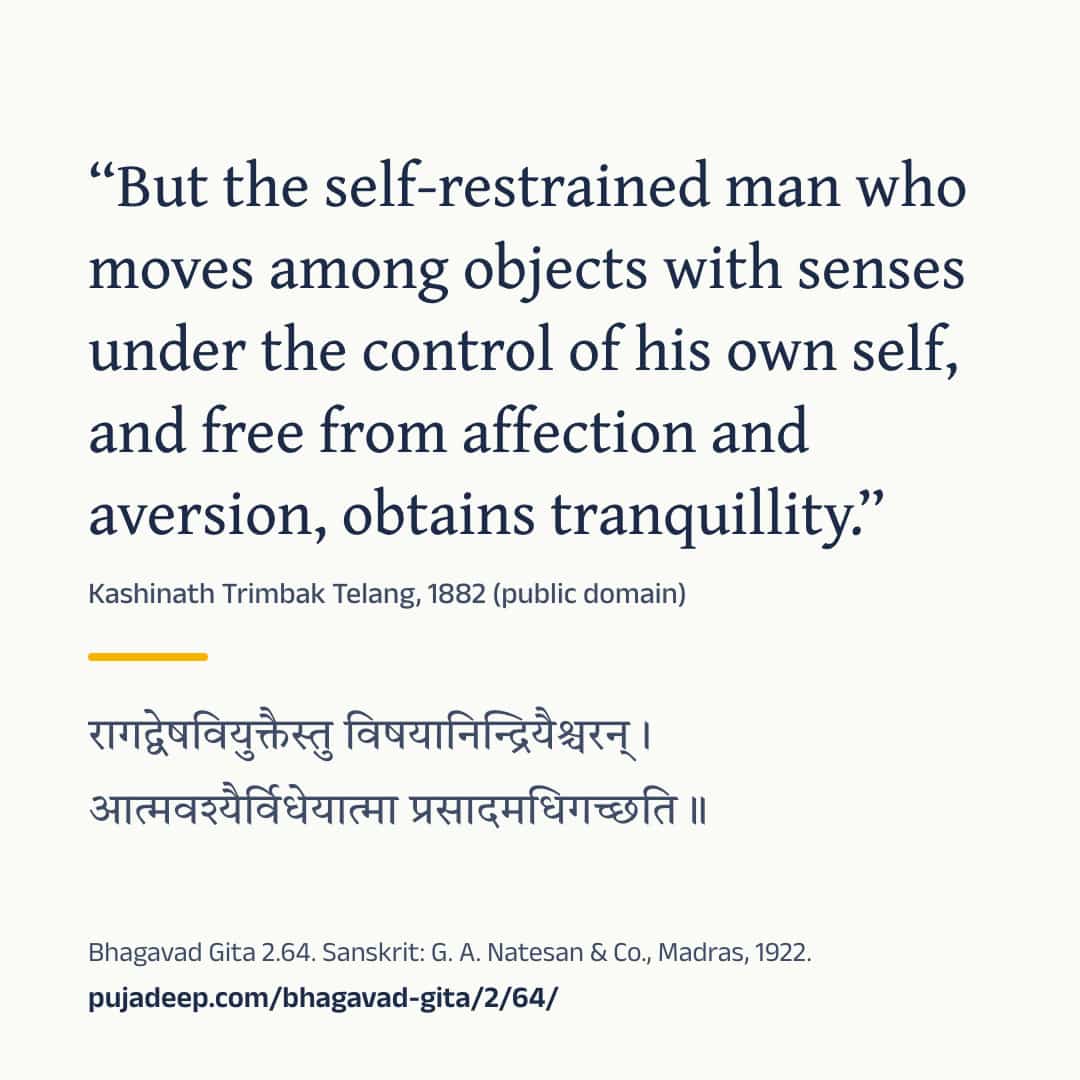
Send as text
The words and the link only. Many elders prefer this.
Bhagavad Gita 2.64

रागद्वेषवियुक्तैस्तु विषयानिन्द्रियैश्चरन् ।
आत्मवश्यैर्विधेयात्मा प्रसादमधिगच्छति ॥

“But the self-restrained man who moves among objects with senses under the control of his own self, and free from affection and aversion, obtains tranquillity.”
(Kashinath Trimbak Telang, 1882, public domain)

“But the disciplined self, moving among sense-objects with senses free from attraction and repulsion, mastered by the SELF, goeth to Peace.”
(Annie Besant, 1895, public domain)

“But the self-controlled man, moving among objects with senses under restraint, and free from attraction and aversion attains to tranquility.”
(Swami Swarupananda, 1909 (first printed 1907), public domain)

Sanskrit: G. A. Natesan & Co., Madras, 1922.
https://pujadeep.com/bhagavad-gita/2/64/?s=copy Nothing is sent from this site. Your own app sends it, to the chat you choose. The picture quotes Telang (1882). If you chose another translation above, the text quotes yours and no picture is offered.
Sanskrit text: The Bhagavad-Gita, or The Lord's Song, with the text in Devanagari and an English translation, 1922. Meanings: written for Pujadeep with AI help and reviewed. Source and changes
Questions families ask
Who speaks Bhagavad Gita 2.64?
Krishna speaks this verse, in chapter 2 (Sankhya Yoga).
Where does the Sanskrit text come from?
Sanskrit text: The Bhagavad-Gita, or The Lord's Song, with the text in Devanagari and an English translation, 1922. Meanings: written for Pujadeep with AI help and reviewed. See the source
Is the meaning on this page a translation?
Explanation written for this site with AI help from the sources listed here, and reviewed. It is not a translation and not the only way to read the text. Free to quote with credit.
Source and licence
- Sanskrit text
- The Bhagavad-Gita, or The Lord's Song, with the text in Devanagari and an English translation (Annie Besant, G. A. Natesan & Co., Madras, 1922). Public domain. The Sanskrit on these pages was read from this printing’s page images.
- Translation
- The Bhagavadgîtâ with the Sanatsugâtîya and the Anugîtâ, translated by Kâshinâth Trimbak Telang (The Sacred Books of the East, vol. VIII, ed. F. Max Müller) (Kashinath Trimbak Telang, F. Max Müller, Clarendon Press, Oxford, 1882). Public domain. Shown verbatim, as printed.
- Translation
- The Bhagavad Gîtâ, or The Lord's Song, translated by Annie Besant (Annie Besant, Theosophical Publishing Society, London, 1895). Public domain. Shown verbatim, as printed.
- Sanskrit text
- Srimad-Bhagavad-Gita, with Sanskrit Text; Paraphrase with Word-by-word Literal Translation; English Rendering and Comments, Index, &c., by the Swami Swarupananda (Himalayan Series, No. XX) (Swami Swarupananda, The Editors and Publishers, Advaita Ashrama, Mayavati, Prabuddha Bharata Press, Mayavati, Almora, Himalayas, 1909). Public domain. Used only to date the text. The Devanagari on this page is a reading text and is not copied from this printing.
- Common wording
- In this text, 32 words follow today's common wording, checked against sanskritdocuments.org; Sanskrit Wikisource; Gita Press, Gorakhpur; GRETIL, Göttingen and Bhaktivedanta Book Trust.
- Our explanation
- Explanation written for this site with AI help from the sources listed here, and reviewed. It is not a translation and not the only way to read the text. Free to quote with credit.
- Review
- AI review: 2 independent reviews against the cited edition, October 15, 2026.