Bhagavad Gita · Chapter 2: Sankhya Yoga · Speaker: Krishna
Bhagavad Gita 2.65: Prasade sarvaduhkhanam
Krishna says that in that calm, all sorrow comes to an end, because when the mind is calm and clear, understanding soon becomes steady.
Bhagavad Gita 2.65
प्रसादे सर्वदुःखानां हानिरस्योपजायते ।प्रसन्नचेतसो ह्याशु बुद्धिः पर्यवतिष्ठते ॥
Prasade sarvaduhkhanam hanirasyopajayate
Prasannachetaso hyashu buddhih paryavatishthate
prasāde sarvaduḥkhānāṃ hānirasyopajāyate |
prasannacetaso hyāśu buddhiḥ paryavatiṣṭhate ||
Our meaning Krishna says that in that calm, all sorrow comes to an end, because when the mind is calm and clear, understanding soon becomes steady.
हिंदी अर्थ कृष्ण कहते हैं कि उस प्रसाद (शांति) में सब दुःखों का अंत हो जाता है, क्योंकि जिसका चित्त प्रसन्न है, उसकी बुद्धि जल्दी ही स्थिर हो जाती है।
Word by word
Every word, with its dictionary page
Word by word
- प्रसादे prasāde in that calm (noun (masculine), locative singular) Dictionary: pra-sāda, Monier-Williams 1899, p. 696, col. 3
clearness, brightness, pellucidness, purity
- सर्वदुःखानाम् sarvaduḥkhānām of all sorrows (compound (neuter), genitive plural) Dictionary: sarva, Monier-Williams 1899, p. 1184, col. 3
whole, entire, all, every
; 1. duḥkha, Monier-Williams 1899, p. 483, col. 2uneasiness, pain, sorrow, trouble, difficulty
- हानिः hāniḥ ending, loss (noun (feminine), nominative singular) Dictionary: hāni, Monier-Williams 1899, p. 1296, col. 2
abandonment, relinquishment
- अस्य asya his (pronoun (masculine), genitive singular) Dictionary: 1. idam, Monier-Williams 1899, p. 165, col. 2
- उपजायते upajāyate comes about (present, 3rd person singular) Dictionary: upa-jan, Monier-Williams 1899, p. 198, col. 1
to be born, originate, come forth, appear, become visible
- प्रसन्नचेतसः prasannacetasaḥ of one whose mind is calm (compound (masculine), genitive singular) Dictionary: pra-sanna, Monier-Williams 1899, p. 696, col. 3
clear, bright, pure (lit. and fig.)
; cetas, Monier-Williams 1899, p. 398, col. 1consciousness, intelligence, thinking soul, heart, mind
- हि hi for (indeclinable) Dictionary: 2. hi, Monier-Williams 1899, p. 1297, col. 3
for, because, on account of
- आशु āśu soon (indeclinable) Dictionary: āśu, Monier-Williams 1899, p. 157, col. 3
quickly, quick, immediately, directly
- बुद्धिः buddhiḥ understanding (noun (feminine), nominative singular) Dictionary: buddhi, Monier-Williams 1899, p. 733, col. 3
intelligence, reason, intellect, mind, discernment, judgment
- पर्यवतिष्ठते paryavatiṣṭhate becomes steady (present, 3rd person singular) Dictionary: pary-ava-sthā, Monier-Williams 1899, p. 607, col. 2
to become firm or steady
Public-domain translations
Kashinath Trimbak Telang, 1882. Public domain. Page 51.
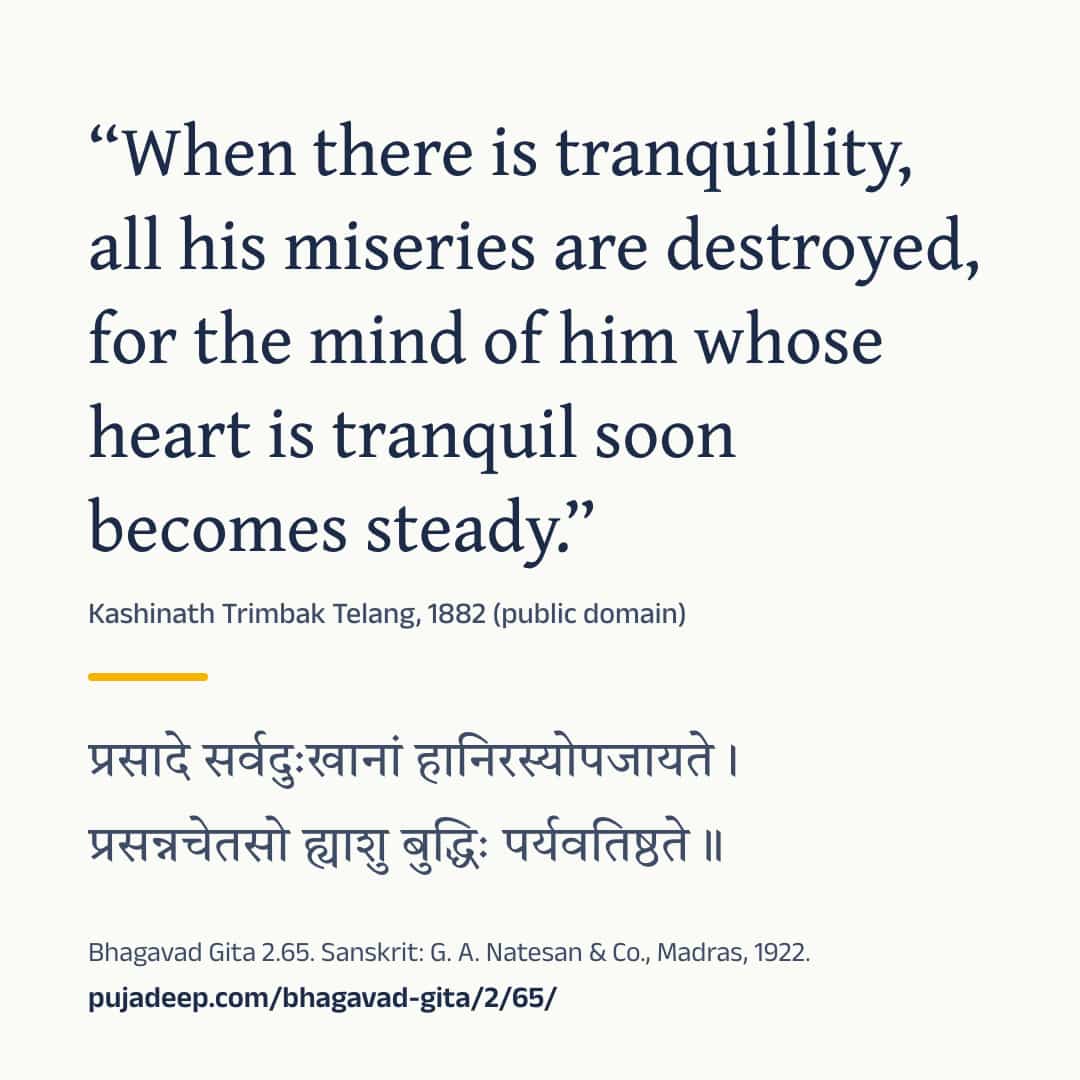
When there is tranquillity, all his miseries are destroyed, for the mind of him whose heart is tranquil soon becomes steady.
Compare 3 translations
Kashinath Trimbak Telang, 1882. Public domain. Page 51.
When there is tranquillity, all his miseries are destroyed, for the mind of him whose heart is tranquil soon becomes steady.
You are reading this one
Annie Besant, 1895. Public domain. Page 37.
In that Peace the extinction of all pains ariseth for him, for of him whose heart is peaceful the Buddhi soon attaineth equilibrium.
You are reading this one
Swami Swarupananda, 1909 (first printed 1907). Public domain. Page 58.
In tranquility, all sorrow is destroyed. For the intellect, of him who is tranquil-minded, is soon established in firmness.
You are reading this one
Share
Send one picture or the text to one chat. The picture names its source and the address of this page.
Send as text
The words and the link only. Many elders prefer this.
Bhagavad Gita 2.65

प्रसादे सर्वदुःखानां हानिरस्योपजायते ।
प्रसन्नचेतसो ह्याशु बुद्धिः पर्यवतिष्ठते ॥

“When there is tranquillity, all his miseries are destroyed, for the mind of him whose heart is tranquil soon becomes steady.”
(Kashinath Trimbak Telang, 1882, public domain)

“In that Peace the extinction of all pains ariseth for him, for of him whose heart is peaceful the Buddhi soon attaineth equilibrium.”
(Annie Besant, 1895, public domain)

“In tranquility, all sorrow is destroyed. For the intellect, of him who is tranquil-minded, is soon established in firmness.”
(Swami Swarupananda, 1909 (first printed 1907), public domain)

Sanskrit: G. A. Natesan & Co., Madras, 1922.
https://pujadeep.com/bhagavad-gita/2/65/?s=copy Nothing is sent from this site. Your own app sends it, to the chat you choose. The picture quotes Telang (1882). If you chose another translation above, the text quotes yours and no picture is offered.
Sanskrit text: The Bhagavad-Gita, or The Lord's Song, with the text in Devanagari and an English translation, 1922. Meanings: written for Pujadeep with AI help and reviewed. Source and changes
Questions families ask
Who speaks Bhagavad Gita 2.65?
Krishna speaks this verse, in chapter 2 (Sankhya Yoga).
Where does the Sanskrit text come from?
Sanskrit text: The Bhagavad-Gita, or The Lord's Song, with the text in Devanagari and an English translation, 1922. Meanings: written for Pujadeep with AI help and reviewed. See the source
Is the meaning on this page a translation?
Explanation written for this site with AI help from the sources listed here, and reviewed. It is not a translation and not the only way to read the text. Free to quote with credit.
Source and licence
- Sanskrit text
- The Bhagavad-Gita, or The Lord's Song, with the text in Devanagari and an English translation (Annie Besant, G. A. Natesan & Co., Madras, 1922). Public domain. The Sanskrit on these pages was read from this printing’s page images.
- Translation
- The Bhagavadgîtâ with the Sanatsugâtîya and the Anugîtâ, translated by Kâshinâth Trimbak Telang (The Sacred Books of the East, vol. VIII, ed. F. Max Müller) (Kashinath Trimbak Telang, F. Max Müller, Clarendon Press, Oxford, 1882). Public domain. Shown verbatim, as printed.
- Translation
- The Bhagavad Gîtâ, or The Lord's Song, translated by Annie Besant (Annie Besant, Theosophical Publishing Society, London, 1895). Public domain. Shown verbatim, as printed.
- Sanskrit text
- Srimad-Bhagavad-Gita, with Sanskrit Text; Paraphrase with Word-by-word Literal Translation; English Rendering and Comments, Index, &c., by the Swami Swarupananda (Himalayan Series, No. XX) (Swami Swarupananda, The Editors and Publishers, Advaita Ashrama, Mayavati, Prabuddha Bharata Press, Mayavati, Almora, Himalayas, 1909). Public domain. Used only to date the text. The Devanagari on this page is a reading text and is not copied from this printing.
- Common wording
- In this text, 32 words follow today's common wording, checked against sanskritdocuments.org; Sanskrit Wikisource; Gita Press, Gorakhpur; GRETIL, Göttingen and Bhaktivedanta Book Trust.
- Our explanation
- Explanation written for this site with AI help from the sources listed here, and reviewed. It is not a translation and not the only way to read the text. Free to quote with credit.
- Review
- AI review: 2 independent reviews against the cited edition, October 15, 2026.