Bhagavad Gita · Chapter 2: Sankhya Yoga · Speaker: Krishna
Bhagavad Gita 2.66: Nasti buddhirayuktasya
Krishna says that a person without discipline has no steady understanding and no deep reflection (bhāvanā).
Bhagavad Gita 2.66
नास्ति बुद्धिरयुक्तस्य न चायुक्तस्य भावना ।न चाभावयतः शान्तिरशान्तस्य कुतः सुखम् ॥
Nasti buddhirayuktasya na chayuktasya bhavana
Na chabhavayatah shantirashantasya kutah sukham
nāsti buddhirayuktasya na cāyuktasya bhāvanā |
na cābhāvayataḥ śāntiraśāntasya kutaḥ sukham ||
Our meaning Krishna says that a person without discipline has no steady understanding and no deep reflection (bhāvanā). Without reflection there is no peace, and without peace, he asks, how can there be happiness?
हिंदी अर्थ कृष्ण कहते हैं कि जो युक्त (संयमित) नहीं है, उसमें न स्थिर बुद्धि होती है, न भावना (गहरा चिंतन)। भावना के बिना शांति नहीं मिलती, और वे पूछते हैं कि अशांत व्यक्ति को सुख कहाँ?
Word by word
Every word, with its dictionary page
Word by word
- न na not (indeclinable) Dictionary: 2. na, Monier-Williams 1899, p. 523, col. 1
ind. not, no, nor, neither
- अस्ति asti is (present, 3rd person singular) Dictionary: 1. as, Monier-Williams 1899, p. 117, col. 2
to be, live, exist, be present
- बुद्धिः buddhiḥ understanding (noun (feminine), nominative singular) Dictionary: buddhi, Monier-Williams 1899, p. 733, col. 3
intelligence, reason, intellect, mind, discernment, judgment
- अयुक्तस्य ayuktasya of the undisciplined (adjective (masculine), genitive singular) Dictionary: a-yukta, Monier-Williams 1899, p. 85, col. 3
- न na not (indeclinable) Dictionary: 2. na, Monier-Williams 1899, p. 523, col. 1
ind. not, no, nor, neither
- च ca and (indeclinable) Dictionary: 2. ca, Monier-Williams 1899, p. 380, col. 1
ind. and, both, also, moreover, as well as
- अयुक्तस्य ayuktasya of the undisciplined (adjective (masculine), genitive singular) Dictionary: a-yukta, Monier-Williams 1899, p. 85, col. 3
- भावना bhāvanā contemplation (noun (feminine), nominative singular) Dictionary: bhāvanā, Monier-Williams 1899, p. 755, col. 1
reflection, contemplation
- न na not (indeclinable) Dictionary: 2. na, Monier-Williams 1899, p. 523, col. 1
ind. not, no, nor, neither
- च ca and (indeclinable) Dictionary: 2. ca, Monier-Williams 1899, p. 380, col. 1
ind. and, both, also, moreover, as well as
- अभावयतः abhāvayataḥ of one without contemplation (negative causative present participle, genitive singular) Dictionary: 3. a, Monier-Williams 1899, p. 1, col. 1
having a negative or privative or contrary sense
; 1. bhū, Monier-Williams 1899, p. 760, col. 2arise, come into being, exist
- शान्तिः śāntiḥ peace (noun (feminine), nominative singular) Dictionary: śānti, Monier-Williams 1899, p. 1064, col. 3
tranquillity, peace, quiet, peace or calmness of mind
- अशान्तस्य aśāntasya of one without peace (adjective (masculine), genitive singular) Dictionary: a-śānta, Monier-Williams 1899, p. 113, col. 1
restless, unresigned
- कुतः kutaḥ from where (indeclinable) Dictionary: kutas, Monier-Williams 1899, p. 290, col. 2
from where? whence?
- सुखम् sukham happiness (noun (neuter), nominative singular) Dictionary: sukha, Monier-Williams 1899, p. 1221, col. 1
ease, easiness, comfort, prosperity, pleasure, happiness
Public-domain translations
Kashinath Trimbak Telang, 1882. Public domain. Page 51.
He who is not self-restrained has no steadiness of mind; nor has he who is not self-restrained perseverance1 in the pursuit of self-knowledge; there is no tranquillity for him who does not persevere in the pursuit of self-knowledge; and whence can there be happiness for one who is not tranquil?
Footnotes (the translator’s own) - For a somewhat similar use of the word bhâvanâ in this sense, comp. Dhammapada, stanza 301. ↩
Compare 3 translations
Kashinath Trimbak Telang, 1882. Public domain. Page 51.
He who is not self-restrained has no steadiness of mind; nor has he who is not self-restrained perseverance1 in the pursuit of self-knowledge; there is no tranquillity for him who does not persevere in the pursuit of self-knowledge; and whence can there be happiness for one who is not tranquil?
Footnotes (the translator’s own) - For a somewhat similar use of the word bhâvanâ in this sense, comp. Dhammapada, stanza 301. ↩
You are reading this one
Annie Besant, 1895. Public domain. Page 37.
There is no Buddhi for the non-harmonized, nor for the non-harmonized is there concentration1; for him without concentration there is no peace, and for the unpeaceful how can there be happiness?
Footnotes (the translator’s own) - Bhâvanâ. ↩
You are reading this one
Swami Swarupananda, 1909 (first printed 1907). Public domain. Page 59.
No knowledge (of the Self) has the unsteady. Nor has he meditation. To the unmeditative there is no peace. And how can one without peace have happiness?
You are reading this one
Share
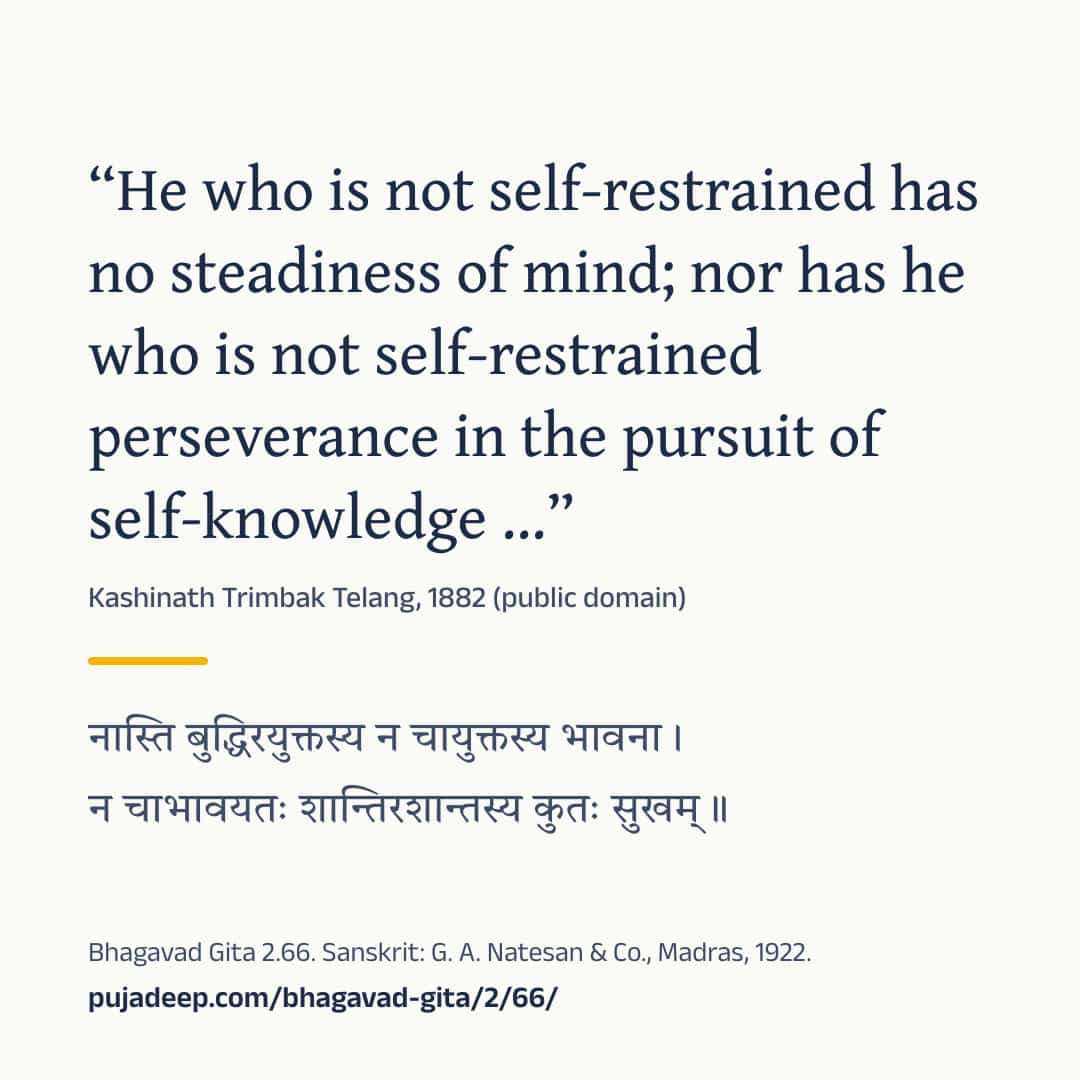
Send one picture or the text to one chat. The picture names its source and the address of this page.
Send as text
The words and the link only. Many elders prefer this.
Bhagavad Gita 2.66

नास्ति बुद्धिरयुक्तस्य न चायुक्तस्य भावना ।
न चाभावयतः शान्तिरशान्तस्य कुतः सुखम् ॥

“He who is not self-restrained has no steadiness of mind; nor has he who is not self-restrained perseverance in the pursuit of self-knowledge; there is no tranquillity for him who does not persevere in the pursuit of self-knowledge; and whence can there be happiness for one who is not tranquil?”
(Kashinath Trimbak Telang, 1882, public domain)

“There is no Buddhi for the non-harmonized, nor for the non-harmonized is there concentration; for him without concentration there is no peace, and for the unpeaceful how can there be happiness?”
(Annie Besant, 1895, public domain)

“No knowledge (of the Self) has the unsteady. Nor has he meditation. To the unmeditative there is no peace. And how can one without peace have happiness?”
(Swami Swarupananda, 1909 (first printed 1907), public domain)

Sanskrit: G. A. Natesan & Co., Madras, 1922.
https://pujadeep.com/bhagavad-gita/2/66/?s=copy Nothing is sent from this site. Your own app sends it, to the chat you choose. The picture quotes Telang (1882). If you chose another translation above, the text quotes yours and no picture is offered.
Sanskrit text: The Bhagavad-Gita, or The Lord's Song, with the text in Devanagari and an English translation, 1922. Meanings: written for Pujadeep with AI help and reviewed. Source and changes
Questions families ask
Who speaks Bhagavad Gita 2.66?
Krishna speaks this verse, in chapter 2 (Sankhya Yoga).
Where does the Sanskrit text come from?
Sanskrit text: The Bhagavad-Gita, or The Lord's Song, with the text in Devanagari and an English translation, 1922. Meanings: written for Pujadeep with AI help and reviewed. See the source
Is the meaning on this page a translation?
Explanation written for this site with AI help from the sources listed here, and reviewed. It is not a translation and not the only way to read the text. Free to quote with credit.
Source and licence
- Sanskrit text
- The Bhagavad-Gita, or The Lord's Song, with the text in Devanagari and an English translation (Annie Besant, G. A. Natesan & Co., Madras, 1922). Public domain. The Sanskrit on these pages was read from this printing’s page images.
- Translation
- The Bhagavadgîtâ with the Sanatsugâtîya and the Anugîtâ, translated by Kâshinâth Trimbak Telang (The Sacred Books of the East, vol. VIII, ed. F. Max Müller) (Kashinath Trimbak Telang, F. Max Müller, Clarendon Press, Oxford, 1882). Public domain. Shown verbatim, as printed.
- Translation
- The Bhagavad Gîtâ, or The Lord's Song, translated by Annie Besant (Annie Besant, Theosophical Publishing Society, London, 1895). Public domain. Shown verbatim, as printed.
- Sanskrit text
- Srimad-Bhagavad-Gita, with Sanskrit Text; Paraphrase with Word-by-word Literal Translation; English Rendering and Comments, Index, &c., by the Swami Swarupananda (Himalayan Series, No. XX) (Swami Swarupananda, The Editors and Publishers, Advaita Ashrama, Mayavati, Prabuddha Bharata Press, Mayavati, Almora, Himalayas, 1909). Public domain. Used only to date the text. The Devanagari on this page is a reading text and is not copied from this printing.
- Common wording
- In this text, 32 words follow today's common wording, checked against sanskritdocuments.org; Sanskrit Wikisource; Gita Press, Gorakhpur; GRETIL, Göttingen and Bhaktivedanta Book Trust.
- Our explanation
- Explanation written for this site with AI help from the sources listed here, and reviewed. It is not a translation and not the only way to read the text. Free to quote with credit.
- Review
- AI review: 2 independent reviews against the cited edition, October 15, 2026.